| Author |
 Replies: 21 / Views: 1,709 Replies: 21 / Views: 1,709 |
Page 2 of 2
|
|
|
|
Pillar of the Community
Canada
6244 Posts |
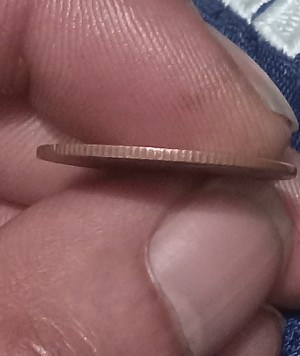
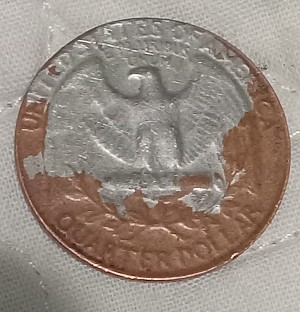
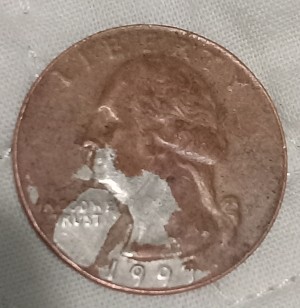
Need side photo, and more close Observe Reverse pics and compare with other coin thickness.
|
|
Moderator
 United States
107650 Posts |
 could be an acid dipped coin, hard to tell. Please post better pictures. |
|
New Member
 United States
16 Posts |
|
|
New Member
United States
16 Posts |
|
|
Bedrock of the Community
Canada
21910 Posts |
With the thin reeding and partial plating, it looks like your QUARTER has spent some time in acid. Not an error, just PMD |
|
New Member
United States
16 Posts |
Im not too sure its acid damage.
|
|
Pillar of the Community
United States
2775 Posts |
Appreciate the added images. I'm still thinking acid etching. I thought seeing the edge would confirm, but now wondering about the diameter.
Normal,
Weight - 5.670gr.
Diameter - 24.26mm.
I'm used to seeing the opposite. Meaning more of the (center) pure Cu missing rather than the outer 75 Cu, 25 Ni. Thanks, Doug.
|
|
New Member
United States
16 Posts |
Interesting. Thanks for the feed back. How do I tell if its acid damage vs. Mint.
|
|
Pillar of the Community
United States
590 Posts |
Each clad layer weighs approximately 1 gram, so a quarter lacking both clad layers should come in around 3.67 +/- grams.
The fact that this example actually has only about 40% of it's cladding remaining (assumption made because photos aren't quite good enough to assert that what we're seeing is cladding on the coin) means it should have a weight of somewhere around 4.87 grams.
The weak reeding (again, better photos would help) is suggestive of something corrosive removing material from the coin since the exposed copper edges typically react faster than the cupro-nickel clad layer.
Can you measure the diameter or at least place it on top of another quarter to show whether it's lost any size in that direction?
|
|
Pillar of the Community
Canada
6244 Posts |
Easy: If missing the clad, then the Design Strike it is nice. If was acid involved (your case Fluoric Acid), where is missing the clad the design it is very low.
|
|
Pillar of the Community
United States
7174 Posts |
With the new pictures, I would think that if acid ate 40% of the weight the devises wouldn't be as struck up as good. And with it being so lite, the reeds would suffer, it wouldn't fill the chamber when struck. With part of the cupronickel layer on both sides, the blank would have had to have been punched from the edge or end of the sheet, where the layers ended before the copper layer.
|
|
Pillar of the Community
Canada
6244 Posts |
From 1990 the clad rolls was received from others companies. The mint always cut 4 feet of those rolls out (the begin and the end) and this is due to the blanking machine. The missing clad come from sides of the roll or somewhere in the middle and not from begin or end. The begin and end of the roll after blanking will can give us the clams.
|
|
New Member
United States
16 Posts |
Sorry for the delay friends. Heres a couple. 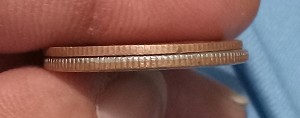 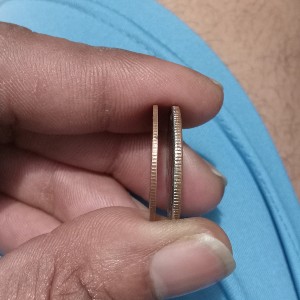 |
|
Pillar of the Community
United States
5895 Posts |
Sure looks like it's spent some time in acid.
Smaller diameter, reeds still visible, and underweight. Acid removes material at a fairly consistent rate and across all surfaces of the coin. So the devices remain visible but weak, distorted, and uneven.
Words of encouragement are one of the major food groups.
We need to consume them regularly to thrive and grow.
|
|
New Member
United States
16 Posts |
|
|
Page 2 of 2
|
Replies: 21 / Views: 1,709 |
Page 2 of 2
|








 First Page


 Posted 03/06/2023 8:47 pm


 Uncirculated American Silver Eagles