| Author |
 Replies: 40 / Views: 5,236 Replies: 40 / Views: 5,236 |
Page 3 of 3
|
|
|
|
Pillar of the Community
 United States
5905 Posts |
Quote:What characteristic(s) did you use that makes you think it is Mechanical Doubling? The area under the yellow lines appears to be flat or even concave (with striations through the area) and that looks MD to me. It certainly isn't raised like we see on true doubling. What are your thoughts on the other part of my reply concerning the erratic edges of the secondary lines not showing separation from hub doubling? EDIT- The areas I call "erratic edges" above, you refer to as "weirdly shaped". Words of encouragement are one of the major food groups.
We need to consume them regularly to thrive and grow.
Edited by Petespockets55
03/31/2023 11:22 am
|
|
Valued Member
 Canada
219 Posts |
Quote:
The area under the yellow lines appears to be flat or even concave (with striations through the area) and that looks MD to me. Thank you for confirming what I was suspecting. Hope you did not see a this doubling as being concave (going into the field of the coin) because it is definitely above the field as shown in image below. Quote:
It certainly isn't raised like we see on true doubling. I did not know there was a standard on how high the doubling must be. On the image below, the thickness of the doubling is about half of the upper design elements thickness! Sorry for the blurry parts, it is due to the limited depth of field of my microscope. 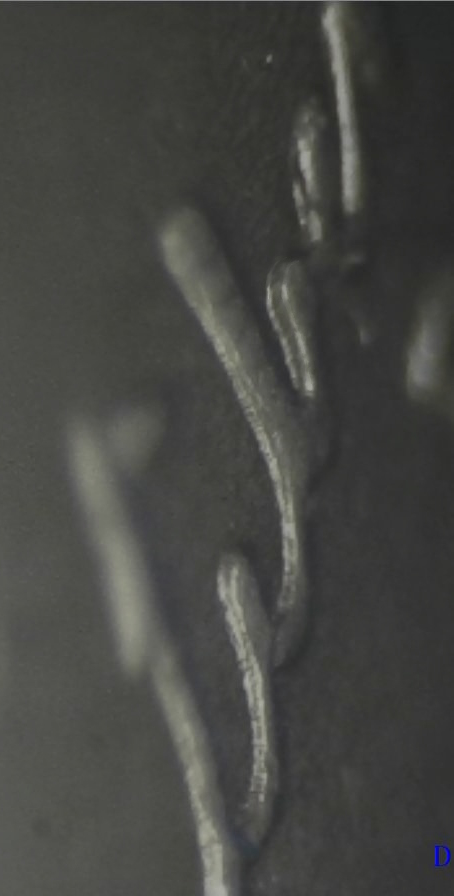 Quote:
erratic edges of the secondary lines It is normal for Mechanical Doubling. As the working die shifts, the sharp edges pushes and slides the metal causing it to look erratic. What is nice with graphics editing programs, when you multiple a red layer with a green layer, it becomes black. So, if you do the exercise as shown below, you can demonstrate (predict) how the edges of Mechanical Doubling will look like. 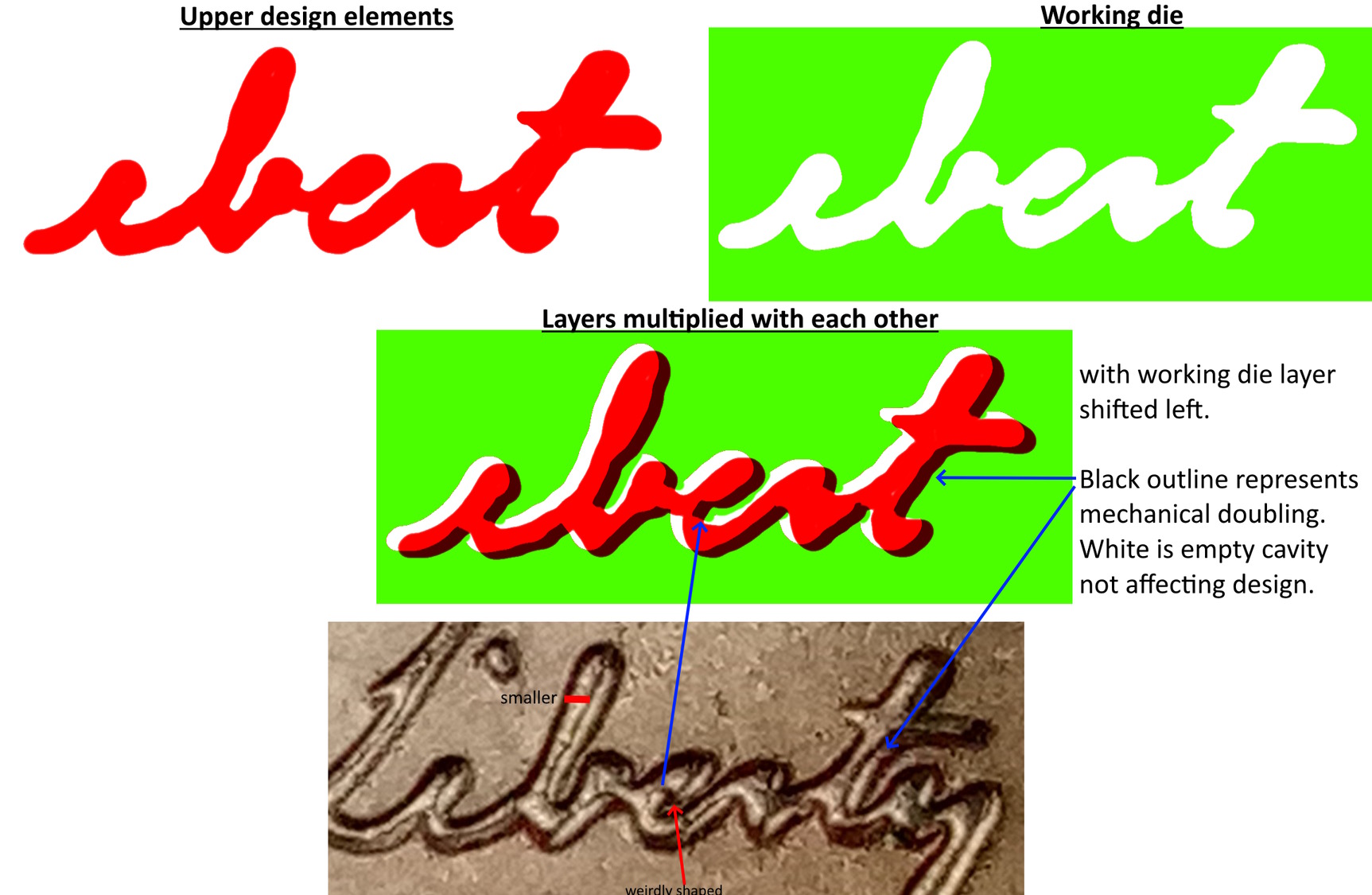 Edited by numidan
03/31/2023 12:57 pm
|
|
Valued Member
Canada
219 Posts |
Quick search for other dates having similar doubling characteristics as my 2005 nickel led me to this post. http://goccf.com/t/428760&SearchTer...bling,nickelMy verification process: -> Upper design elements same as a normal coin -> reference not available but does look the same as reference present in this post. -> checking outline -> exact alignment with small imperfections 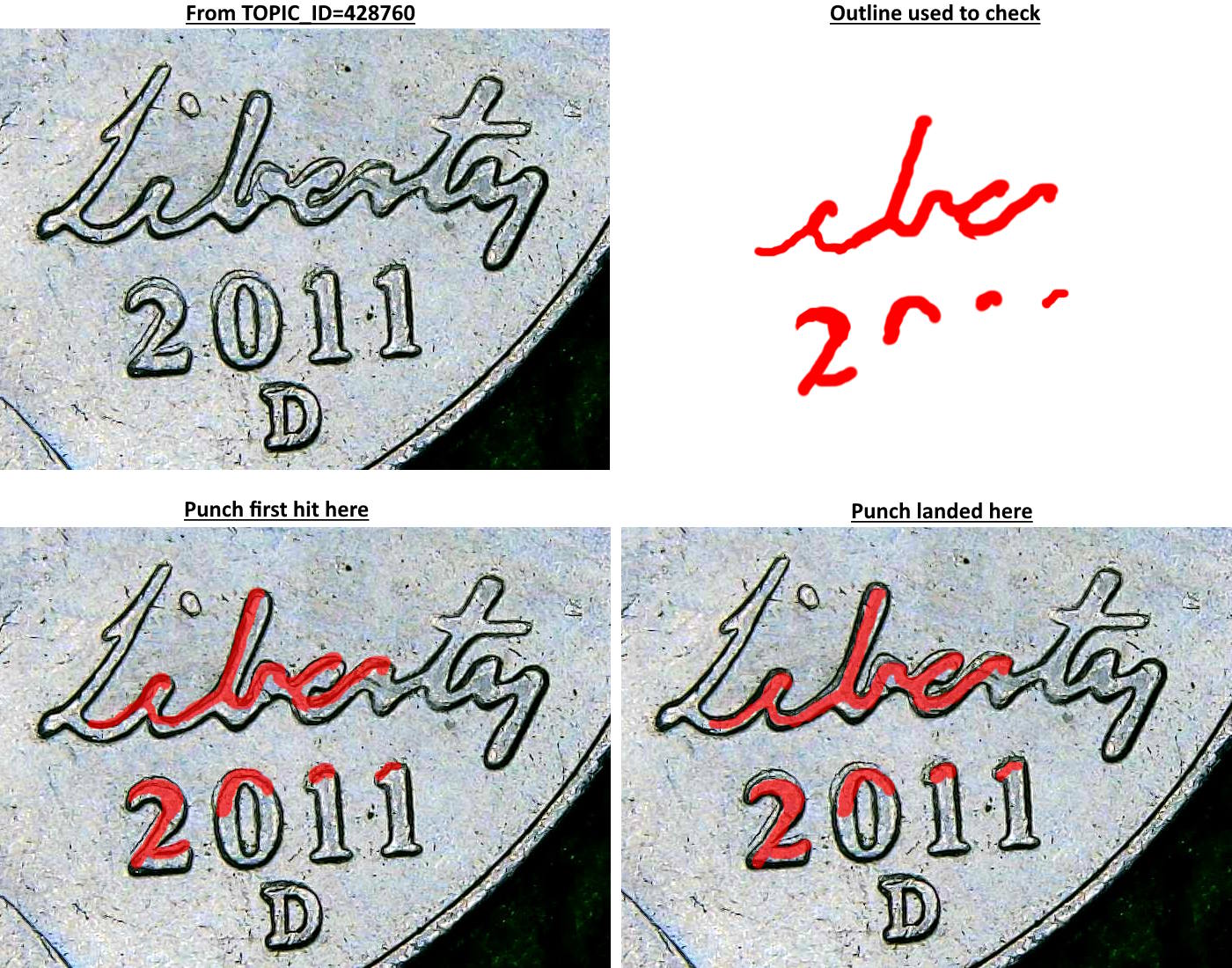 IMHO, this is not due to MD. Edited by numidan
04/01/2023 10:14 am
|
|
Pillar of the Community
United States
5905 Posts |
Quote:
...Hope you did not see a this doubling as being concave (going into the field of the coin) because it is definitely above the field as shown in image below.... No, it is raised from the field and then has a "concave curve" ending at the higher part of the device. The area under the yellow lines is not raised like the image you provided with the opaque "ribbon" on the "O" that demonstrated a "Doubled die". The yellow hash area looks more like the preceding image of the Mechanical Doubling. The image of the edge looks to confirm to me. Quote:Quote: "erratic edges of the secondary lines" It is normal for Mechanical Doubling. I don't agree "erratic edges" or "weirdly shaped" devices are normal for MD, unless you and I are talking about different things. You seem to be trying to get people to agree that this isn't MD but it looks like so many examples I have seen, especially at the yellow diagonal lines. Quote:
...
-> checking outline -> exact alignment with small imperfections... I'm not sure what you were trying to show with the four comparison images of the same coin. MD can be present on a coin from any year, even similar looking MD. "... >exact alignment with small imperfections" would tend to make me lean towards MD unless there was clear doubling. I guess I've lost sight of your reason for this thread. Is it to convince us that the doubling your 2005 is hub doubling and not MD? Or are you asking about the "weirdly shaped " edges to some of the devices? Or both? ps. I've only been back into collecting for 10 years now but I'm enjoying learning new things all the time. (Some of which I actually remember on occasion. LOL) Words of encouragement are one of the major food groups.
We need to consume them regularly to thrive and grow.
|
|
Valued Member
Canada
219 Posts |
At first I was asking if this was a genuine DDO and if someone else had found one. The post has evolve toward proving that the doubling on my 2005 coin is not due to mechanical doubling. As I can see, I was not successful at that. Bear with me as I will attempt a different way. Let's make sure we are at least all on the same page by taking the US penny. Mechanical Doubling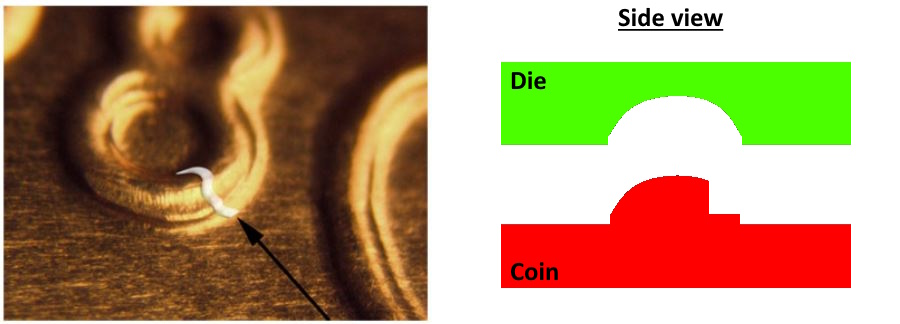 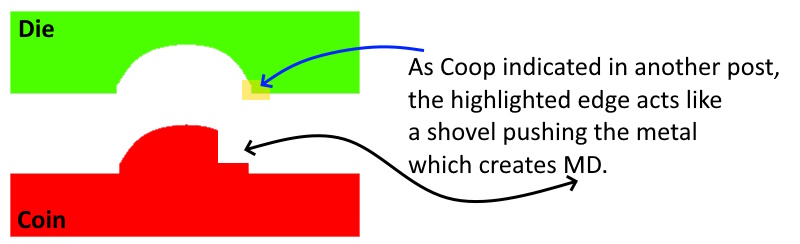 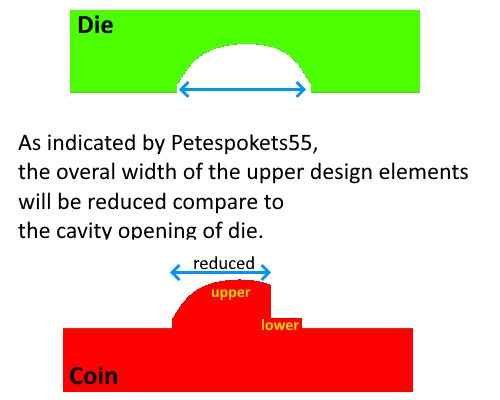 Double Die Double Die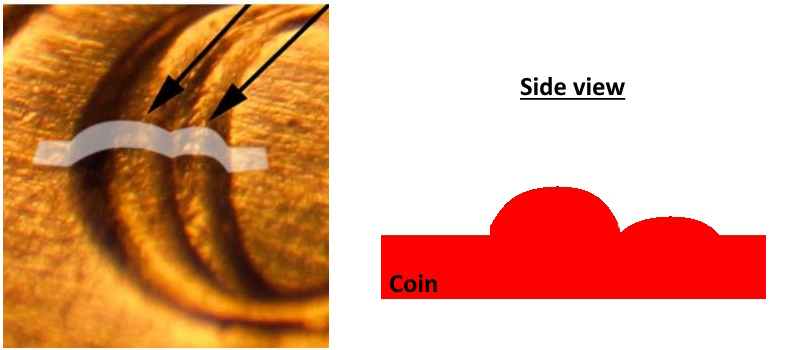 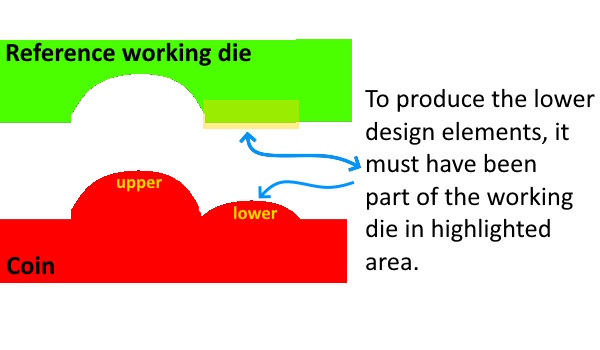 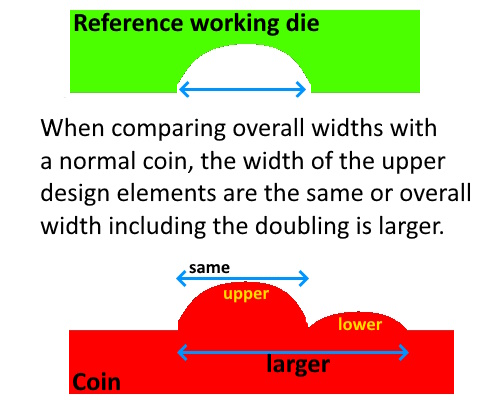 So, on US pennies, was I successful in demonstrating that all coins with MD will have the upper design elements reduced and if it is the same it is another type of doubling (in this case DD). So, on US pennies, was I successful in demonstrating that all coins with MD will have the upper design elements reduced and if it is the same it is another type of doubling (in this case DD).P.S. If you are reading this reply, please participate. Agree / Disagree and even a popcorn emoji will do. |
|
Valued Member
Canada
219 Posts |
And here is the rest. Mechanical doubling 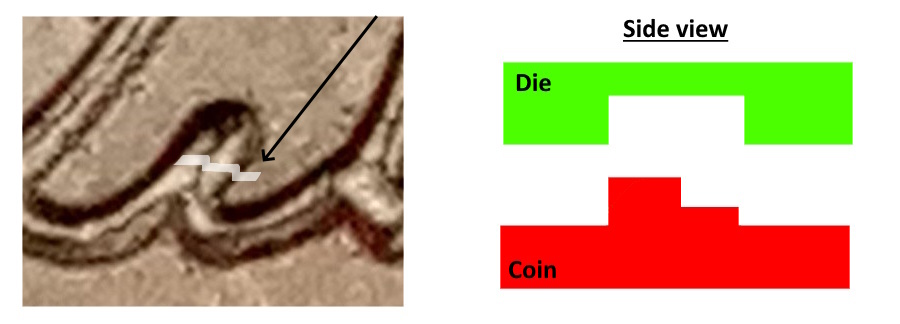 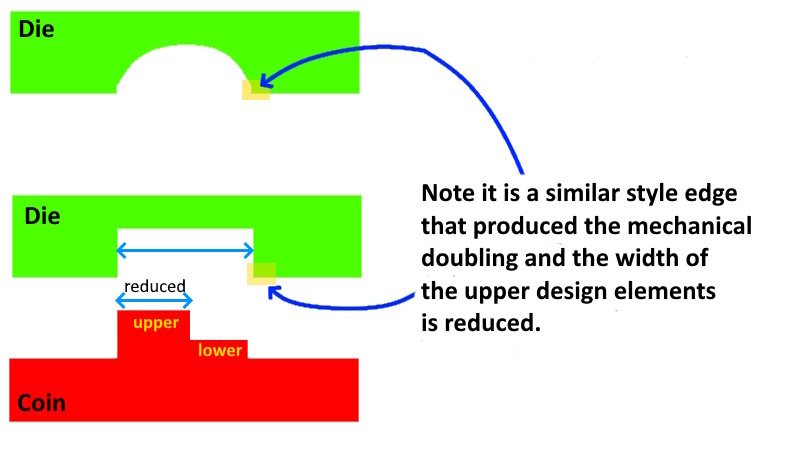 Double Die Double Die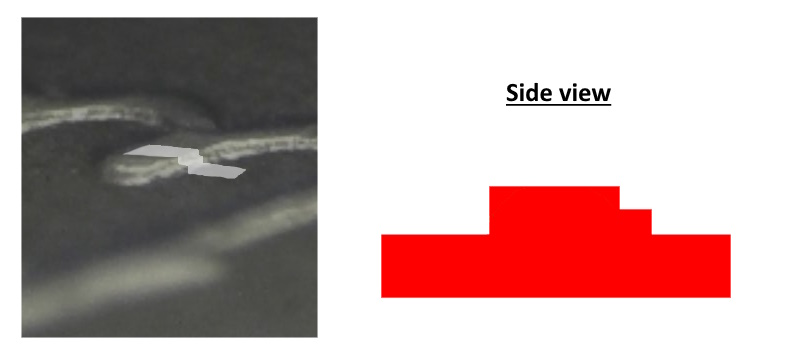 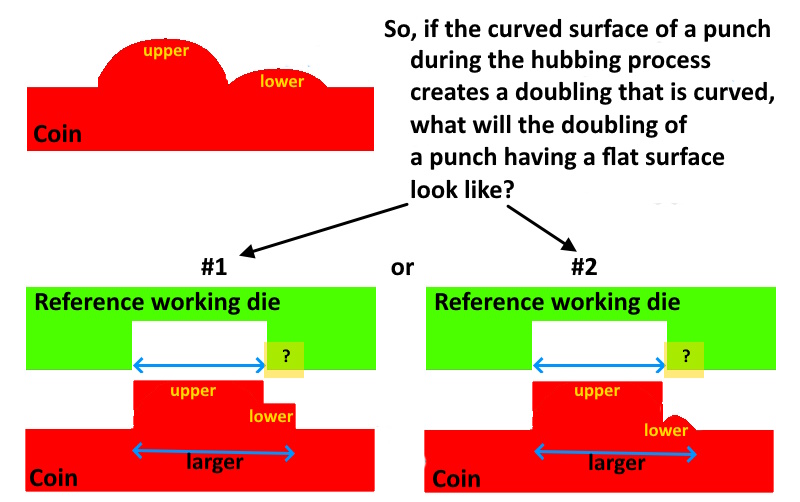 My vote is #1, what about yours? |
|
Pillar of the Community
Canada
6244 Posts |
@ numidanI like your explanations, except you do not mention Machine Doubling. We have three kind: Strike Doubling ( Die Deterioration), Machine Doubling and Mechanical Doubling. I like the way you explain and show. From a long time me and others we question the attribution of MD. For me in 95 % of the case is wrong, and this from the pure physical, mechanical, molecular points of view. Thank you come to show what science can find. What Soft you use for those studies?all my respect Silvio PS: NUMIDIAN please PM me I want to talk with you. Fantastic study.
Edited by silviosi
04/02/2023 9:06 pm
|
|
Valued Member
Canada
219 Posts |
Thank you Silviosi. Sure we can talk. Quote:I like your explanations, except you do not mention Machine Doubling. We have three kind: Strike Doubling ( Die Deterioration), Machine Doubling and Mechanical Doubling. All of the listed terms at the exception of Die Deterioration means the same thing. Verifying this great web site: https://www.error-ref.com/ , the correct term I should have used is indeed " Machine Doubling" which is a sub-category of Striking errors. Quote:
What Soft you use for those studies? The software I use is "Paint.NET" . With a steady hand and the use of layers, you can do anything. Quote:
From a long time me and others we question the attribution of MD. Warning if you post your finding and ask for peoples' opinion, be grateful for any opinion they give. It is with these opinions that you get to learn and develop your own skills. So, if many people gives the same opinion and you think your opinion is better, make sure you provide proof beyond reasonable doubt! To be able to say a coin has a "Double Die" , your need to first look at other possibilities and reject them one by one. Wow, this will take time! Yes at first but you will get better at it as you gain experience. So, is the doubling on my 2005 nickel a "Double Die"? I do not know. Are there other possibilities to investigate? What I do know, it is not due to MD. Edited by numidan
04/03/2023 09:11 am
|
|
Valued Member
United States
392 Posts |
@numidan BTW, the correct terminology is doubled die, not double die.
|
|
Valued Member
Canada
219 Posts |
Quote:
the correct terminology is doubled die, not double die. Duly noted. I do not always proof read what I write in forums. Hope it did not affect what I was trying to demonstrate. BTW. I have noticed other grammatical errors but it is too late to edit them. If required, maybe an administrator can make those corrections. Back to businessIs it a doubled die? On my side, I have ruled out Machine Doubling, flat field doubling, double-struck, die damage, raised doubling, Longacre doubling, split plating doubling, and Die Deterioration. Is there another form or probable cause I should look into? |
|
Pillar of the Community
United States
4429 Posts |
A little late to this thread, so it's a little hard to parse through all this information now. But I'd still like to give my opinion on this one. I feel strongly that this is Die Deterioration, not a doubled die. Very clearly a late die state coin with heavy die flow and rougher surfaces and certainly not Machine Doubling as you have noted. That 2011-D example you referenced is a great example because similar doubling shows on both sides of the coin. You can't see it on the obverse because the lettering closest to the center is only on one half of the face, but on the reverse you can really get a sense for the direction of the doubling. Notice how the doubling is always towards the center of the coin. If it were a doubled die, this means the die or the hub would have had to physically expand or contract to have doubling with that trait. Now this is possible because of metal expanding and contracting from heating (see Class II doubled dies) but doubling caused by that would not show anywhere near the center of the coin, it would be confined to the lettering at the very edge, and it is likely that class of doubled die was eliminated with the introduction of the single-squeeze hubbing process in the late 1990s. |
|
Valued Member
Canada
219 Posts |
Quote:
Very clearly a late die state coin with heavy die flow and rougher surfaces I agree this is a late die state coin and my pictures does clearly show that. Quote:certainly not Machine Doubling as you have noted Thank you for confirming it is not MD. Quote:
I feel strongly that this is die deterioration It is plausible. I do not have access to large amount of US nickels (2005 - ) to see how dies deteriorate and what part of the coin is affected. On this site, have not seen much DDD for this obverse design either . So, for now until someone else finds another coin with earlier die state, I will agree with Die Deterioration.Quote:
doubled die was eliminated with the introduction of the single-squeeze hubbing process We were told the same thing up here in Canada. Under normal circumstances, I agree that for single-squeeze hubbing process doubled dies are concentrated in the central part of the coin. Like I have indicated earlier, I have no experience with US coins. So, I do not know the differences between our mints' processes. Can this also apply to you guys? Up here in Canada, I do not know exactly why but since 2012, we have found several coins with doubled die occurring in different directions. Here are two of my best examples. 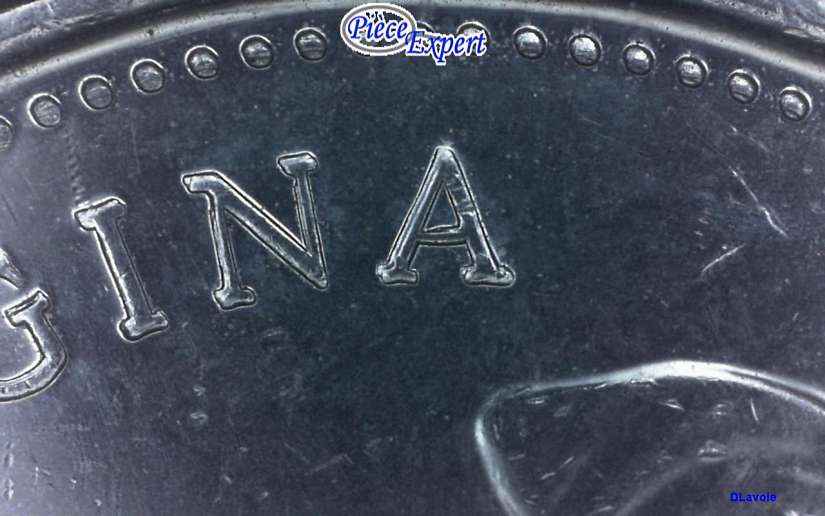 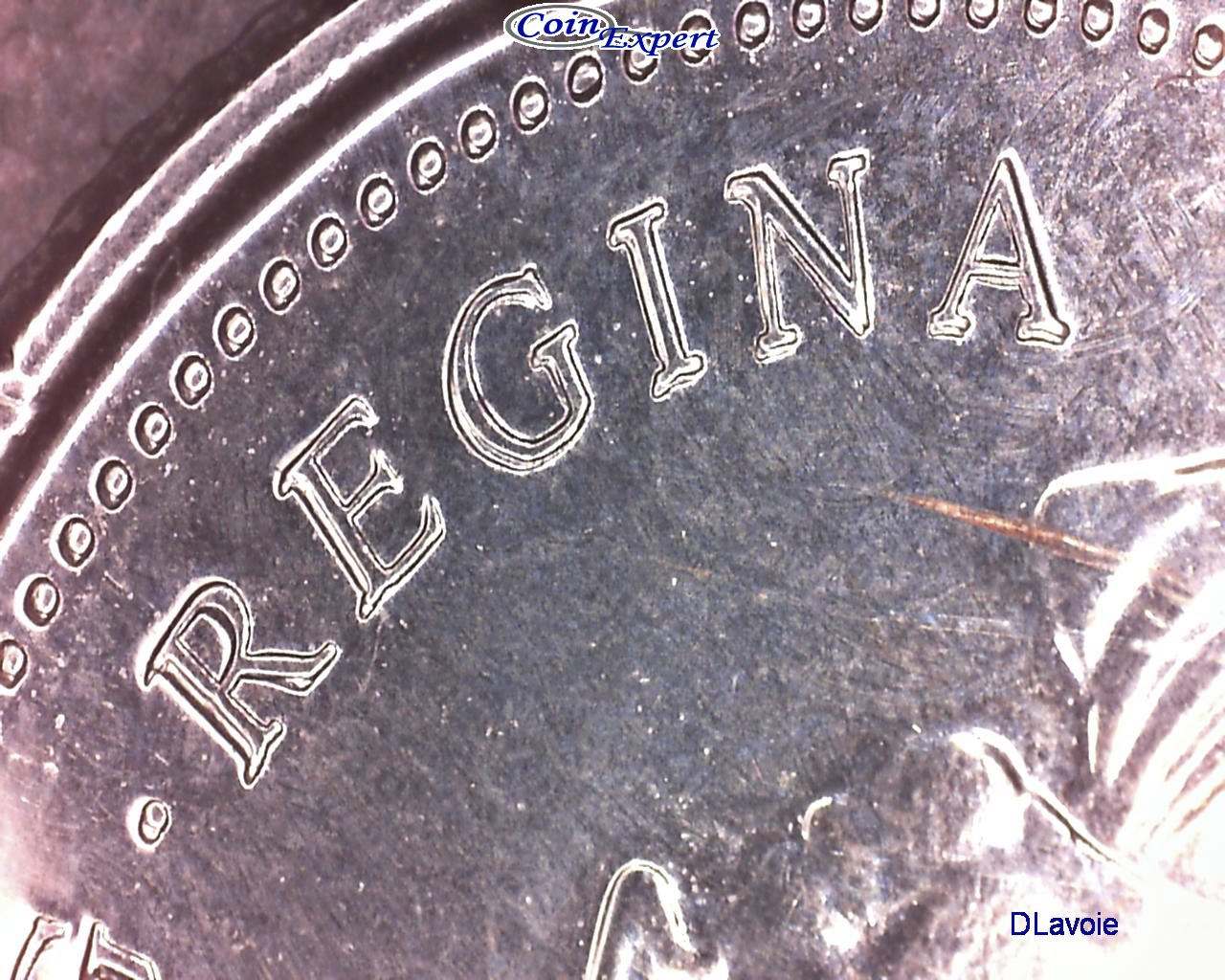 Edited by numidan
04/07/2023 4:45 pm
|
|
Pillar of the Community
United States
4429 Posts |
Quote:
We were told the same thing up here in Canada. Yeah they definitely didn't eliminate the doubled die entirely, but certainly made some classes unlikely to ever occur again. Though I am now reminded of a recent discovery: http://www.varietyvista.com/04d%20J...2PDDO001.htmProbably the only plausible Class II/VI doubled die from the single-squeeze era I've seen, which reasonably should not exist. But that die is what you would expect from a doubled die caused by thermal expansion/contraction of the die or hub, doubling exclusively on the lettering or design near the rim in a direction perpendicular to the rim. It wouldn't be centrally located. I'm not too familiar with the differences between the Canadian and American mints, though there are probably some slight differences. We never see any doubled dies like those two you posted with such strong separation lines, normally it's just thickness and vague split serifs if not tiny and at the very center. Though the direction of the spread is very similar to what we see here, all of the doubling is in some random but consistent direction. |
|
Pillar of the Community
United States
5905 Posts |
Quote:
... we have found several coins with doubled die occurring in different directions. Here are two of my best examples. To clarify: the doubling you are referring to is in the same direction on each coin, correct? I misread it the first time. I thought you were going to show us doubling going in different directions on the same coin. Words of encouragement are one of the major food groups.
We need to consume them regularly to thrive and grow.
|
|
Valued Member
Canada
219 Posts |
Quote:
the doubling you are referring to is in the same direction on each coin, correct? Not on the same coin but the directions are different. The top image has the doubling towards the edge of the coin (slightly rotated anti-clockwise) and the bottom image the doubling is towards the center of the coin (slightly rotated anti-clockwise). Just curious. Did anyone notice the differences in curvature of the field of nickels produced before 2004 and those after? Did the mint make changes to the slope of the pointed shape of the working die rods used as shown in image below? Does someone have a recent picture of a working die rod? 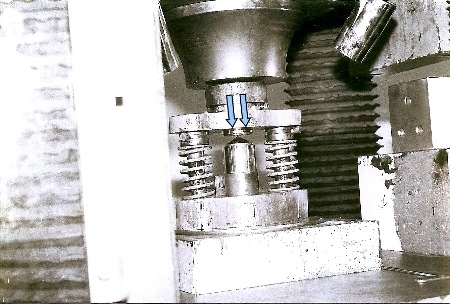 source: https://doubleddie.com/58222.htmlEdited by numidan
04/07/2023 9:49 pm
|
|
Page 3 of 3
|
Replies: 40 / Views: 5,236 |
Page 3 of 3
|





 First Page
 Previous Page

 Posted 03/31/2023 12:30 pm


