| Author |
 Replies: 19 / Views: 1,575 Replies: 19 / Views: 1,575 |
Page 2 of 2
|
|
|
|
Moderator
 United States
56855 Posts |
 Weight? John1  |
|
Moderator
United States
15971 Posts |
to the CCF Take a look at my other hobby ... http://www.jk-dk.art |
|
Bedrock of the Community
United States
19648 Posts |
Agree with the heat damage assessment.
|
|
Pillar of the Community
 Canada
1812 Posts |
 With above, PMD (heat damage). @Cybereyes Edited by Sharks
02/14/2024 1:19 pm
|
|
New Member
 United States
38 Posts |
Solved. Thanks everyone for the info on the coin.
|
|
Pillar of the Community
United States
7174 Posts |
to the CCF Not heat damage. You can't heat the surface of the coin up to the melting point to where it puddles and not effect the middle of the coin. Especially a coin the thickness of a dime. To me it looks like it was sandblasted with glass beads. Beads wouldn't take very much of the surface off like sand or silicon carbide. The face on the obverse and the fasces on the reverse is where they held it so this area wouldn't get exposed to the beads. |
|
Pillar of the Community
United States
3848 Posts |
Sandblasting does not give that effect. My first thought was acid damage. What is the weight?
Suffering from bust half fever. Want to learn how to attribute early half dollars by die variety? Click Here: http://goccf.com/t/434955Shoot me a PM if you are looking to sell bust halves. |
|
Valued Member
United States
425 Posts |
First look I thought acid damage too. With a blow torch or high heat don't you get toning and the coin turns colors?
|
|
Bedrock of the Community
United States
94367 Posts |
I lean toward acid as well. to the CCF! |
|
Moderator
Australia
17012 Posts |
My problem with the "acid" theory is: which acid does this to coin silver? The usual culprits (hydrochloric acid, coca-cola etc) don't dissolve silver, so shouldn't show this effect. I've seen blowtorched coins posted on the forum before that look exactly like this wavy pattern. Here's Coop's image of a blowtorched cent: 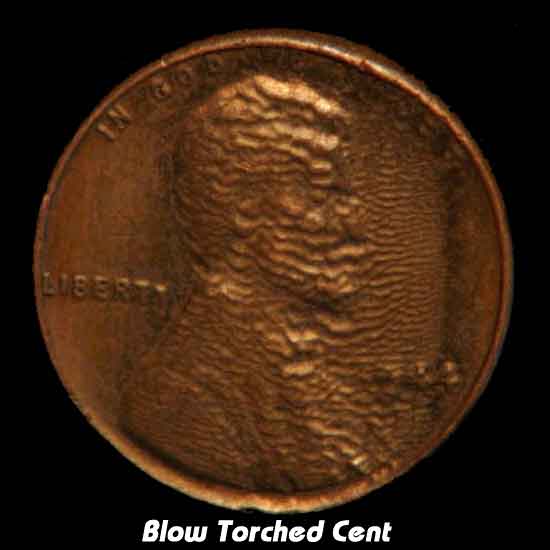 The explanation of the high points knot showing the damage is simple enough: the coin re-entered circulation for a while (or became someone's lucky pocket piece, or was simply buffed down with a polishing cloth) after being torched. The wear patterns on the cheeks and on the fasces look normal enough. Any "blowtorch colors" would also be removed the same way. A weight might help discern the difference with more certainty; a coin this badly acid-etched should be severely underweight, while a blowtorched coin shouldn't have lost much if any weight. Don't say "infinitely" when you mean "very"; otherwise, you'll have no word left when you want to talk about something really infinite. - C. S. Lewis
|
|
Moderator
United States
56855 Posts |
Quote:
A weight might help discern the difference with more certainty  John1 |
|
Moderator
United States
54300 Posts |
In focus sharp images might help.
Show your financial support of the Coin Community Family (click here)See my topic on Mexican Numismatic Medals (click here) |
|
New Member
United States
38 Posts |
Sorry, but I do not currently have the ability to provide the coin weight. I guess a coin scale would be a good investment. (but in my mind I am thinking I could buy another coin for the price of a coin scale |
|
New Member
United States
38 Posts |
NSS-52, The photos actually are in focus. Not trying to say I have the best camera in the world. This is just a really messed up coin and I had no idea what would have caused such and effect.
|
|
Moderator
United States
56855 Posts |
Quote:
(but in my mind I am thinking I could buy another coin for the price of a coin scale) If you want to be a chef, you have to at least buy a chefs' hat and a chefs' knife, right? If you want to be a numismatist you have to at least have a scale and a Jewlers loupe right? John1 |
|
Page 2 of 2
|
Replies: 19 / Views: 1,575 |
Page 2 of 2
|




 First Page


 Posted 02/14/2024 05:52 am





