| Author |
 Replies: 20 / Views: 1,420 Replies: 20 / Views: 1,420 |
Page 2 of 2
|
|
|
|
Bedrock of the Community
United States
79187 Posts |
I'm thinking AU.
Errers and Varietys.
|
|
Pillar of the Community
 United States
790 Posts |
Thanks so much for your opinions so far! I think I posted this in the incorrect place--can someone with the power to do so move this to the US classic and colonial grading forum?
|
|
Bedrock of the Community
United States
37152 Posts |
A very nice looking AU-55.
|
|
Pillar of the Community
United States
3848 Posts |
Messed with but market acceptable. XF-45
Suffering from bust half fever. Want to learn how to attribute early half dollars by die variety? Click Here: http://goccf.com/t/434955Shoot me a PM if you are looking to sell bust halves. |
|
Moderator
 United States
15924 Posts |
Very attractive coin. I'm at AU-something.
|
|
New Member
United States
2 Posts |
Nice S-242. I am almost certain that it is straight graded. Cleaned, with a poor recolor job. My TPG grade is XF-40. My EAC grade is F-15. Edited by Coins4Eli
02/23/2024 12:50 pm
|
|
Bedrock of the Community
United States
12057 Posts |
I don't see any evidence of recoloring. Old cleaning? Maybe. The reverse is a bit blotchy. Obverse looks like it should given the apparent sharpness.
If this was in an envelope in my collection it's a net 35 EAC. I would have no problem with owning (or selling) it.
Member ANA - EAC - TNA - SSDC - CCT #890 "Most of the things worth doing in the world had been declared impossible before they were done." -- Louis D. Brandeis |
|
Valued Member
United States
466 Posts |
Hmmm
I think AU 55 but I wonder if pcgs questioned the authenticity of the color because of the roughness of the obverse in the area between the chin and rim. Almost looks like it may of had environmental damage and was toned over it. I'm far from an expert though.
|
|
Pillar of the Community
United States
3755 Posts |
|
|
Pillar of the Community
United States
790 Posts |
I thank you all for sharing your opinions--it amazes me how early American copper can lead to such a wide variety of opinions and assessments. I love all of my EAC coins, including their flaws (like the little spots on my uncleaned 1794 Half Cent and the blue patch on my 1839 "booby head" cent), and the evaluations of their features (both positive and negative) richly characterize those coins, giving them a sort of "identity" or "personality." As I continue to amass more for my US type set (I certainly see more and more factors that help construct a coin's identity in the marketplace. Less than one day left before I reveal the PCGS grade on this coin :). The color looks better in person than it did in my photos. The lighting in this photo was weird, under a lamp on a nightstand. Four weeks ago I was shooting ancient Nabatean tombs in a Saudi Arabian desert, capturing subtle hues of gold, orange, tan, red, and even some purples in the stone in varying intensities of sunlight. Apparently I am much better at capturing landscapes and buildings than I am little metal discs esconsed in plastic slabs. Edited by Adam590
02/23/2024 3:50 pm
|
|
Bedrock of the Community
United States
12057 Posts |
Coins can very difficult to photograph well. A good setup is to use a copy stand and adjust the angle until the coin "shoots" the way you want it to. Straight-on shots will maximize contrast (useful if shooting, e.g. proof coins) especially if you are using a direct light source perpendicular to the coin's facing surface.
One thing that I have had good luck with is using a "coin box" - a box, open to the front, lined on the other 3 sides with black or dark blue fabric. You can then use indirect incident light sources positioned in such a way that the luster is maximized or the surface detail/color. This avoids some of the "light pollution" from ambient light sources and lets you fine-tune your lighting. Use an incident light meter to set your stop and speed once you have your coin and lighting set up (I've found that the built-in meter in modern DSLR setups tends to underexpose shots if the subject is super-lustrous or proof/prooflike.)
People far more expert than I swear by small "penlight" LED light sources but I've always found that makes white balance tricky to dial in and also can add cyans/blues to the shot. I prefer a soft white incandescent light, but it needs to be cool enough that it doesn't add in a bunch of reds and oranges which will have to be desaturated later in post. Either way, you're going to want to have good post-processing software of some sort (I use a very old PhotoShop CS2, but still very effective) or your camera software (e.g. Nikon's NX Studio.)
I shoot all my coins using a Nikon DSLR at either 35 or 55 mm. I'd have much better luck with a decent copy stand, but for now, I make do!
Member ANA - EAC - TNA - SSDC - CCT #890 "Most of the things worth doing in the world had been declared impossible before they were done." -- Louis D. Brandeis |
|
Bedrock of the Community
United States
94367 Posts |
@Coins4Eli - EAC grade F-15? Really?!
|
|
Pillar of the Community
United States
790 Posts |
Thanks again to everyone who weighed in. Paralyse, thanks for sharing your numismatic photography methods. I will work on mine in the future. PCGS called this AU(50). I upgraded to this one from an AU(53) that is a bit darker and with a distracting hit on the cheek. I like this coin more as a type coin, both in the fields and color. 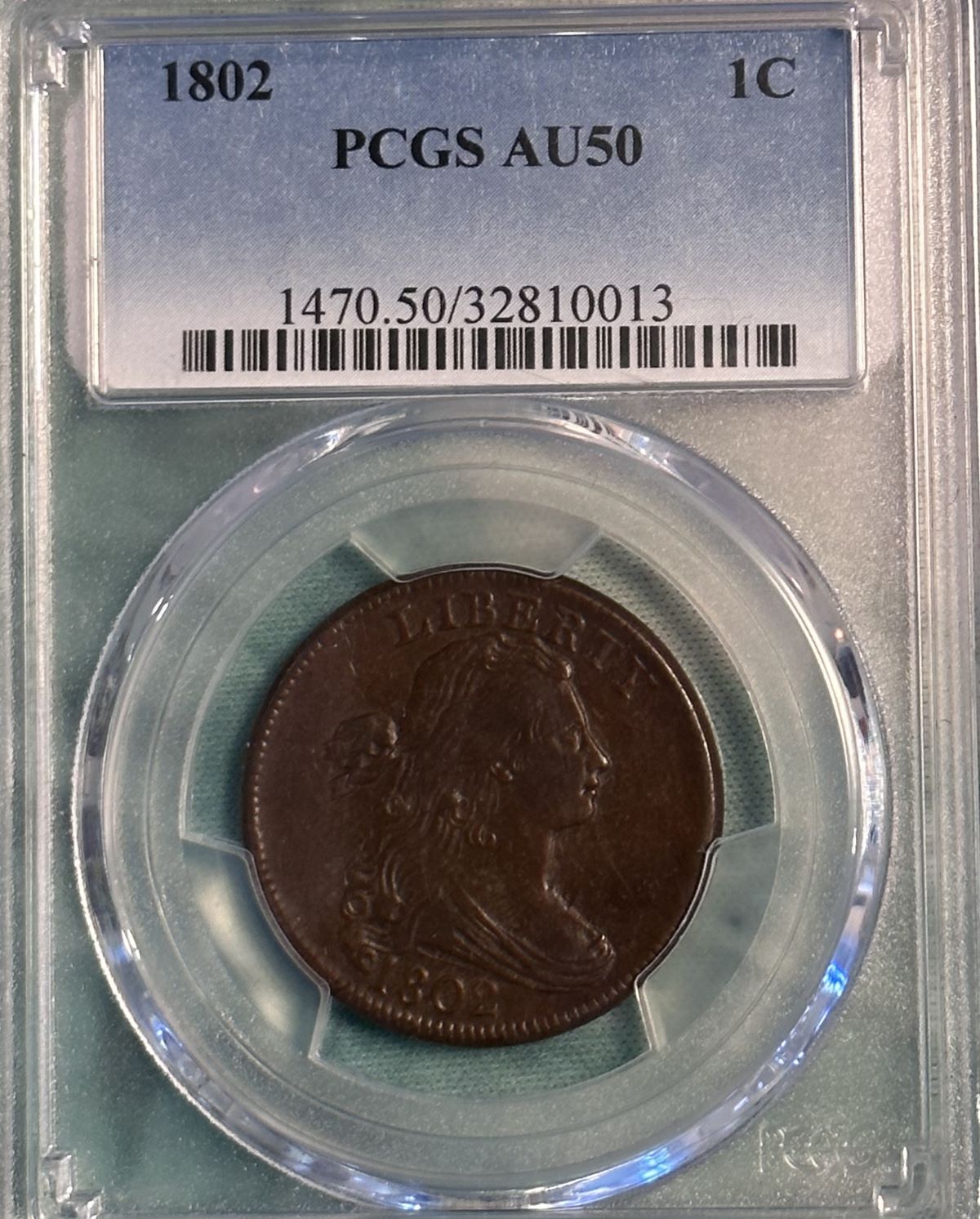 |
|
Bedrock of the Community
United States
12057 Posts |
Nailed it! I think it's a very attractive coin for a TPG 50. I would keep it. Member ANA - EAC - TNA - SSDC - CCT #890 "Most of the things worth doing in the world had been declared impossible before they were done." -- Louis D. Brandeis |
|
Pillar of the Community
United States
980 Posts |
That is a beauty! Congrats. I love the draped bust cents.
|
|
Page 2 of 2
|
Replies: 20 / Views: 1,420 |
Page 2 of 2
|






 First Page


 Posted 02/22/2024 7:26 pm





