| Author |
 Replies: 18 / Views: 1,245 Replies: 18 / Views: 1,245 |
Page 2 of 2
|
|
|
|
Bedrock of the Community
 United States
10601 Posts |
"Buy the slab - not the description"  "Mint Error 1944 Lincoln Cent Thick Planchet 66.3 Grams" 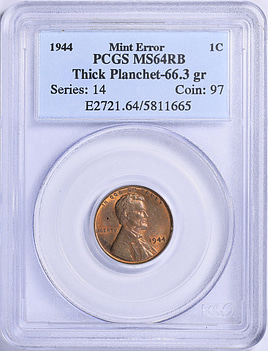 |
|
Moderator
Australia
17013 Posts |
One can do the maths. Let's assume for starters that the object is actually still made of regualr coinage bronze. Density = mass / volume. Therefore volume = mass / density. The volume of a piece of bronze weighing 66 grams is therefore 66 / 8.9 = 7.42 cubic centimetres. The volume a cylinder = pi x radius^2 x height. The height of a cylinder of known volume is therefore = volume / (pi x radius^2). A Lincoln Cent has a radius of 0.925 cm. This now gives us a height of our postulated cylinder = 7.42 / (3.14159 x 0.925^2) = 2.76 cm, or just over one inch thick. I don't think that would comfortably fit inside a standard slab. Don't say "infinitely" when you mean "very"; otherwise, you'll have no word left when you want to talk about something really infinite. - C. S. Lewis
|
|
Bedrock of the Community
United States
27514 Posts |
Great job on the maths, Sap! Quote:
2.76 cm It must be a variation of the "thnickels": https://thick-coins.net/From the site: 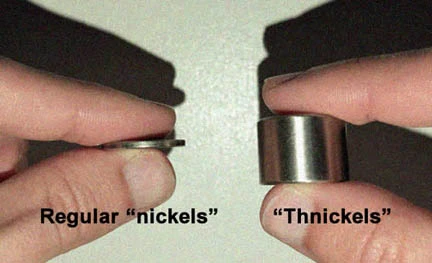 Inordinately fascinated by bits of metal with strange markings and figures
|
|
Moderator
United States
108677 Posts |
|
|
Forum Dad
United States
24238 Posts |
I shot an email off to Ian.
|
|
Pillar of the Community
United States
2752 Posts |
I've seen a number of 1944 cents struck on thick planchets that weigh around 4.2 grams. So, the auction coin fits well within that sample. Similarly heavy Lincoln cents occur in other years.
Error coin writer and researcher.
|
|
Pillar of the Community
United States
593 Posts |
66.3 grains = 4.29 grams.
Is it possibly confusion over the abbreviation "gr" vs "g"?
|
|
Pillar of the Community
United States
6928 Posts |
You can see on the reverse where the excess metal was forced past the collar and into a Rim Fin. Looks like it got rolled over onto the rim. What do you guys make of the hieroglyphics from K3-4 obverse, and that matching pair of grooves at K1 reverse? PMD? Or was the coin struck through feeder fingers or another mechanism? It's easy to believe that moving parts could get jammed in the striking area if the planchet is 140% the correct size. |
|
Moderator
United States
108677 Posts |
Nice observation Brand - didn't corelate the Rim Fin to the extra weight.  |
|
Moderator
United States
196946 Posts |
Very interesting! |
|
Bedrock of the Community
United States
79876 Posts |
|
|
Moderator
Australia
17013 Posts |
To my mind, the more important question is: why was coin slabbed with the weight in "grains" in the first place, when most people in the coin biz seem to be comfortable using grams? I assume PCGS doesn't routinely use grains here, otherwise everyone at Great Collections would have known this.
Or is this a case of "the submitter put 'grains' on the submission form, so that's what PCGS used on the label"?
Don't say "infinitely" when you mean "very"; otherwise, you'll have no word left when you want to talk about something really infinite. - C. S. Lewis
|
|
Pillar of the Community
United States
6928 Posts |
Sap, isn't the congressional specification for coinage given in grains?  |
|
Pillar of the Community
 United States
7376 Posts |
Is it really worth.........wait for it.... Hammered at $850.....w/BP....$ 956.25.......  Guess I better start weighing all my LWCs |
|
Bedrock of the Community
United States
10601 Posts |
Quote:
Hammered at $850.....w/BP....$ 956.25.......
What?.........How?..........Why?  |
|
Page 2 of 2
|
Replies: 18 / Views: 1,245 |
Page 2 of 2
|





 First Page


 Posted 03/07/2026 04:02 am


