| Author |
 Replies: 86 / Views: 7,325 Replies: 86 / Views: 7,325 |
|
|
|
|
Pillar of the Community
 United States
2448 Posts |
I too think Francisci's design is nicer and more representative of the woman of the "20s" than the "Rubenesk" Morgan. But I wish it could have been stuck properly. As to Lady Liberty's mouth agape; I seem to remember reading somewhere that Francisci used his wife as his model. That explains everything, since when has YOUR wife stopped yelling at you?   |
|
Bedrock of the Community
United States
10982 Posts |
I've heard the same model was used on the Peace dollar and the $10 Indian Head Eagle. What do you think?    |
|
Pillar of the Community
United States
2448 Posts |
I thought the same thing and even thought that Francisci copied the design from Saint Gaudens. I'll bet someone at the mint thought the same also. Looked it up again just to verify, my source was from Breen's Complete Encyclopedia of US and Colonial Coins. Teresa Francisci was just 23 when he used her as the model for his design.
I don't remember reading if Francisci was of the "St. Gaudens" school. I do believe that the "school" had a lasting affect on coin design. I still think some of the most handsome coins come from this era.
If you think about it, both artists were affected by the Art Nouveau movement. The move to more slender and sensual images of women were creeping into coinage all over the world. The French Mint fully embraced the movement and many of their depictions of Liberty were very much like Fancisci and Saint Gaudens offering.
Just my opinion, but if you really look at the images on the coins, there are definite differences in the noes, eye, mouth, and jaw. They're subtle, but they're there.
Edited by carmykle
08/30/2010 2:55 pm
|
|
Valued Member
United States
380 Posts |
They are very similar for sure.
|
|
Pillar of the Community
United States
2448 Posts |
And is equally similar to the un-minted Saint Gaudens l Cent below: 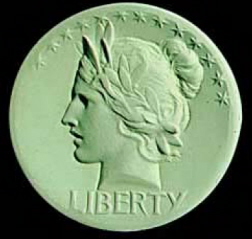 Took me a while to find it. |
|
Bedrock of the Community
United States
11951 Posts |
You all have have some very nice Peace dollars .. really make mine look bad. But I do like them. That 1921 of bherring1964 is a beautiful coin. I don't dare take any close up pics of mine but here are a few I picked up ... mostly from the silver boxes over the years. 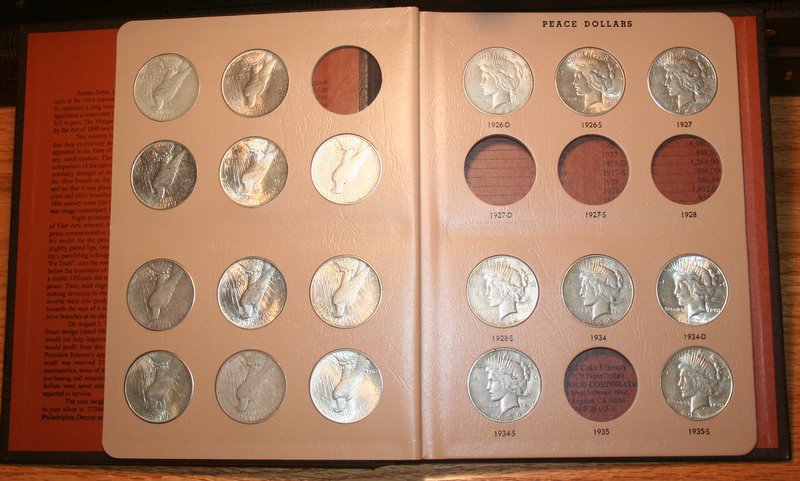 Edited by GR58
09/01/2010 3:27 pm
|
|
Valued Member
United States
380 Posts |
Hmmmm... you should be able to complete that fairly easily (minus the 1928... depending on grade, she is expensive and THE KEY to the set)
Love the album.
Edited by remmy1100
09/01/2010 1:43 pm
|
|
Bedrock of the Community
United States
11951 Posts |
Remmy1100
I have been looking at a 1928 at a local shop. It looks to be AU and he is wanting mid to high $300's.
If I catch him on a good day I think I can get it at a good price.
Only problem is he also has two capped bust halves I want too...
So many coins and so little money ....
|
|
Pillar of the Community
 3660 Posts |
Quote:
The dies were designed so you could not get 2 reverses or obverse coins. The existing reverse dies fit into the hammer die holder. That is all the proof I need... it is documented beyond that as well.. not just hearsay. No, the dies were not designed for that purpose at all. The 'only' difference between a reverse die and an obverse die is the design on the face of each. They will both fit into either lower or upper location. Two reverses or two obverses in the press is entirely possible. There is absolutely no proof of which die was the upper other than collar clash marks on a few coins of one year at one mint. Documentation would have to refer to 'that', and 'that' is far from being conclusive, as such documentation has not been produced from the Mint Archives as of yet. |
|
Pillar of the Community
United States
5700 Posts |
I have read this entire topic and come away with a few thoughts, 1st the Morgan silver dollar was designed after a kindergarten teacher, ANNA WILKES, which I think is a beautiful design for a dollar, the Peace dollar, was as stated above designed after De Francisci's wife Teresa, also another beautiful design for the times and still today they both are excellent examples of the unique abilities of those artists. I also would like to take the same view as "Remmy" on the notion of the reverse die being used for the hammer die, why, I have done some research in and on this topic and from the marks observed on some of the Peace dollar coins, it would be more than plausible for this to be true, while I also have not seen any written information about this, and if I did I would take it and much of what I read with a grain of doubt, till proven different. I know from being around for a few years there are some very well educated people on the Morgan/Peace Dollar subject and respect you all for having that knowledge and readily sharing it with us all, enjoy the Anna's and Teresa's of yesteryears coinage........Just my opinion...... |
|
Pillar of the Community
3660 Posts |
Dad, I actually 'have' seen 'information' printed on the reverse die being the upper die. Yes, this particular bit of hearsay very well could be true, but until someone produces the actual mint 'document' verifying this, it remains hearsay. Breen's, Newcomb's, or anyone else's thoughts put to paper may qualify as 'documentation' to some folks, but not to me. Even Van Allen is careful to word his thoughts on the matter as follows: Quote:"The lower die was the reverse die for the Morgan dollar, and it was 'probably' the obverse for the Peace dollar." Now here is what I said on the page preceding this one: Quote:Now, although it is not attested to yet through researched documents at the National Archives, I do think that indeed the reverse die was used as the upper die on at least some Peace dollars based on rim markings that I have noticed on a few Peace dollars. The markings appear to coincide with the collar teeth. The teeth marks (when found) are always only on the reverse rim of the coin. This would be compatible with the possible 1/32" die variation of the upper die within the die chamber. That is the sort of thing that I base my beliefs on, not some garbage that someone else either said or put to print. To expound upon this point, I too believe that the reverse die was the upper die on some (if not all) Peace dollars. Do I believe that documentation attesting to this exists in the Archives? Yes, I do, but until such a document is actually uncovered from the Mint Archives, I do not consider it to be documented. My belief is based on evidence of collar teeth marks transferred to the reverse of coins, and is not based on something somebody else just happened to speculate on, and put it in print thereby conjuring the notion of 'documentation'. That is how myths get started, and that is why not 'all' knowledge is king. |
|
Moderator
 United States
23522 Posts |
The Archives are open on the second Saturday of each month. This month, that day is 9/11 and I will be in New York City. Next month, I already have vacation scheduled.  |
|
Pillar of the Community
United States
3076 Posts |
while the best "speculation" is many times considered the knowledge, it's just simply not true....though it is given much thought it's not absolute.....the facts are the facts, which are not absolutely presented in this case....and I do believe the marks from the process lead us on to the right path....while Peace dollars still have much to research, I personally don't think the minting processes of the Morgan era....meant there were never any changes in the process over the 50 some years, as if no lessons were learned.......clearly things did change...even in 1921 Morgans........Peace dollars had the problems, but (my wild guess here) that 90% of the Morgan issues did not occur with the Peace dollars...Some things in the process did change. |
|
Valued Member
United States
380 Posts |
The information related to the dies was release by the GSA. I will try to dig up the who and where later when I have time. But this is beyond speculation.
|
|
Pillar of the Community
3660 Posts |
|
|
|
Replies: 86 / Views: 7,325 |
|







 First Page
 Previous Page


 Posted 08/29/2010 7:11 pm





 Hope you don't hate me for being the way I am about not believing things without credible evidence, but I have been conditioned to this state by all of the horsepucky that I've been fed elsewhere. If you say that it is so, then I will accept that.


