|
This page may contain links that result in small commissions to keep this free site up and running.

Welcome Guest! Registering and/or logging in will remove the anchor (bottom) ads and the security checks. It's Free!
To participate in the forum you must log in or register.| Author |
 Replies: 21 / Views: 5,781 Replies: 21 / Views: 5,781 |
Page 2 of 2
|
|
|
|
Valued Member
Canada
107 Posts |
BU has always meant a coin with original lustre.. as far as I KNOW. Rather a general term for quick reference, with bag marks etc you would step up the descriptions.
Also were not the early pl coins just normal bussiness strikes that were handled with more care ?
|
|
Valued Member
Canada
107 Posts |
PROOF-LIKE sometimes abbreviated as PL, is an odd category. These are coins minted for special mint sets made for sale to collectors, and not intended for circulation. The mint never claimed they were anything other than choice MS coins, but are very early strikes from fresh dies and were selected out for the sets as nice coins before going through the entire mint handling process so tend have have higher lustre and fewer bag marks than MS coins. However they are not perfect mark-free coins and average PL-64 to PL-66 right out of the sets. Any experienced collector or dealer will know one when he see's one. The term Proof-like was invented by dealers to differentiate these from normal MS coins, for reasons I will discuss below. Proof-like sets were first sold to the public in 1954, although single PL coins earlier than 1954 do exist.
compliments from another site ccs
|
|
Valued Member
 Canada
250 Posts |
Thanks for the replies guys, I'm learning... I was looking over some coins on ebay and found some advertised as "specimen' and certified by ICCS as SP-64 how does specimen fit in with PL, BU and MS? cheers |
|
Valued Member
Canada
107 Posts |
Specimen is probably a description of coins in relation to surfaces ie frosted,mirror fields,raised elements and so on, only a guess. j
|
|
Pillar of the Community
Canada
1051 Posts |
Quote:
how does specimen fit in with PL, BU and MS? The answer(s) to that question totally depends on the year the coin was issued. The newer "parallel lined" specimen coins are easy to spot (and nice looking, IMO). The slightly order ones are, in honesty, somewhere between tough and impossible to discern from strong PL's in some cases - and that's for me, for you, and for major TPG's. The much older coins are, like the very modern specimens, also fairly easy to identify. It may be a poor comparison, but I'd liken older Canadian specimens to US proof issues. Back in the 1940's and prior things were easier: you had your standard business strike coins, and your specimen coins struck for the collectors. The modern proof, at least in theory, could have replaced the specimen coins. Just to make things even more complicated, the early "Prestige" sets that were packaged like modern proof sets (and are sometimes called "proof" sets) contain specimen coins. The mint does not seem to have any desire to get rid of the specimen coin, and as such it is produced along with the PL, MS, and PF coins to this day. |
|
Valued Member
Canada
367 Posts |
NC = not circulated C = circulated 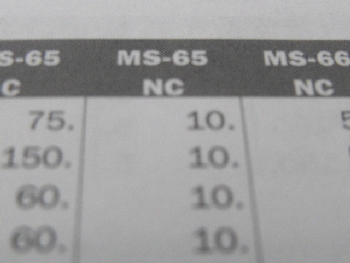 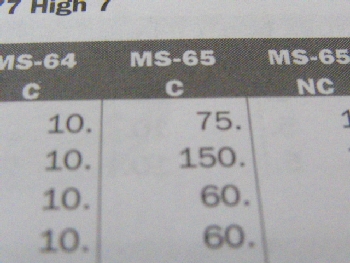 |
|
Pillar of the Community
Canada
3692 Posts |
If you've ever seen Canadian mint sets from around the 1950s-60s, they have proof-like coins. You'll know when you see one. They seem whiter from the reflection.
BU is just a generic term for UNC with more lustre and eye appeal. Some dealers mark their coins BU or BUNC so that there's more subjectivity to the grading.
The whole C and NC thing refers to business strikes and colectors' sets. It's much more impressive to find a business strike in mint-state than it is to find a collectors' coin in mint-state (because they come like that), so the price reflects that.
Edited by Libertad
10/15/2010 10:40 am
|
|
Valued Member
Canada
367 Posts |
and buisness is circulated right?
|
|
Pillar of the Community
 Canada
9909 Posts |
NC=non circulation, i.e. coins from sets with the same finish as circulation coins C=circulation ,coins for everyday commercial use circulated=used BIG difference between the words circulated and circulation A circulated coin graded MS65? It doesn't make sense. Edited by DBM
10/15/2010 11:00 am
|
|
Pillar of the Community
United States
2120 Posts |
if I'm wrong don't flame me. :D But you gotta remember, MS (mint state) and BU (Brilliant Uncirculated), refer to levels of preservation, not how the coin was obtained or where its been. An MS/BU coin retains the same level of quality and preservation as when it was minted. If by the term Uncirculated alone we assume the coins history, then I could take any MS coin, rub it in my fingers for a few weeks, down to an AU/XF, but still sell it as MS, because its never been in "circulation". Quote:
A circulated coin graded MS65? It doesn't make sense. If you pulled it from a roll, that you got directly from a bank, that was still in its original wrapper, that would be circulated, right? What if you got that same roll from the market, or gas station. Circulated, right? A coin from this roll could have absolutely no wear (or nicks, marks, etc) and be a Mid-grade MS coin, even though it was technically, circulated. Quote:
Some dealers mark their coins BU or BUNC so that there's more subjectivity to the grading. Yea I see that a lot myself. I assume BU = MS60-62, CHBU = MS63-65, GemBU = MS65-* Makes sense though, its harder to argue price/grade and they can slap a median price on the coin. chances are they paid at the bottom of the range (or a grade less) than what they marked the grade at. Tell you what. you can get some great deals if you can break your dealers code, and be able to tell what they are in to a coin for. |
|
Valued Member
United States
273 Posts |
Quote:
NC=non circulation, i.e. coins from sets with the same finish as circulation coins
C=circulation ,coins for everyday commercial use
circulated=used
BIG difference between the words circulated and circulation
A circulated coin graded MS65? It doesn't make sense. That's how I understand it too, but it doesn't make any sense to me at all. If they have the same strike and same finish, how can someone possibly tell the difference between say a "MS-C65" and a "MS-NC65"? There's just no way. As far as I'm concerned, if it has the same finish and same strike, it's simply MS-65 no matter where it came from. |
|
Valued Member
United States
273 Posts |
Quote:
An MS/BU coin retains the same level of quality and preservation as when it was minted. If by the term Uncirculated alone we assume the coins history, then I could take any MS coin, rub it in my fingers for a few weeks, down to an AU/XF, but still sell it as MS, because its never been in "circulation". Not quite. While the coin would still technically be uncirculated, it wouldn't still be in Mint State (MS) -- or, in condition similar to when it left the mint, and as such would no longer earn an uncirculated grade (MS60+). On that note, it is very possible to pull a MS coin from circulation. Ever get a brand new coin straight out of a roll in your change? That has technically been in circulation, but would likely still grade MS60+. Quote:
I assume BU = MS60-62, CHBU = MS63-65, GemBU = MS65-* That's how I understand it too. I just hate the whole BU nonsense. If you're going to assign a grade, assign a grade. |
|
Pillar of the Community
Canada
1051 Posts |
Whether a coin is mint state or not is determined solely by wear on the coin, not whether it has been in circulation. Coins spending a short time in circulation can and do grade MS if no visible wear has occurred. Conversely, there are specimen and PL coins out there that have received circulated grades. Not as a result of true circulation, but as the result of (most likely) poor handling and/or storage. Quote:
I assume BU = MS60-62, CHBU = MS63-65, GemBU = MS65-* I agree 100%. I think the Charlton (possibly?) used to even use these terms. 63 was choice, 65 was gem, and (if memory serves) 67 was superb. |
|
Pillar of the Community
Canada
1581 Posts |
BU was always more a luster comment, wasn't it? It's a different attribute than the grade. And one that is badly handled right now. It used to be applied to coppers too, but nowadays we have the slightly less useless Brown (<30%?), Red and Brown, and Red (>70%?). There's nothing modern for silver/nickel. Perhaps the answer is to standardize everything with a new four value system: Finish-Grade:Luster:Cameo Finish: B (business strike), NC (non-circulation), SP (specimen), RP (reverse specimen), PR (proof), RP (reverse proof) Grade: 10-100 (poor to perfect) Luster: 0-100 (percentage of mint luster, or Cleaned if that is the case) Cameo: 0-100 (from no cameo all the way to proof maximum) Assume cameo proofs are by definition 100:100 luster:cameo A rough mapping allowing finer grading at the top (each TPG would release their own specific mapping for their grades): 10 - Poor 20 - G 30 - VG 40 - F 50 - VF 60 - EF 70 - AU 80 - MS e.g. B-90:95:50 (~MS-65 with 95% full luster and 50% of maximum cameo) B-70:Cleaned (AU cleaned) SP-85:30:20 (a nice old toned specimen coin) PR-92:100:100 PR-93 (assume 100% for luster and cameo, if not provided) Want to go nuts? Allow for the obverse/reverse to be finally have independent grades: B-55:30:0/35:20:0 |
|
Valued Member
United States
273 Posts |
dialog, I like it. But that would be a nightmare!
|
|
Page 2 of 2
|
Replies: 21 / Views: 5,781 |
Page 2 of 2
|
To participate in the forum you must log in or register.
- 1974 San Marino 20 Lire, PCGS MS-67, San Marino, Lobster
- How Far Back Can We Go? Ninth Edition!
- An Old Advert In One Of My Old Books.
- Around The World With Coins - A Coin Geography Game
- Are You Looking For A Steal?
- Real Stinker Of An ICCS Grade. Anyone Else Ever Experienced This?
- Seamonkey's Eisenhower Dollar - Dansco 8176
- Publishing Toned Copper Coin Here
- 1988 Mexico - 50 Pesos, 10-15% Off-Center Strike
- 1990-D Dime Minor Greaser
- 1944-D Lincoln Cent Altered To Be A 1914-D Lincoln Cent - 100% Authentic
- 1795 Liberty Cap Large Cent, PCGS AU-58+, S-76 Struck Over 1794 S-71, Jeff Garrett Discovery
- 2026 P Nickel: Low Potential DDR
- All Members, Post Your Most Recent US Coin Purchases!
- Continuing List To Show Everyones Latest Acquisitions
- Post Your Coins With Coats Of Arms, Shields, Crests, Crowns, Etc.
- G L B 49's Random Silver Coins
- Post Your Bird Coins
- Yet Another Forum Game - Numismatic Go Fish!
- Post Your Coins With Stars
Disclaimer: While a tremendous amount of effort goes into ensuring the accuracy of the information contained in this site, Coin Community assumes no liability for errors. Copyright 2005 - 2026 Coin Community Family- all rights reserved worldwide. Use of any images or content on this website without prior written permission of Coin Community or the original lender is strictly prohibited.
Contact Us | Advertise Here | Privacy Policy / Terms of Use
|
| Coin Community Forum |
© 2005 - 2026 Coin Community Forums |
| It took 0.38 seconds to rattle this change. |
 |
|
| |
| |




 First Page

 Posted 10/12/2010 12:27 am


