Hey Scooby, first, that in-depth comment by John Stafford-Langan of Irishcoins.com:
Quote:I have a fairly extensive assembly (I'd hesitate to call it a collection) of Irish 1968 pennies - and I do have examples of this distinction - unfortunately I also have examples which fall into the gap between the two coins illustrated on the site, which suggested that this is not a case of two distinct pieces rather of a range of types of which these two are near the extreme ends - at least this had always been my understanding.
However recent, as yet unpublished, research is uncovering evidence that
The Royal Mint was under pressure to produce the coins for Ireland in 1968 (remembering that they had stopped the production of English pennies in 1967) as they were ramping up production of the new decimal coins (and complete replacement required many more coins than normal annual production for wastage and economic growth / inflation). And it looks as if
The Royal Mint may have contracted the external producton of as much as 9 million of these Irish pennies - but the dies should still have been
Royal Mint dies.
The Royal Mint was in competition with other mints for the Irish business, which was at the time very attractive to them for the decimal coins as they did not need to retool for blank production for the Irish coins (which they would typically have to do for other countries), so they appear to have wanted to keep their short term production shortfall secret from the Irish Central Bank. If this was the case then even if
The Royal Mint was responsible for the supply of dies to the contractor then if they were using different minting technology the die production may have resulted in these types of differences.
I haven't really though much about the range of 1968 pennies for a while - but in the light of this new evidence (which I have yet to understand fully) I will have to look again. And it may be that instead of a continuous range of types with the extremes appearing quite distinct there may be two ranges of types - with some of the coins quite similar but the extremes being quite identifiable.
The picture is confused by the fact that there was a small batch of 'proof' coins from an external contractor that came to light a few years ago - and which were initally identified as a small trial production of coins for a proof set to mark the end of the LSD coinage. But it now looks as if these coins may have been the trial pieces associated with the contracting of the external production of currency pieces to meet
The Royal Mint shortfall.
Interesting how he mentions an outside mint was contracted to produce business strike coins and proof coins. Whether the two were the same mint is unclear, but John thinks the dies were provided to these outside contractors. That makes sense to me, since it would be very time-consuming to reproduce the obverse/reverse designs faithfully "from scratch". And, it would be harder to hide the fact they outsourced production that way.
The "range of types" mentioned by John above could be explained by differences in how dies were made, seen in differences on the harp.
on my part, the differences between the "large date" and "small date" are too great to be explained by minting technology. Those two dates came from different punches or hubs--however that was done. Later, I'll put together an overlay of the dates for comparison. A quick look on
suggests the (top) "large date" appears more common.






 First Page


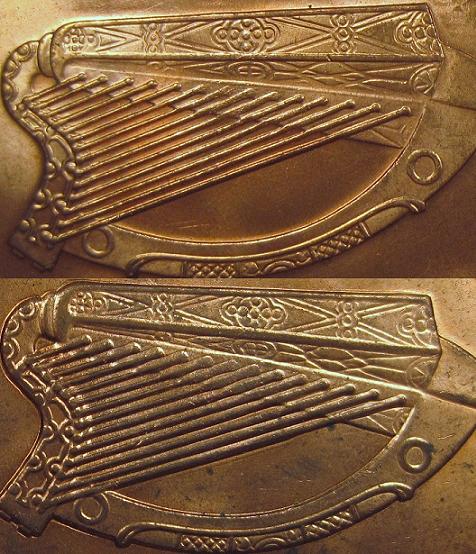


 Posted 04/09/2011 8:53 pm





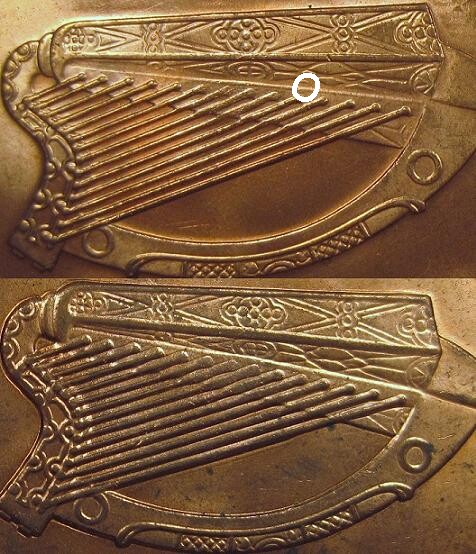
 However, what if


