| Author |
 Replies: 21 / Views: 2,393 Replies: 21 / Views: 2,393 |
Page 2 of 2
|
|
|
|
Valued Member
United States
87 Posts |
Matt, I would have said MD but you bring up a good point about the horse being flat to begin with. Wait for an expert. Buddy, This thread below has helped me and alot of people on Machine Doubling (MD). You can also do searches at the top left of the page. The search has helped me find examples where the glossary is just the definition. Good luck. http://www.coincommunity.com/forum/...PIC_ID=51410 |
|
Valued Member
 United States
187 Posts |
|
|
Bedrock of the Community
United States
62064 Posts |
Machine doubling. The dies moved during the strike and left a damaged area on the device in that area. Normal dies, just slightly damaged while the strike was happening.
|
|
Valued Member
United States
187 Posts |
coop - thanks, that's what I was worried about. Dang, thought I might have found a new one. Now, if you could explain to me...the DDRs for the Wyoming quarters that I have seen look to my amature eye exactly the same. I trust your strength as Pillar of the Community to somehow educate me here... So what is the difference between what I posted and the other DDR wyomings I've seen? Thanks in advance. |
|
Bedrock of the Community
United States
62064 Posts |
Here is a few I've saved images of from other posters: 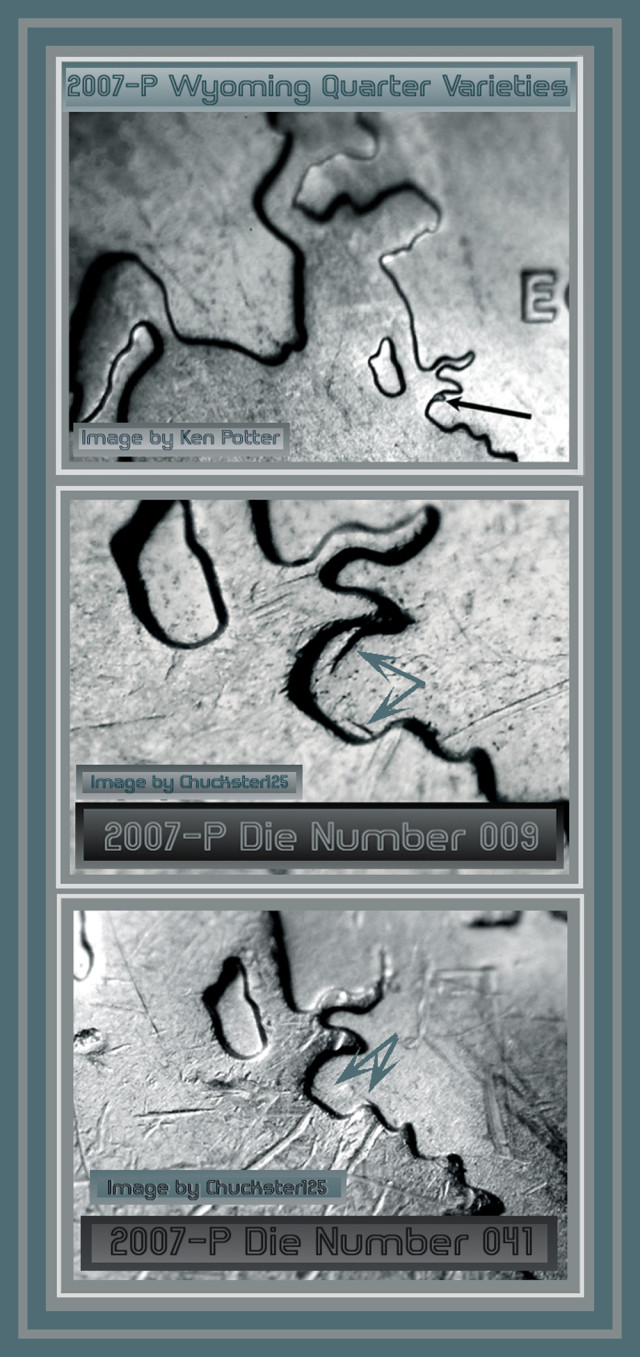 |
|
Valued Member
United States
187 Posts |
Thanks - I'm still not certain what makes one a double die and one a Machine Doubling in this case though, with the flat design and the "flaw" not involving any letters/numbers it is difficult for me to see/understand the differences. How can you tell that the tail is Machine Doubling? Is there something you see that you could point out? I've read lots of literature on double dies vs. Machine Doubling and the wonderful reference on here with pictures, but with this particular coin I can't seem to apply any of what I've seen... ... ...? |
|
Bedrock of the Community
United States
62064 Posts |
On a doubled die, the hubbing is what created the doubling on the die, thus a die variety. On Machine Doubling it is a normal die that moved during the striking that made the device damaged. |
|
Valued Member
United States
187 Posts |
Coop - I understand the mechanics of how they are produced. I have read A LOT. What I don't understand is how to tell this tail doubling is Machine Doubling vs. double die. They look the same to me on the Wyoming quarter - you say mine is Machine Doubling, but it looks like the double dies of Wyoming quarters to me - they ALL look like "shelfing" on this particular quarter. Maybe I'm not phrasing my question correctly, I just want to know what you see that I don't - my non-expert eye is not discerning a difference. If there were letters/numbers/lines affected them I think it would be easier for me to see and understand...but with this stupid flat horse, I don't know. Sorry to be naive here...but I want to learn! |
|
Bedrock of the Community
United States
62064 Posts |
On the doubled dies you see the doubling raise from the field on coins I posted. On your coin, the area is not raised, just metal pushed from the movement of the dies. The field below is normal on your coin.
|
|
Valued Member
United States
187 Posts |
Coop - when you say the are on my coin is "not raised" - are you meaning that it's just a smear on the coin? Because on mine it is definitely raised, but maybe only 75% the height of the rest of the design...Like if you start in the middle of the tail & head east, there's a step down about 25% of the total height of the overall design above the background, then the "smear" is about 75% of the height, then drops off abruptly to the background, straight down. See my confusion?
|
|
Bedrock of the Community
United States
62064 Posts |
Look at the examples of doubled dies I posted. Note the field area is raised. On your coin the devices are normal with an area pushed in a direction. If this were a doubled die, the device would be enlarged and not step like. This was created from a normal die that moved during the strike. The next coin may have totally different machine damage on it. But on a doubled die, each coin struck with that die will have the same doubled area.
Edited by coop
09/30/2011 01:39 am
|
|
Pillar of the Community
United States
7629 Posts |
|
|
Pillar of the Community
United States
584 Posts |
Welcome Matthew. Thank you for posting something I've wondered.
Coop THANK YOU! The light just went off in my head! OOOOHHHHHH!
I get it now, Well their goes about a 10 examples I had on the side. lol
|
|
Bedrock of the Community
United States
62064 Posts |
|
|
Rest in Peace
United States
7075 Posts |
Thanks to everybody for their explanations. I really feel like I understand the difference.
|
|
Page 2 of 2
|
Replies: 21 / Views: 2,393 |
Page 2 of 2
|







 First Page


 Posted 09/28/2011 7:08 pm


