|
This page may contain links that result in small commissions to keep this free site up and running.

Welcome Guest! Registering and/or logging in will remove the anchor (bottom) ads and the security checks. It's Free!
To participate in the forum you must log in or register. | Author |
 Replies: 27 / Views: 3,714 Replies: 27 / Views: 3,714 |
|
Pillar of the Community
United States
3229 Posts |
Grading Systems for Ancient Coin Grading
I have been following the "sticky" ancient coins grading thread. It has got me digging around because I find it hard to grade without basic descriptions to grade from. Turns out there are a couple of systems used. Echizento thanks for starting grading thread! I think this fits into the grades you have at the beginning of the sticky thread. At least mostly. BTW, I was going to put this in the sticky thread but thought (because of size) that this would be better as separate. I found the NGC grading system (below), but there was no description for each level of their Adjectival / Sheldon scale. Then I found a Numiswiki scale that was different and more like what I have seen and heard of from others. http://www.ngccoin.com/ancients/grading.aspx My thoughts are that the "NGC" grading is specific to NGC, and that the Numiswiki scale is what has been more the "standard" ancient coin collecting. If I am wrong, please correct me. As an exercise I have placed both the Sheldon scale (from Austin Coins) and the Nimiswiki scale side by side for a comparison (see below): http://www.austincoins.com/page/Coi...le/33/410849http://www.forumancientcoins.com/nu...ient%20Coins; (seen below Underlined) At first the two seemed very different, but as I placed the Numiswiki description alongside of the Sheldon descriptions I realized that the labels were the bigger difference. Note that the designation of "Fine" is huge! Also here is Rasiel Suarez's take on grading (Nicely done IMHO); some pics are included too� http://www.forumancientcoins.com/nu...nd%20Grading What do you think of these systems? Quote:
Mint State â€" The terms Mint State (MS) and Uncirculated (Unc.) are interchangeable and refer to coins showing no trace of wear. Such coins may vary slightly due to minor surface imperfections, as described in the following subdivisions:
Perfect Uncirculated (MS-70) â€" Perfect new condition, showing no trace of wear. The finest quality possible, with no evidence of scratches, handling, or contact with other coins. Very few circulation-issue coins are ever found in
this condition.
FDC (fleur de coin): Mint State plus all characteristics are superb - well centered, mint luster, exceptional strike, and so forth. No flaws will be described because there are none. This grade is very rarely used by FORVM
Gem Uncirculated (MS-65) â€" An above-average uncirculated coin that may be brilliant or lightly toned and that has very few contact marks on the surface or rim.
Choice Uncirculated (MS-63) â€" A coin with some distracting contact marks or blemishes in prime focal areas. Luster may be impaired.
[bUncirculated (MS-60 â€" A coin that has no trace of wear, but which may show a number of contact marks, and whose surface may be spotted or lack some luster.
MS (Mint State): As struck, often with mint luster, no evident wear, no indication of circulation, no corrosion, no scratches, and no encrustation. May have strike flaws and die wear. All but the most insignificant strike flaws should be described, especially if a photograph is not provided. This grade is rarely used for ancient coins.
Choice About Uncirculated (AU-55) â€" Evidence of friction on high points of design. Most of the mint luster remains.
About Uncirculated (AU-50) â€" Traces of light wear on many of the high points. At least half of the mint luster is still present.
aMS (about Mint State): As struck with no evident wear, no indication of circulation, no scratches, no corrosion. May have strike flaws, die wear, light patina or toning and very small bits of encrustation. Usually some mint luster. All but the most minor strike flaws should be described, especially if a photograph is not provided. This grade is rarely used for ancient coins.
Choice Extremely Fine (EF-45) â€" Light overall wear on the highest points. All design details are very sharp. Some of the mint luster may show.
EF(Extremely Fine) An exceptional coin with just traces of wear on just the highest portions of the designs. Even minor features (if struck) are visible and complete. May have strike flaws, slight encrustation, minor scratches, piercings, slight bends, cracks, and may even have very small spots of corrosion. All but very minor flaws should be described, especially if a photograph is not provided.
Extremely Fine (EF-40) â€" Light wear on the design throughout, but all features are sharp and well defined. Traces of luster may show.
aEF (about Extremely Fine) An exceptional coin with wear only on the highest portions of the designs. Even minor features (if struck) are visible and complete. May have strike flaws, slight encrustation, minor scratches, piercings, slight bends, and may even have small spots of corrosion. All but very minor flaws should be described, especially if a photograph is not provided.
Choice Very Fine (VF-30) â€" Light, even wear on the surface and highest parts of the design. All lettering and major features are sharp.
gVF (good Very Good) An attractive desirable coin with light overall wear. All major features (if struck) are visible and nearly complete. Separation between all devices is visible (such as between the ear and laurel on a portrait head) is clear (if fully struck). May have strike flaws, small encrustations, small spots of corrosion, some scratches, piercings, slight bends, or frosty or grainy surfaces. Strike flaws that obscure any major features or legends, grainy or frosty surfaces, scratches, piercings, bends, and pitting should be described, especially if a photograph is not provided.
Very Fine (VF-20) â€" Moderate wear on high points of the design. All major details are clear.
VF (Very Fine) A desirable coin with general overall wear. All major features (if struck) are visible and nearly complete. Legends (when present) are readable. May have strike flaws, piercings, slight bends, encrustations, scratches, areas of corrosion, or overall roughness or porosity. Flaws that obscure major features or legends, overall roughness or porosity, scratches, piercings, bends, and pitting should be described, especially if a photograph is not provided.
Fine (F-12) â€" Moderate to considerable even wear. The entire design is bold with an overall pleasing appearance.
aVF (about Very Fine) A collectible coin with general overall wear. All major features (if struck) are visible and but not always complete (most of the laurel wreath is present but the highest 1/4 is worn smooth, for example). Legends (when present) are visible and readable. May have strike flaws, encrustations, scratches, areas of corrosion, or overall roughness or porosity. Flaws that significantly obscure major features or legends, overall roughness or porosity, scratches, piercings, bends, and pitting should be noted, especially if a photograph is not provided.
Very Good (VG-8) â€" Well-worn with main features clear and bold, although rather flat.
gF (good Fine) A collectible coin with much overall wear. Legends (when present) are visible and somewhat readable. May have strike flaws, encrustations and areas of corrosion, or overall roughness or porosity. Pitting, overall roughness, scratches, piercings, bends, and significant flaws should be noted, especially if a photograph is not provided.
Good (G -4) â€" Heavily worn, with the design visible but faint in areas. Many details are flat.
F (Fine) A coin with much overall wear present. The overall design is complete but detail is worn or obscured by corrosion. Legends are visible but may not be fully readable. The bulk of ancient coins available today are in fine condition. Pitting, overall roughness, large scratches, piercings, bends, and major flaws should be noted, especially if a photograph is not provided.
About Good (AG-3[/b]) â€" Very heavily worn with portions of the lettering, date, and legend worn smooth. The date may be barely readable."
aF (about Fine) A coin with a great amount of wear. Legends may not be visible any longer. Main designs of the coin can be seen. Severe pitting, overall roughness, large scratches, piercings, major bends, and large cracks should be
(Poor) A coin with extensive wear making identification a challenge. Flaws may not be noted"
|
|
|
|
Moderator
 United States
23731 Posts |
Thanks TJ, I would be more inclined to use the Forum and Rasiels methods these fit more in line with ancient grading. IMO the Sheldon scale doesn't really apply to grading ancients. I wasn't able to get the NGC's link to work so I'm not sure what they use. The guide lines on the sticky thread were gleamed from several sources and being lazy like I am I only gave a general idea what to look for when grading. Your references are more in-depth and should also be used.
|
|
Bedrock of the Community
Australia
21794 Posts |
The grading comments by Rasiel Suarez in forumancientcoins.com makes the most common sense to me. That has been my approach to grading for ancient coins from the beginning.
Sheldon MS60 and above is obviously irrelevant as regards ancient coins, but is by far the best for modern coins in MS60 and above.
Yes, I have seen tray after tray of ancient gold coins in As Struck condition, but that was in the strong room of the British Museum. Sheldon grading MS60 and above applied to these coins would make no sense at all.
I have seen a numerical grading system suggested for ancient coins, so a value could be more accurately attached.
It suggested a weighting scale for every type of defect that a coin may have, and a total of defect points ascribed to the coin. It would have introduced several layers of opinion for each of the weighting scales, which made overall grading of the coin impossibly cumbersome.
I am glad the system has never been adopted by anyone.
|
|
Pillar of the Community
 United States
3229 Posts |
Echizento and Sel, I agree that the method Rasiel shows is probably the better method. I only found the Numiswiki site after I put together the above and included it because I liked it so much:)
It is interesting to me how different grading is in different parts of numismatics. I will say in defense of the Sheldon Scale that, as it is used by EAC (Early American Copper), grading early coppers is much more like grading ancients than grading Modern coins.
I am sorry the link to the NGC grading is not working. I kinda like their grading using what they call adjectival grading that they correspond to the Sheldon scale. it is to bad they don't just use the same scale as numiswiki but it is always hard to everyone on the same page. Just search "grading ancient coins ngc" and it should pop right up:) Or click here (hope the link works this time.
|
|
Pillar of the Community
United States
3229 Posts |
|
|
Pillar of the Community
United States
3229 Posts |
Here is example of one I saw at a show the other day:) 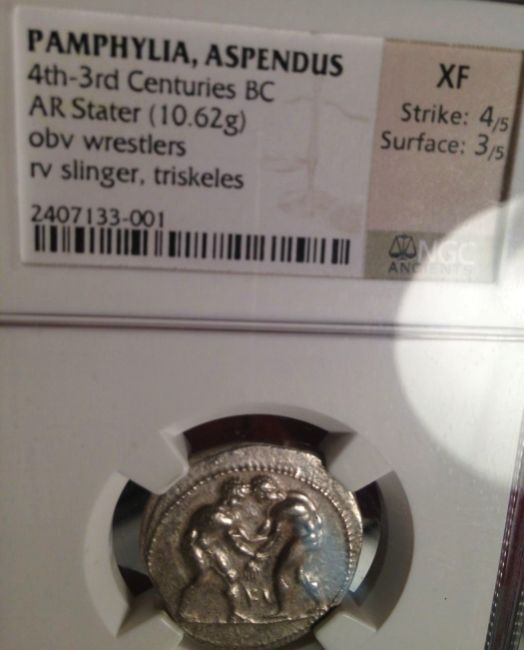 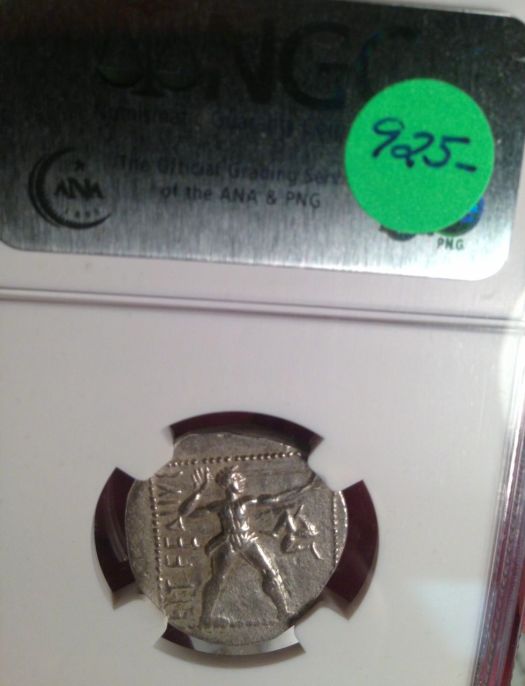 |
|
Pillar of the Community
United States
5014 Posts |
thanks for posting this info TJC.
|
|
Pillar of the Community
United States
3499 Posts |
Just like going to the museum to see your own coins behind a plate of glass. You can look don't touch.
Or like having your own collection in a vault and only being able to look at the photo's
I'd rather sell them all and go walk the plains around Hisarlik
|
|
Pillar of the Community
United States
3229 Posts |
chrsmat71, glad you like it:) FR, I was just offering the NGC slab pics to show how they grade. I know that many are not for slabs or TPG's and I agree with a lot of the reasoning. Having said that I believe TPG's offer the hobby the minimum security against forgery and counterfeit coins...and no TPG's are not infallible. If I am looking at a slabbed coin I just remember the old adage, "buy the coin, not the holder:)" And if I want to, I just bust the coin out of its prison. I wish my pics of the wrestler coin were better. It was a stunning coin! Graded well by NGC IMHO. |
|
Pillar of the Community
United Kingdom
2624 Posts |
I just don't get it as I said before.
I don't get the coin slabs or the fascination with ascribing a number to something. A photo and description is fine if you are buying or selling, or even cataloguing items, but why the need to put a number on it.
This seems a particularly American phenomenon (wasting money to have someone else slab a coin and give their opinion of it) IE spend money you could have used towards another coin to reduce the appeal of the coin you have and have someone you don't know declare the coin to be a grade when whatever he says the coin is what it is and no opinion will change it.
This also applies to certification of diamonds (we tend to send stones to New York for certification when required) but I can see more merit in this practice than for coins. It offers certain customer protection especially in the case of engagement ring purchases which are often made by a man who will only ever buy that one diamond in his life and probably doesn't have a clue what he is looking at.
I imagine its easier to take photo's if the coin isn't in a slab, and slabs provide some storage dilemma's for me. That wrestler coin is nice regardless what NGC think of it.
True, third parties do offer some protection against fakes, but then dealing with a reputable and knowledgeable dealer generally offers the protection similar protection. But I just wonder why this is all the rage in America of all places, a country that doesn't even have a mandatory hallmarking system for precious metals.
|
|
Pillar of the Community
United Kingdom
2838 Posts |
Must admit, it perplexes me too with ancients. Those from the US on here will have far more experience with grading than most as many have / still collect modern US coins where it is commonplace. Maybe my lack of experience prevents me from seeing the benefits or how it can be applied to ancients. If I had valuable ancients I would certainly consider getting them graded before selling them but only as it may attract more potential buyers. The 'old school' collectors would ignore the grade and smash the slab the second the coin arrives but many of the new US ancient collectors may appreciate the 'warm' feeling a slab and a grade gives. The customer is always right, spending £30 to help sell a £1000 coin makes good business sense. Personally I'd prefer a coin if it was sent to David Sear, I've seen too many mis-attributed coins with woefully inadequate descriptions from the TPGs. A few questions the more experienced might be able to answer are: How can a score be given for 'strike' on a worn coin when a die may have been worn, its often not possible to tell? Unlike modern coins the style of ancients can vary massively on coins from the same series, I'm assuming this would make no difference to the grade but is something that could make a £5 coin worth £50, is the ultimate purpose of grading price related, it seems so in moderns? If so how can we deal with the many subjectives in ancients? If a 'good' coin of excellent style is worth more than an 'EF' from the same series are we wasting our time? When looking at an ancient coin I'm almost unknowingly making 100s of decisions about its workmanship, desirability, style and worth. Ultimately all I do is decide if I want it and if I consider the price fair. I would never buy without a picture, no matter who graded it and no matter how long a description accompanied the sale. As far as I'm aware (correct me if I'm wrong), grading started before it was cost effective or possible to show auction lots with pictures, those days are long gone, are we trying to apply a long outdated practice that is not necessary for ancients? |
|
Pillar of the Community
Netherlands
1204 Posts |
|
|
Pillar of the Community
United States
3486 Posts |
The American fascination with plastic and numbers was the answer
to the desire for NON-collectors to invest in coins.
An idea which refuses to die.
Collectors in Europe are more apt to study coins before buying them.
So, people today who start out buying slabbed coins because they
have been convinced to do so are unable to judge the coin on its merits.
A major deficiency and a sure way to end up with costly mistakes.
|
|
Pillar of the Community
United States
3229 Posts |
I appreciate your comments!  Started this thread too learn more about grading ancients and to get your views of the systems that are used. Thanks!:) I believe that some minimum standardization can help collectors better communicate about and understand their coins. Reading how others grade coins has gives me an expanded language to describe ancient coins and allow me to see how they view ancient coins. Like reading wine reviews and tasting wine. The more you read about and taste wine, the more you appreciate fine wine:) Or in this case the more Fine coins, EF coins, Good coins, and I-like-that-coin coins you review the more you appreciate them. Not because of the grade designation, but because understanding how to accurately derive that designation gives pleasure to the collector. At least for me:D |
|
Pillar of the Community
United States
3229 Posts |
Quote:
A few questions the more experienced might be able to answer are:
How can a score be given for 'strike' on a worn coin when a die may have been worn, its often not possible to tell?
Unlike modern coins the style of ancients can vary massively on coins from the same series, I'm assuming this would make no difference to the grade but is something that could make a £5 coin worth £50, is the ultimate purpose of grading price related, it seems so in moderns? If so how can we deal with the many subjectives in ancients? If a 'good' coin of excellent style is worth more than an 'EF' from the same series are we wasting our time?
When looking at an ancient coin I'm almost unknowingly making 100s of decisions about its workmanship, desirability, style and worth. Ultimately all I do is decide if I want it and if I consider the price fair. I would never buy without a picture, no matter who graded it and no matter how long a description accompanied the sale. As far as I'm aware (correct me if I'm wrong), grading started before it was cost effective or possible to show auction lots with pictures, those days are long gone, are we trying to apply a long outdated practice that is not necessary for ancients?
Bobby, it my understanding that the people who grade the are experts (likely fellow collectors) who give their subjective grades and descriptions for money. I like to think they do their best, just like we do:) |
|
Pillar of the Community
United States
3499 Posts |
It is rare that I actually remember what I paid for a coin. Unless I was so thrilled with the purchase that it is indelibly written inside my brain ! For me it has always been my 'art' collection and a connection to something which which is beyond reach ...... the distant 'foggy' past. I agree the idea of slabbing is someones approach to 'marketing' and making collecting ancients an investment rather than the beautiful thing it should be ...... and doing it for ones own satisfaction. When the world changed in the 1990's and vast hoards of ancient coins came pouring out of eastern Europe it sent the prices of many types crashing to earth. I have one Roman Provincial for which I paid something close to $100 for. It is very nice. But when I discovered ebay around 2002 and found more than a few very reliable sellers who seemed to have access to an almost limitless supply of really 'good stuff' I was delighted ! I was paying a fraction of what I was accustomed to paying ! Beautiful Imperial AE's for $60-70 ! Heaven on earth. Of course it didn't last too long and some prices recovered. I can't find 'gem' Nero's for $75 anymore. The big money will ruin it for the little guys eventually. But perhaps what scares me even more are the new 3D printers ! If the copy is an exact duplicate down to the molecules ? Is there really any difference ? Perhaps the only coins we will be sure about are those 'slabbed' before they figure out how to do it. |
| |
Replies: 27 / Views: 3,714 |
To participate in the forum you must log in or register.
 
- US Colonial 1787 Connecticut Variety Attribution - Help Needed!
- Commems Collection Modern: 2000 Leif Ericson Millennium - The Coins
- Commems Collection Modern: 2000 Leif Ericson Millennium - The Journey / Part II
- Commems Collection Modern: 2000 Leif Ericson Millennium - The Journey / Part I
- I Found Two Of Those Pennsylvania One Denver 92 Close Date
- 1975 D Lincoln Cent 2 Lincoln's Reverse Memorial And Obverse
- 1974 San Marino 20 Lire, PCGS MS-67, San Marino, Lobster
- 1795 Liberty Cap Large Cent, PCGS AU-58+, S-76 Struck Over 1794 S-71, Jeff Garrett Discovery
- 2026 Declaration Of Independence Quarter With July 4th Privy Mark, PCGS MS-66
- 1978 Mexico - 10 Centavos W/Straight Clip
- 2019 P Nickel: WDDR-005
- 1994-P Nickel Overpolished Die?
- 2022 10c Double Clipping Error
- 1871 Victoria Sovereign, London
- Possibly Merovingian 8th Century
- Specie Payments Suspension And Gold Coin Circulation After 1861 In The Usa?
- Looking For Nic-A-Date Pro's And Con's
- 2021-P Nickel With Feeder Finger Damage.
- 2025 P Nickel With DDR.
- 2021 - P Lincoln Shield Cent With Uncentered Broadstrike, Stiff Collar, And Ffd (Coin #3 Of 3)
Disclaimer: While a tremendous amount of effort goes into ensuring the accuracy of the information contained in this site, Coin Community assumes no liability for errors. Copyright 2005 - 2026 Coin Community Family- all rights reserved worldwide. Use of any images or content on this website without prior written permission of Coin Community or the original lender is strictly prohibited.
Contact Us | Advertise Here | Privacy Policy / Terms of Use
|
| Coin Community Forum |
© 2005 - 2026 Coin Community Forums |
| It took 0.52 seconds to rattle this change. |
 |
|
| |
| |




 Posted 12/20/2013 8:52 pm


