| Author |
 Replies: 10 / Views: 2,204 Replies: 10 / Views: 2,204 |
|
|
CCF Master Historian of Commemorative Coins
 United States
12515 Posts |
In 1935, the Delaware General Assembly created the Delaware Swedish Tercentenary Commission to begin planning for the 1938 celebration of the 300th anniversary of the first permanent settlement in Delaware (by Sweden) at present-day Wilmington. In addition to its planning role, a key objective of the Commission was to secure passage in the US Congress of a bill authorizing a commemorative 50-cent piece. They succeeded in their efforts, and today collectors enjoy their 1936-dated Delaware Tercentenary half-dollars.
The Dutch established a small settlement at what is now Lewes, Delaware in 1631. It did not survive, however, due to conflicts with the local Native American inhabitants. Twenty years later in 1651, another Dutch expedition arrived and formed a settlement approximately six miles down river of the Swedish settlement; it was more successful than the previous Dutch effort and became a permanent settlement. It was originally named Fort Casimir, but was later renamed New Amstel. When the entire area came under British rule in 1664, the name of the settlement was changed to New Castle.
In 1949, to support preparations for the celebration of the 300th anniversary of the founding of the state's first permanent Dutch settlement and to "pay fitting tribute to the Dutch Founders," the Delaware General Assembly authorized the Governor to form a New Castle Tercentenary Commission. Likely recalling the success of its "New Sweden" predecessor, the New Castle Commission also petitioned Congress for a commemorative half-dollar.
Senator Joseph Frear (D-DE) introduced a bill for the Commission in January 1950. It called for the minting of up to 50,000 silver 50-cent pieces. Net proceeds from the sale of the coins were to be used "to defray the necessary and appropriate expenses incurred by it in carrying out its authorized functions." The bill was referred to the Senate Committee on Banking and Currency, but was never reported out for further consideration.
And so, the citizens of Delaware (and US commemorative coin collectors everywhere!) were forced to be content with just one tercentenary coin commemorating their early settlements. Swedes 1, Dutch 0.
Collecting history one coin or medal at a time! (c) commems. All rights reserved.
|
|
|
|
Moderator
United States
195024 Posts |
It makes me wonder about all of the possibilities for commemorating different colonial settlements. Being in South Carolina, I am a little bit perturbed that there is a Columbia Sesquicentennial commemorative, while there is nothing for the more historical (and, in my opinion, vastly superior) city of Charleston. 1920 would have been a good year, given its 1670 founding date.
|
|
Moderator
United States
15874 Posts |
I've often wondered as well commems about the logic behind selecting settlement anniversaries as the subject for USA commemorative .... The process from a 2014 perspective appears to be quite random .... and as you report is this excellent addition of your "What-If" series .... there is no obvious reason why the Dutch in New Castle were denied versus the Swedes in Wilmington who have their coin. Clearly recognize that politics of the day swayed the decision ... just not clear in your thread who/why objected. Those details would make an excellent addition to the appendix of the forthcoming Volume 1 book.  David Take a look at my other hobby ... http://www.jk-dk.art |
|
Valued Member
United States
217 Posts |
Another fantastic post! I agree, I would love to hear any thoughts about the presumably political issues that kept this one from being coined.
|
|
New Member
United States
23 Posts |
Love these posts!
Back in the day, the Numismatic Scrapbook had a column about numismatic goings-on in Washington. Naturally, a lot of the content concerned the various commemorative bills being proposed. While I don't have a complete collection, I do have a bunch of issues from the 30's. I'll have to dig them up and see if I can find any additional info on some of these.
|
|
CCF Master Historian of Commemorative Coins
 United States
12515 Posts |
@jbuck: The US commemorative program was just picking up steam in 1920, with bills for the Alabama, Maine and Pilgrim half-dollars all being introduced in Congress during the year. Unfortunately, the 250th anniversary of the founding of Charleston, SC was overlooked. Hopefully, you'll accept this 1883 US Mint commemorative medal in place of a half-dollar. The medal shown was struck to commemorate the 100th anniversary of Charles Town becoming Charleston in 1783. It is bronze and just under 58mm in diameter.  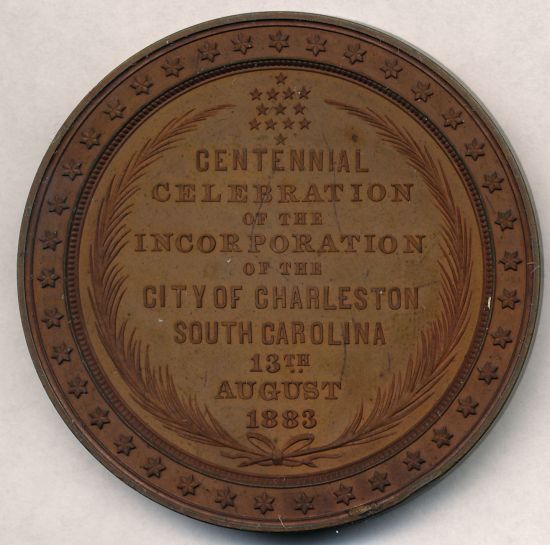 Collecting history one coin or medal at a time! (c) commems. All rights reserved.
|
|
CCF Master Historian of Commemorative Coins
United States
12515 Posts |
@nickelsearcher/Wiggam007: The failure of the New Castle coin bill was more a matter of timing than anything else. The 1936 Delaware Tercentenary coin was introduced at a time when US commemorative coins were being proposed - and approved - in large numbers. The coin approval "process" was at its easiest during the mid-1930s. By 1951, the Treasury's objection to such bills had gained some level of traction in Congress and few commemorative bills were receiving much attention beyond their referral to the appropriate Committee. In fact, the only commemorative-related bill introduced in the 81st Congress that did move forward to approval was one for a medal to commemorate the 150th anniversary of Washington, DC being established as the permanent home of the US Federal Government. I've shown a bronze example below; the medal was also struck in silver. The medal is 41.5mm in diameter. The example shown has a number of toned areas, but it was the only example I had here at the house.  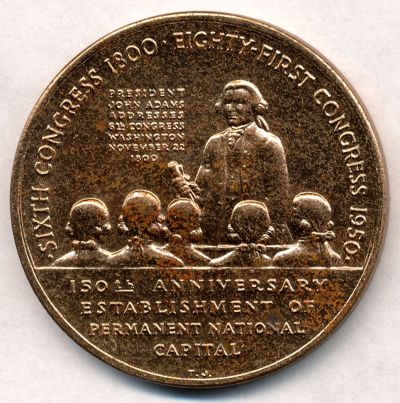 Collecting history one coin or medal at a time! (c) commems. All rights reserved.
Edited by commems
03/12/2014 7:48 pm
|
|
Pillar of the Community
United States
4409 Posts |
I wonder if the National Capital Sesquicentennial was the inspiration for the obverse of the 1989 Bicentennial of Congress?
Edit: I see that in 1950 the Postal Service issued commemorative postage stamps for the White House, The Supreme Court and the Capitol Building. They also issued one featuring the Statue of Freedom on the Capitol Dome.
-MV
Edited by MeadowviewCollector
03/12/2014 11:08 pm
|
|
Pillar of the Community
United States
5227 Posts |
The 1989 Congress definitely shows styling cues from the 1950 pictured above  |
|
CCF Master Historian of Commemorative Coins
United States
12515 Posts |
While it's possible that the 1950 medal was reviewed when the design for the 1989 silver dollar was being prepared, it's more likely just a numismatic coincidence.
The Statue of Freedom that is depicted on both pieces sits upon the dome of the US Capitol building and is an iconic symbol of the US Congress. It has been the design basis for multiple US stamps and a good number of other US Mint medals.
Collecting history one coin or medal at a time! (c) commems. All rights reserved.
|
|
Moderator
United States
195024 Posts |
Quote:
Hopefully, you'll accept this 1883 US Mint commemorative medal in place of a half-dollar. The medal shown was struck to commemorate the 100th anniversary of Charles Town becoming Charleston in 1783. It is bronze and just under 58mm in diameter. That is very nice. I really like it.  |
| |
Replies: 10 / Views: 2,204 |
|










 Posted 03/11/2014 7:52 pm


