| Author |
 Replies: 16 / Views: 3,048 Replies: 16 / Views: 3,048 |
|
Pillar of the Community
United States
1267 Posts |
As I was reading my recent issue of Archaeology magazine I noticed in the Letters to the Editor section that an individual was compelled to broach the emotionally, legally, and scientifically charged topic of recovering "ahem, BOOTY" from sunken treasure ships without archaeological documentation. What do you think about the issue and the article. Remember this is a magazine dedicated to the study of the past. Here is the article for your enjoyment. 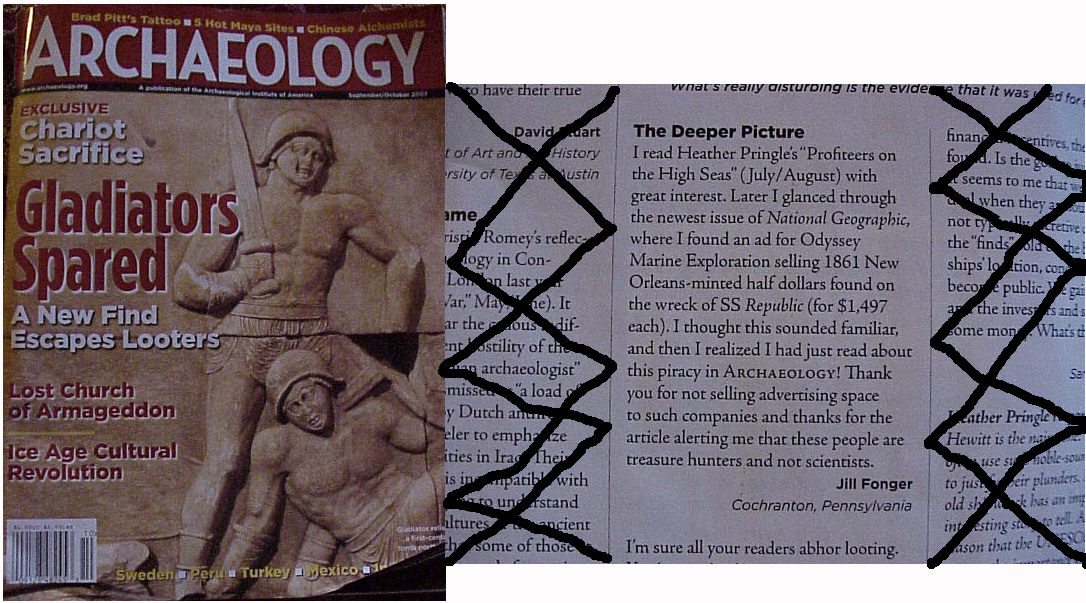 |
|
|
|
Pillar of the Community
United States
597 Posts |
I don't have so much of an issue with salvors selling these coins etc, as that they price them at ridiculous sums. Notice with the SS Central America, the SS Brother Jonathan, etc. that the coins are selectively released, at high prices to keep the market firm. Eventually when they are all saturated in the market the prices of the $20's etc. will come down.
A lot of the stuff from the Atocha is absorbed into the market so much that now the gold bars are not always going for a lot over bullion.
|
|
Pillar of the Community
United States
533 Posts |
Treasure hunting doesn't bother me per say. Of course I am assuming that the proper channels are followed to get these to market. In other words I don't think people should be able to loot illegally found items on the black market. Personally I would rather let people enjoy and appreciate the surplus finds as opposed to storing them in a box somewhere. On another note, I was amused by the subtitle at the top of the cover regarding "Brad Pitt's Tattoo."  It seems that no matter where you go, their Brad will be. |
|
Pillar of the Community
United States
1173 Posts |
I guess for me it depends on the exact nature of the booty. Some archaeological finds are one-of-a-kind, have great historical significance, and are in some ways, the property of all people, and should be in a top notch museum. At the other end of the spectrum are artifacts that are common and rally hold little value. It is a shame to lose a historical treasure, in my eyes. But the salvor deserves to profit from his/her research, efforts, and investment. It's never an easy answer, I suppose.
|
|
Pillar of the Community
United States
2254 Posts |
So, this may seem rude to some I guess, but how is this different than finding "treasure" anywhere else per say. Even when using a metal detector...Just because it's in a ship in the ocean shouldn't affect whether or not the "finder" can sell for a profit. I'm certainly not trying to minimalize or make this seem like a trivial issue, I'm just adding my opinion and trying to get an understanding for this mindset the writer had. If you find a buried bag of Trade dollars in a park, tell someone about it, and they become your property in the end, are you a bad person for selling it? By the way, forgive my ignorance, but how old do things have to be to be an "archeological" find? 1 Day, 1 Year? |
|
Moderator
 Australia
16960 Posts |
"Archaeology" and similar publications are written from an anti-collector viewpoint. A fair proportion of the archaeological community believes that "archaeology for profit" is an oxymoron, that the collecting and private ownership of ancient or historic artefacts of any kind is wrong and should be made illegal, and that collectors are either ignorant, evil or selfish for thinking otherwise. Coin collectors are included among the "enemy", because coins are considered to be just another kind of artefact, and it's primarily things like coins that the looters are looking for - small, valuable, and not easily traced. They do have some valid arguments I have sympathy for. Notably, that looting of ancient and historic sites is occurring way too much, that collector demand for such artefacts raises their price and encourages such looting, and that ebay and other Internet sites have made it much easier for the looters to get top dollar for their plunder. I, personally, would prefer to know for sure that all my ancient and mediaeval coins were from properly excavated and documented digs, rather than black market smash-and-grab looting. Unfortunately, almost all of my coins are unsatisfactorily provenaced - meaning I don't know where they came from, beyond "I bought them from a coin dealer downtown". That's enough to make me a "bad guy" as far as the anti-collector camp is concerned. I don't believe the answer to the "collector problem" lies in making collecting illegal, or in forcing collectors to jump through so many hoops that many of us would just give up. I would rather see a system where, after an official excavation is completed, coins and similar "mundane artefacts" are sold on the market, fully documented, with the money raised by the sale to go towards preserving and displaying the "prize artefacts" from the dig, as well as funding future digs and protecting historic sites from looters and vandals. Purchasers of the coins should be recorded and the general whereabouts of such coins should be knowable, in the event that a numismatically-inclined historian at some future point in time wishes to study the coins again with newly discovered techniques or technologies. Like it or not, the archaeologists and collectors need each other. The archaeologists do the hard slog, the legwork and research which enables us to know so much about the coins, and the cultures that made them. And the collectors help create enthusiasm and support for history amongst the general public; many of the anti-collector lobby admit that they themselves first caught the history bug by seeing an ancient coin or artefact in somebody's collection. Don't say "infinitely" when you mean "very"; otherwise, you'll have no word left when you want to talk about something really infinite. - C. S. Lewis
|
|
Pillar of the Community
 United States
1267 Posts |
quote:
"Archaeology" and similar publications are written from an anti-collector viewpoint. A fair proportion of the archaeological community believes that "archaeology for profit" is an oxymoron, that the collecting and private ownership of ancient or historic artefacts of any kind is wrong and should be made illegal, and that collectors are either ignorant, evil or selfish for thinking otherwise. Coin collectors are included among the "enemy", because coins are considered to be just another kind of artefact, and it's primarily things like coins that the looters are looking for - small, valuable, and not easily traced.
They do have some valid arguments I have sympathy for. Notably, that looting of ancient and historic sites is occurring way too much, that collector demand for such artefacts raises their price and encourages such looting, and that ebay and other Internet sites have made it much easier for the looters to get top dollar for their plunder.
I, personally, would prefer to know for sure that all my ancient and mediaeval coins were from properly excavated and documented digs, rather than black market smash-and-grab looting. Unfortunately, almost all of my coins are unsatisfactorily provenaced - meaning I don't know where they came from, beyond "I bought them from a coin dealer downtown". That's enough to make me a "bad guy" as far as the anti-collector camp is concerned.
I don't believe the answer to the "collector problem" lies in making collecting illegal, or in forcing collectors to jump through so many hoops that many of us would just give up. I would rather see a system where, after an official excavation is completed, coins and similar "mundane artefacts" are sold on the market, fully documented, with the money raised by the sale to go towards preserving and displaying the "prize artefacts" from the dig, as well as funding future digs and protecting historic sites from looters and vandals. Purchasers of the coins should be recorded and the general whereabouts of such coins should be knowable, in the event that a numismatically-inclined historian at some future point in time wishes to study the coins again with newly discovered techniques or technologies.
Like it or not, the archaeologists and collectors need each other. The archaeologists do the hard slog, the legwork and research which enables us to know so much about the coins, and the cultures that made them. And the collectors help create enthusiasm and support for history amongst the general public; many of the anti-collector lobby admit that they themselves first caught the history bug by seeing an ancient coin or artefact in somebody's collection.
Now that my friends is a GREAT post.  |
|
Bedrock of the Community
United States
20753 Posts |
What Sap said.
I'd like to throw in one little thing. If all such found, so called treasures, end up in a box or drawer in a basement of a museum, What good are they? Virtually mountains of such items are lost to the public for ever in such places. I'd rather have someone selling them on the open market if that is the end results.
|
|
Pillar of the Community
United States
2254 Posts |
quote:
Now that my friends is a GREAT post
I agree. I guess I was just unaware of the distinctions between the two groups per say. It would have never dawned on me that collectors would be frowned upon in that manner. Again, part of it is my ignorance in that fact that I picture Archaeologists in my mind strictly from what is seen in films and media and not from a "core" definition. Thanks again for the posts. This is a great read in my opinion. |
|
Pillar of the Community
United States
1173 Posts |
You see the same thing in dinosaur digs by ameteurs and for-profit types. I have no problem with someone making a profit, but to do so while ignoring the scientific value is nothing less than a crime. The same holds true for archaeological digs. People who are only after the $$$ destroy sites and render the collected material scientifically valueless because the location and layer of the dig are not documented, and what was found is not shared with people.
The rights of indigenous peoples need to be taken into account, as well. Digging in an Indian burial ground in ND is not a "God-given" right. Respect for those who came before us should play a role.
|
|
Valued Member
Ireland
498 Posts |
|
|
Pillar of the Community
United States
2443 Posts |
quote:
You see the same thing in dinosaur digs by ameteurs and for-profit types. I have no problem with someone making a profit, but to do so while ignoring the scientific value is nothing less than a crime. The same holds true for archaeological digs. People who are only after the $$$ destroy sites and render the collected material scientifically valueless because the location and layer of the dig are not documented, and what was found is not shared with people.
 I think that people need to respect certain sites of treasures that are found. I think that when someone finds a sight, the government and the person(s) who found it should split the cost 50/50 on the expense of the recovery and on the profits of selling them. If not, when something is found a qualified individual should be present to catalog everything and to make sure everything is being persevered and no damage is being done. Once that is done, every item should be taxed and certain percentage of the recovered items should be donated to a museum. |
|
Bedrock of the Community
United States
17884 Posts |
Supposedly the Odyssey folks DO have archaeologists as part of their recovery efforts and they do map out the site and record the location of all of the artifacts before they are removed from the site. The artifacts are photographed and well documented. So they supposedly DO follow proper archaeological practices ad then sell MOST of the artifacts, WITH providence, but apparently they also use some of the material for museum type exhibits. I think a lot of the grumbling in the archeology community is because they aren't as well funded and they can't get a share of the proceeds. (I have to admit I am seriously disturbed by what they seem to have done off the Spanish coast this year though. There was not enough time passed for them to have done proper site work on that shipwreck.)
As far as land based "treasure hunting" I think a lot of the problems would be eliminated if more countries adopted British "Treasure Trove" type legislation.
|
|
Pillar of the Community
United States
1267 Posts |
To put some of these comments in perspective please read my last post in the link. https://goccf.com/t/17770The fenced in Indian Mound area is about 8 feet tall and 1/2 of an acre square with a chained gate. it's still on private land but has been declared a Texas Memorial Location. I think the indians who built it were of the Mississippian culture. http://en.wikipedia.org/wiki/Mississippian_cultureTake Care Ben Edited by Bonedigger
09/26/2007 3:52 pm
|
|
Pillar of the Community
United States
3355 Posts |
It strikes me that all this "booty" is just corroded bullion coins. Yes, cobs are fascinating and every one is uniquely and badly struck. Yes, Pirates of the Caribbean is a great franchise to sell tourists piratey coins. But does any of this have any numismatic value beyond type coin collecting? If someone discovers a hidden cache of circulated, corroded 1922 Peace dollars my local coin dealer puts them in a coffee can and sells them for $12. Most look better than a Mel Fisher Grade 1 Atrocha coin. Maybe the dealer needs to raise the prices on his Peace dollars. "Two minutes ago I would have sold my chances for a tired dime." Fred Astaire
|
|
Pillar of the Community
United States
1267 Posts |
|
| |
Replies: 16 / Views: 3,048 |








 Posted 09/24/2007 8:39 pm


