











 Posted 01/15/2019 6:39 pm


CanQob Hello and 
I know that the Portrait 8 Reales series can be difficult to understand. I would be the first to agree with this statement since I have spent decades and do not understand all the aspects of the series completely.
That said, I have formed a preliminary opinion about your coin.
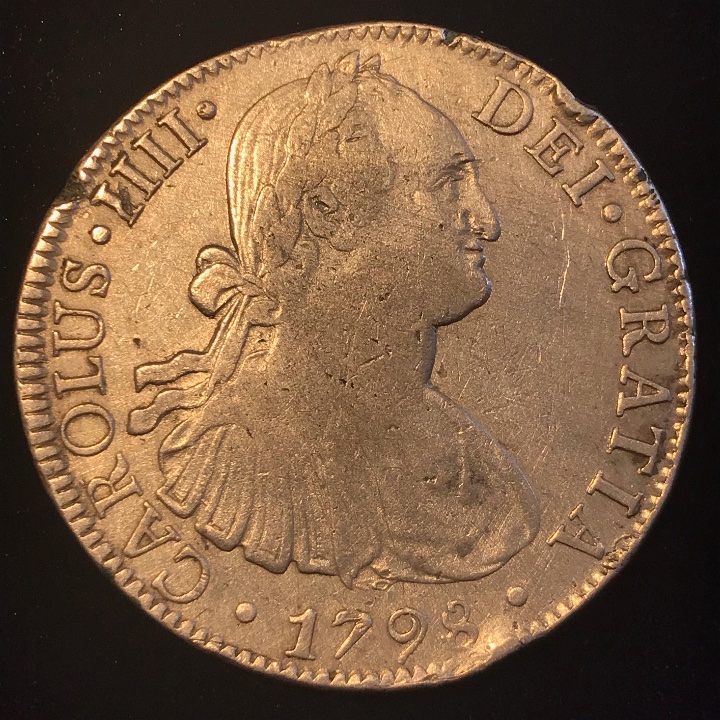
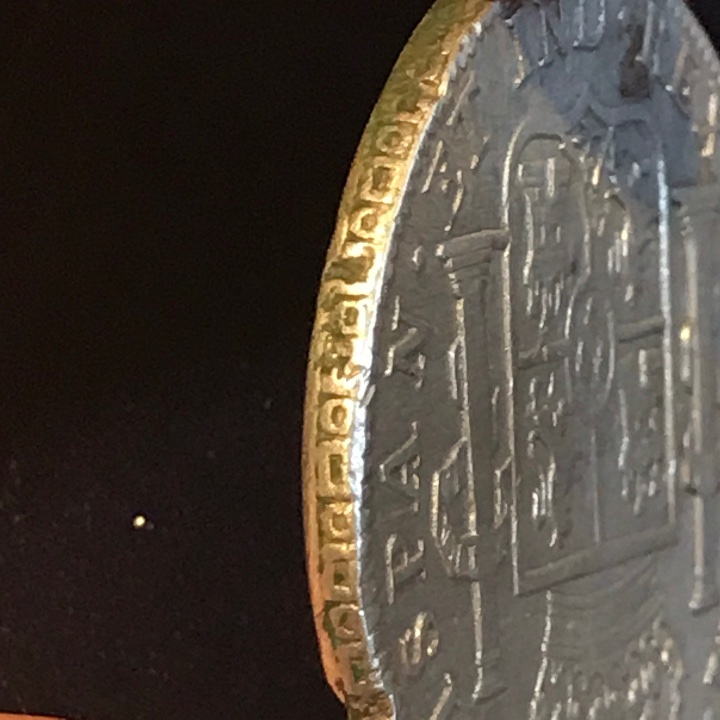
I believe your coin is a Class # 2 Contemporary Silver Counterfeit struck as a trade coin and meant for China. The weight is correct as is the size. My primary reason for saying this is a counterfeit is because of what I see on the edge. The edge has rather typical square sided circles seen on most edges that have been confirmed as counterfeit. The edge also has a wide border and not all the segments appear to be identical in size. I would like to see more of the edge (with enough of one face visible to position all of the edge photos in relation to that one face.)
In this case the King's mouth is also a clue - it is a straight line and expressionless. I can not rule out a die correction done after the die went into service, so the smile alone is not absolutely definitive.
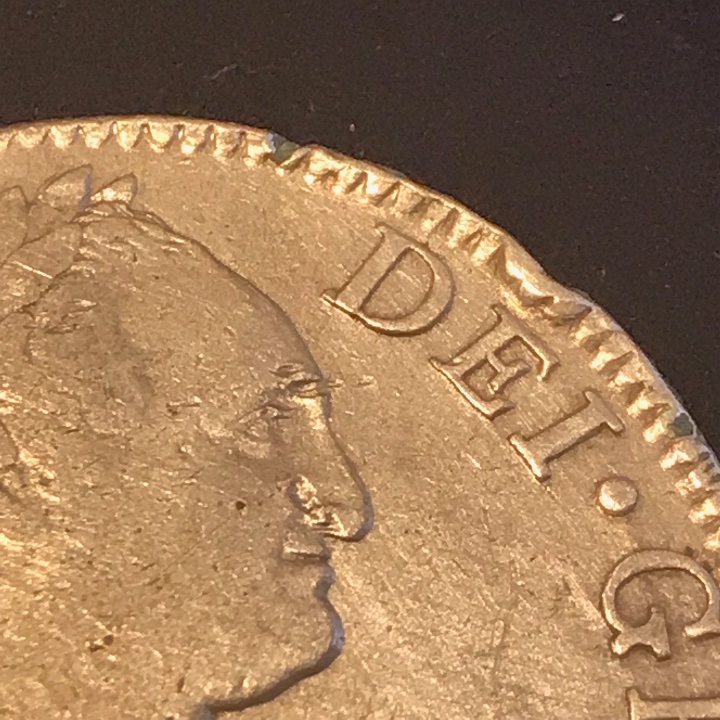
The edge on the obverse between 1 and 2 which you pointed out, looks like metal was pressed (rolled) from the edge to the front. It is similar to but not a precise match for what I refer to as an arc at which the dentils terminate. That terminal arc clue is actually for a more recently made forgeries (usually transfer die impressions) and not for a typical Class #2 silver counterfeit.
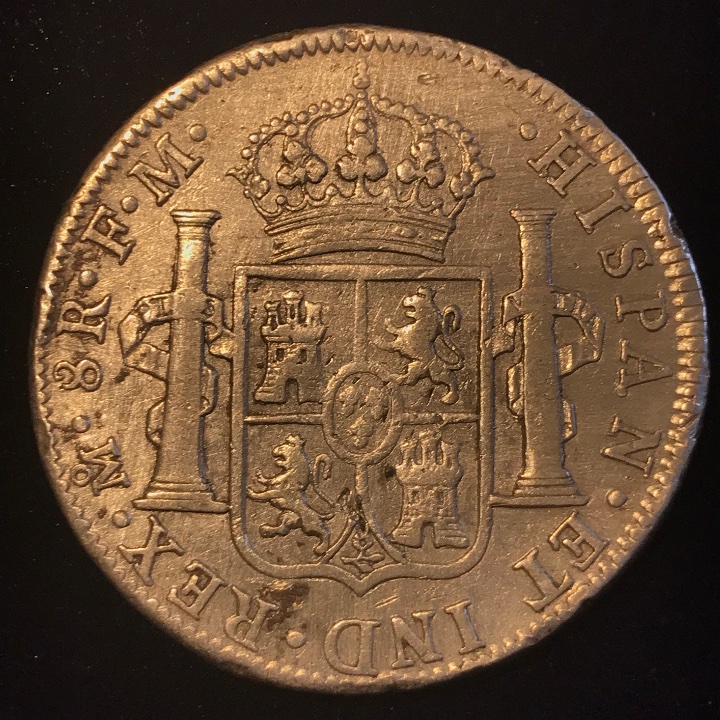
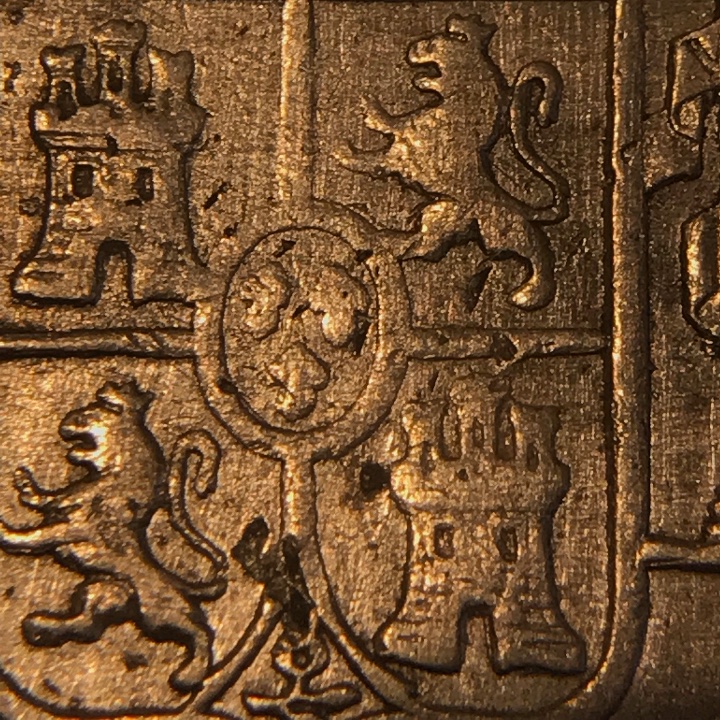
I see other more minor clues in the shapes of the castles, lions and some letters that are often seen on silver counterfeits. In addition there are a few raised dots that are positioned suspiciously. These too are not definitive but taken together make me suspicious of the origin.
The silver counterfeits made for China come in two primary types - the First is the UK emission made from approximately 1820 to 1850. These are well made from punched dies. In most cases the punches were created from genuine coins but the replication of the detail was not always perfect. These were made of older pre-1850 silver (so gold may or may not be present depending on the origin of the silver). The best clue will come from the alloy used in the UK. From period documentation date 1835 it should test 850 fine silver. To test a coin like this with XRF for variation in the silver alloy of only 5% you would need to use a lab testing machine that can do a spot test under 1mm in diameter. The test should be done within the rim test cut and AFTER you file the test cut to show bright metal. The lab XRF may create a tiny 0.5 mm hole so that is why I suggest using the damaged area. This would not damage the coin any more than it has already been damaged by the test cut itself. The test apparatus used must be capable of accurate detection to 10 PPM or better. That is a rigid standard and I know of only a few labs with this capability who will test for a private party. The test typically will cost over $100 and as much as $500. That of course is prohibitively costly. The only alternative would be a laboratory equipped to do a very accurate Specific Gravity test. A test scientifically accurate to three decimal points is the minimum needed. The scale needed would have to be absolutely accurate to 0.0001 gram.
The second emission of silver counterfeits were produced in the US from roughly 1870 to 1930. These were made in multiple locations and the results vary in design accuracy. However, a large portion of this emission can be identified by the lack of gold. A typical reading runs from 0 to 12 ppm. These are usually the type with the bad edging. These are usually 900 fine silver so SG will not be able to distinguish any of them. So it is the coins made from about 1880 to 1930 that can be spotted by a more simple XRF test that looks for the gold trace. This because in the US the counterfeiters used 900 fine silver (coin silver) from the western US (Comstock Lode). After 1880 the purity of the silver made for the commercial markets was 99.99 or 99.999 fine. The newer refining processes introduced in 1879 removed nearly all of the gold from the silver.
So if you can find someone with a handheld XRF tester you can eliminate the newest type (the no or low gold types) by checking how much gold is found. XRF returns a signal from gold that comes from deeper into the coin than does either silver or copper. So a surface reading on a relatively clean part of the coin tests well for gold but will NOT BE ACCURATE FOR EITHER SILVER OR COPPER because of surface toning which distorts the silver dopper ratio. The denser the metal the better the XRF return signal, but at the surface silver enrichment is a normal problem due to acid baths used in the production process. Even the junk yard type testers should return a signal above 0.04% gold and often read 0.1% gold (rounded 0.06%) for coins made in the 1780 - 1820 period in Mexico City.
At present I am of the opinion that nearly one half of all Portrait 8R's existing today may in fact be the Class 2 type. That means that most are unidentified and the prices of common date worn 8Rs are the same for genuine and Class 2 types. Until there is a concern by collectors that the two types must be divided the prices will stay as they are and Class 2 coins will be accepted as genuine.
I know that the Portrait 8 Reales series can be difficult to understand. I would be the first to agree with this statement since I have spent decades and do not understand all the aspects of the series completely.
That said, I have formed a preliminary opinion about your coin.
I believe your coin is a Class # 2 Contemporary Silver Counterfeit struck as a trade coin and meant for China. The weight is correct as is the size. My primary reason for saying this is a counterfeit is because of what I see on the edge. The edge has rather typical square sided circles seen on most edges that have been confirmed as counterfeit. The edge also has a wide border and not all the segments appear to be identical in size. I would like to see more of the edge (with enough of one face visible to position all of the edge photos in relation to that one face.)
In this case the King's mouth is also a clue - it is a straight line and expressionless. I can not rule out a die correction done after the die went into service, so the smile alone is not absolutely definitive.
The edge on the obverse between 1 and 2 which you pointed out, looks like metal was pressed (rolled) from the edge to the front. It is similar to but not a precise match for what I refer to as an arc at which the dentils terminate. That terminal arc clue is actually for a more recently made forgeries (usually transfer die impressions) and not for a typical Class #2 silver counterfeit.
I see other more minor clues in the shapes of the castles, lions and some letters that are often seen on silver counterfeits. In addition there are a few raised dots that are positioned suspiciously. These too are not definitive but taken together make me suspicious of the origin.
The silver counterfeits made for China come in two primary types - the First is the UK emission made from approximately 1820 to 1850. These are well made from punched dies. In most cases the punches were created from genuine coins but the replication of the detail was not always perfect. These were made of older pre-1850 silver (so gold may or may not be present depending on the origin of the silver). The best clue will come from the alloy used in the UK. From period documentation date 1835 it should test 850 fine silver. To test a coin like this with XRF for variation in the silver alloy of only 5% you would need to use a lab testing machine that can do a spot test under 1mm in diameter. The test should be done within the rim test cut and AFTER you file the test cut to show bright metal. The lab XRF may create a tiny 0.5 mm hole so that is why I suggest using the damaged area. This would not damage the coin any more than it has already been damaged by the test cut itself. The test apparatus used must be capable of accurate detection to 10 PPM or better. That is a rigid standard and I know of only a few labs with this capability who will test for a private party. The test typically will cost over $100 and as much as $500. That of course is prohibitively costly. The only alternative would be a laboratory equipped to do a very accurate Specific Gravity test. A test scientifically accurate to three decimal points is the minimum needed. The scale needed would have to be absolutely accurate to 0.0001 gram.
The second emission of silver counterfeits were produced in the US from roughly 1870 to 1930. These were made in multiple locations and the results vary in design accuracy. However, a large portion of this emission can be identified by the lack of gold. A typical reading runs from 0 to 12 ppm. These are usually the type with the bad edging. These are usually 900 fine silver so SG will not be able to distinguish any of them. So it is the coins made from about 1880 to 1930 that can be spotted by a more simple XRF test that looks for the gold trace. This because in the US the counterfeiters used 900 fine silver (coin silver) from the western US (Comstock Lode). After 1880 the purity of the silver made for the commercial markets was 99.99 or 99.999 fine. The newer refining processes introduced in 1879 removed nearly all of the gold from the silver.
So if you can find someone with a handheld XRF tester you can eliminate the newest type (the no or low gold types) by checking how much gold is found. XRF returns a signal from gold that comes from deeper into the coin than does either silver or copper. So a surface reading on a relatively clean part of the coin tests well for gold but will NOT BE ACCURATE FOR EITHER SILVER OR COPPER because of surface toning which distorts the silver dopper ratio. The denser the metal the better the XRF return signal, but at the surface silver enrichment is a normal problem due to acid baths used in the production process. Even the junk yard type testers should return a signal above 0.04% gold and often read 0.1% gold (rounded 0.06%) for coins made in the 1780 - 1820 period in Mexico City.
At present I am of the opinion that nearly one half of all Portrait 8R's existing today may in fact be the Class 2 type. That means that most are unidentified and the prices of common date worn 8Rs are the same for genuine and Class 2 types. Until there is a concern by collectors that the two types must be divided the prices will stay as they are and Class 2 coins will be accepted as genuine.


