|
This page may contain links that result in small commissions to keep this free site up and running.

Welcome Guest! Registering and/or logging in will remove the anchor (bottom) ads. It's Free!
To participate in the forum you must log in or register. | Author |
 Replies: 105 / Views: 11,055 Replies: 105 / Views: 11,055 |
|
Pillar of the Community
4628 Posts |
My new collection now my Predecimals are largely complete is Tradesmen's tokens of New Zealand 1857 - 1882 and later special purpose tokens to the 1960s. These were issued at a time when Imperial coinage was in short supply. Up to 1858 coins from all over the world were legal and allowed to be used in New Zealand which had only been a functioning colony since 1840 and had a parliament since 1854. However in 1858, only coinage of the United Kingdom, the colonial overlord was made legal for usage in New Zealand (This did not stop other currency though). As NZ had no mints and they were only minting gold in neighbouring Australia, all coins had to be imported from England and these shipments were few and far between. There was a constant shortage of silver and copper coins. Many merchants had to give change in bitsy promissory notes, kind, matches, food and the like. In 1857 several merchants decided to start issuing tokens for amounts of One penny or a halfpenny. Already similar tokens from Australian merchants and the Professor Holloway Pennies were being used here too. Never officially legal these tokens did fill a gap and were issued on and off by up to 80 merchants between 1857 and 1882. These coins as you will see showed some interesting and naive scenes of New Zealand and also the Maori people and culture, often imaginative given the wars and poor relations between Maori and Pakeha at this time. Mostly tokens advertised the individual merchant, what they did or sold and where they were located. Better and later coins often showed images of the merchant, something they sold or some made up scene of Maori culture, scenery or NZ wildlife. Sometimes a date was included, sometimes not. It was a matter of whether these tokens were accepted outside of the merchant's venues or not - but given the wear of most of these things - it is likely many went well beyond their merchant's issuing point. After 1876 with the abolition of Provinces and a unified colony, with steam ships rather than sailing ships serving the colony, token usage dropped and imperial coins became more common. The last tokens were issued in 1882 and they were demonitised in 1897.   Alliance Tea Company c1870s -1882, naive art work of Kiwi and Maori with elaborate roman legionary style shield, a charming piece. Alliance Tea Company c1870s -1882, naive art work of Kiwi and Maori with elaborate roman legionary style shield, a charming piece. |
|
|
|
Pillar of the Community
 4628 Posts |
Some background on these things.
I will go into more detail on individual tokens and makers at a later date when I know more about them.New Zealand in 18571857 is the date on the earliest tokens and in that year NZ really was a frontier, it had a Governor and the European Population was around 75,000 people with about 60,000 Maori mostly living apart. Some Maori were actively involved in the cash economy running market gardens and flour mills - most were not and only encountered Pakeha(Whites) for trading for commodities like Tobacco, alcohol, blankets and muskets. In 1860 the Maori Land wars began and they ended in a stalemate 12 years later, although the Pakeha stole the land and Maori remained marginalised until the 1950s when they mostly gave up country life. There was no infrastructure in NZ in 1857, about 10 settlements of Pakeha and the largest was Auckland and Wellington with around 5 - 8k each, mainly wooden buildings, dirt roads and no sanitation. The rest were villages of a few hundred people or isolated towns like Christchurch (3k) and Dunedin (2k). Due to bush and hostile Maori, you got around the country by boat and there was no railways or roads more than a few miles out of the towns. It took 3 months to come out by boat if you were lucky and got a good voyage, 2 way letters to home took a year between replies! Although stamps had been introduced. It was in this era the first tokens were issued. My oldest is an 1858 coin from Dunedin. 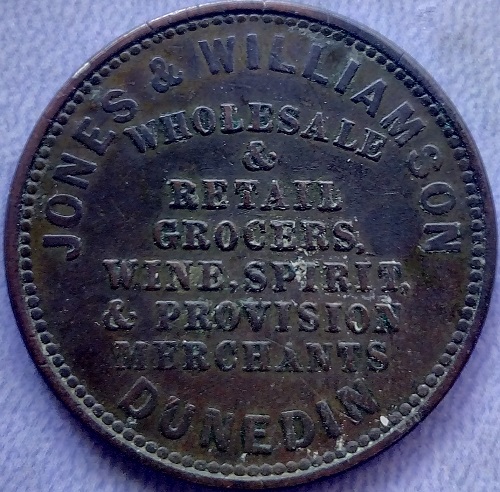 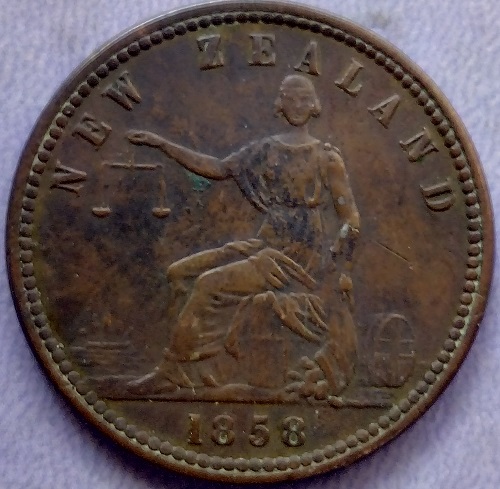 Jones and Williamson Dunedin, Penny token 1858 - Zealandia with a bale of wool and scales. Jones and Williamson Dunedin, Penny token 1858 - Zealandia with a bale of wool and scales.These guys mostly likely brought their cargo off clippers from London, the USA and more closely Sydney Australia, which had a population of around 100k in 1858. Like all penny tokens of the era, this is copper and weighs 18 grams. The change to Bronze in 1860 saw a change to smaller and lighter tokens, yet many were large and coppery into the mid 1860s. In 1861 Gold was discovered near Dunedin and a gold rush attracted paid up miners from Victoria and elsewhere. The population of Dunedin increased from 3k in 1860 to 25k by 1866. All of a sudden the rest of the country grew with gold, land wars freeing up land, mixed farmers from the UK and in Canterbury wealth from wool and meat. Between 1857 and 1870, the population of New Zealand grew from 75k to nearly 300k. Auckland, Christchurch and Dunedin changed from towns of a few thousand, to cities approaching 30k people each.
Edited by Princetane
08/11/2021 06:51 am
|
|
Pillar of the Community
Australia
9555 Posts |
Tokens don't interest me that much, but I like that first one.
Thanks for sharing.
Steve :)
|
|
Pillar of the Community
 Sweden
2124 Posts |
 Completely unknown territory to me, but that first one is really outstanding! |
|
Bedrock of the Community
United Kingdom
18069 Posts |
Fascinating! I also like the Alliance Tea token. Very interesting for me as one of my ancestors moved to NZ from Oxford, England in the mid-19th century. |
|
Pillar of the Community
4628 Posts |
Don't worry Steve, you will be addiqted when I am finished with this.
NumisRob - hang on because the designs are about to get crazier.
Erafjel - they are new territory for me too, expensive in any condition above VG - these are all EF down to Fine at worst.
I have wanted a collection of Tokens for years but until now never really bothered with them, as I neede to wait until I had enough money to buy these and undivided attention to buy them. Plus they don't come on the market often and there is a huge group collecting them here in NZ. I missed out on more than I won!
|
|
Pillar of the Community
United States
1062 Posts |
While I have a couple of dozen of the mid-1800's New Zealand tokens to drop into this forum from time to time, my contribution today is slightly more modern: a Wanganui Cosmopolitan Club threepence token from 1905. The Cosmopolitan Club, one of many branches scattered around the world, is still in existence in what is now known as Whanganui on New Zealand's North Island. Back in 1905, when it was less than 20 years old, it was a civic/social organization that seems to have focused on formal banquets, cricket matches and sailing regattas, but now in the 21st century they've teamed up with other groups and appear to serve primarily as a social club and service resource for military veterans. 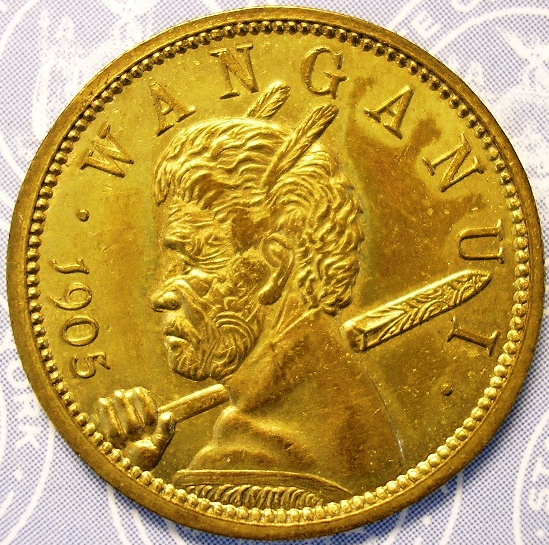 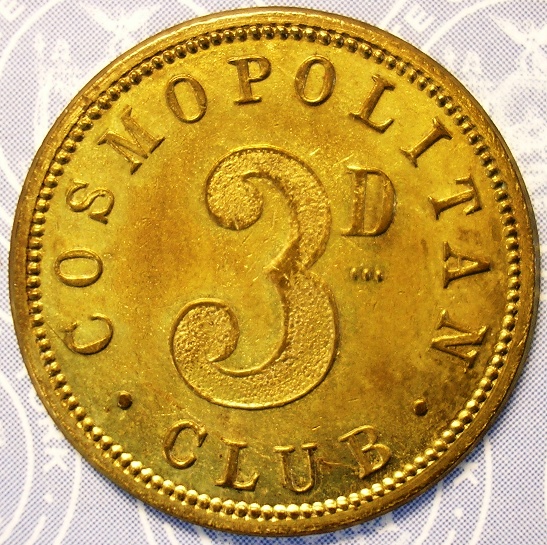 The original Cosmopolitan Club as it appears today in downtown Whanganui, now a town of about 42,000 people. The original Cosmopolitan Club as it appears today in downtown Whanganui, now a town of about 42,000 people.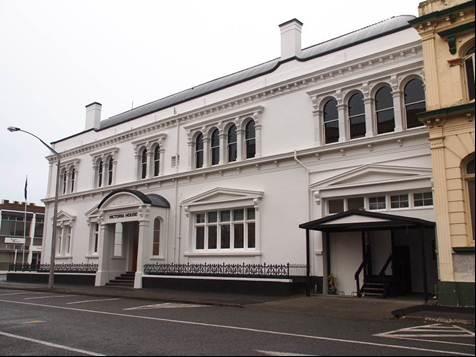
"If everything seems to be under control, you're just not going fast enough."
--- Mario Andretti
|
|
Moderator
 United States
191235 Posts |
Nice examples! |
|
Pillar of the Community
4628 Posts |
Daltonista - yes totally, those Cosmo club tokens are very collectible and come into the 2nd type of these tokens, which were either tokens offering a free sample of something or a the price of a drink, bar of soap, bread etc. These are all after 1897 as it was illegal to use them as money outside the venue on them.
There is also a 6d token of this type too. Also in NZ we consider Whanganui a city with a population of around 55k.
The third type which I also have some examples of is company scrip tokens. These are big in America and Europe too, but here was mostly Farmer's co op tokens paid to labourers and share milkers in the 1920 - 1950 period. The tokens were base metal and went up to 40/- (£2) in some cases. They were used for purchases at company stores.
|
|
Pillar of the Community
United States
1062 Posts |
Princetane wrote: Quote:
There is also a 6d token of this type too. And if memory serves, I believe I've seen 4d and shillings too...back before the dawn of time.
"If everything seems to be under control, you're just not going fast enough."
--- Mario Andretti
|
|
Pillar of the Community
United States
1062 Posts |
And now, for our FOURTH Maori portrait of the day, we have my fairly beat-up undated penny issued by Edward Waters, an Auckland confectioner (Wholesale and Retail). If this were in better condition we'd see more ornamentation and tatooing on the head. Renniks 582; Andrews 610; KM Tn70.2 (33mm, issued late 1850's - early 1860's)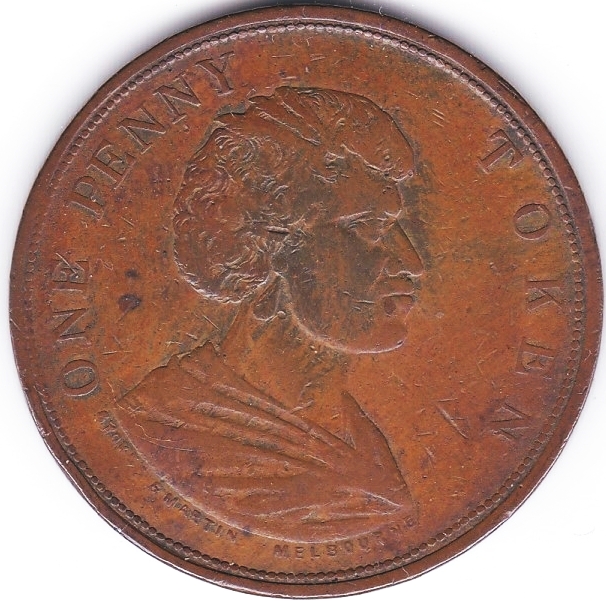 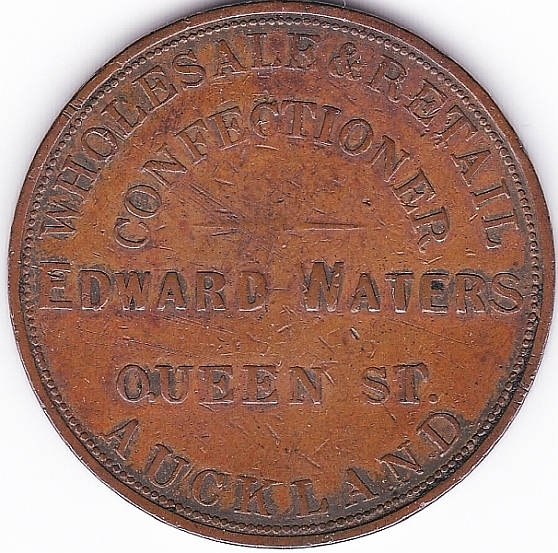
"If everything seems to be under control, you're just not going fast enough."
--- Mario Andretti
|
|
Pillar of the Community
4628 Posts |
One of my best books I use is by an American called Terence Roker, who has images of all the tokens and varieties. My Bertrand catalogues also include good listings and inlcude the later stuff like Cosmopolitan clubs, Farmers Co - ops and the like Daltonista, your Waters token is from 1873 according to the Bertrand catalogue. MintsNone of these tokens was minted in New Zealand, all were ordered from overseas. The 3 main mints were. 1. Stokes and Co, Melbourne (Mostly early tokens to mid 1860s) 2. WJ Taylor in London - minted many Australian and New Zealand tokens 3. Heaton and Sons, as we know they also minted copper and bronze coins at various times for Britain and many South American nations. Also all of the Tradesmen's tokens of this era were minted in Copper or Bronze, no silver, gold or other metals were used in tokens. Gold and Silver were used for medals and medallets for the 1865 onwards exhibitions and various prize medals. These are another field of study. More tokens from me. The Advance NZ token was apparently by Alliance Tea Company, but is bizarre in that it shows only Maori and natural scenes, however back in 1866 a Bronze token using multiple fonts was issued by them. 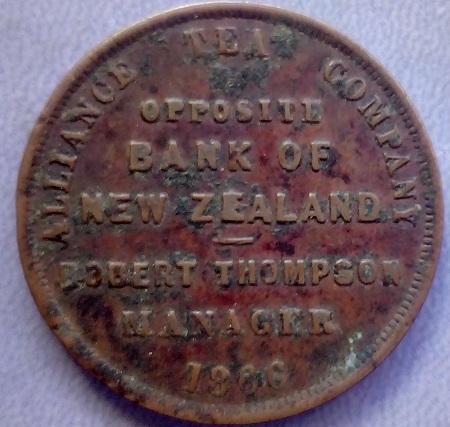 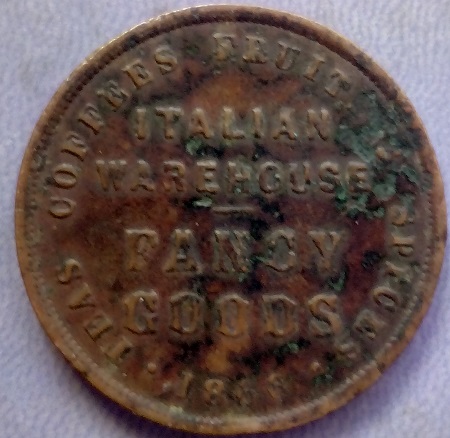 1866 Alliance Tea Company (Milner and Thompson) Penny token - Copper 1866 Alliance Tea Company (Milner and Thompson) Penny token - CopperThis is a Christchurch token and uses many fonts, it promotes and Italian Warehouse (Whatever that was as spaghetti did not catch on until the 1950s and Italians never came here in any numbers), they sold spices, coffee and of course tea. Fancy goods meant stuff like Crockery sets, pottery, vases, knives and forks and any thing that would make colonial life nicer. The token is Milner and Thompson. In 1866 Christchurch was only 15 years old and had about 8,000 people. 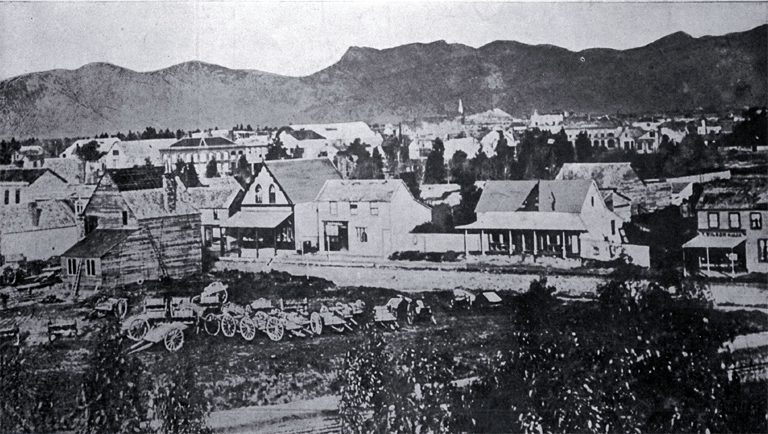 Downtown Christchurch at the time of my token. Photo by AC Barker 1864 to 1866. Downtown Christchurch at the time of my token. Photo by AC Barker 1864 to 1866. |
|
Pillar of the Community
4628 Posts |
My initial starting stake is 6 tokens and 5 Scrip pieces of the early- mid 1900s. I have already got a 7th token! This will be an ongoing project and I will be revisiting tokens already shown as I find out more about them. 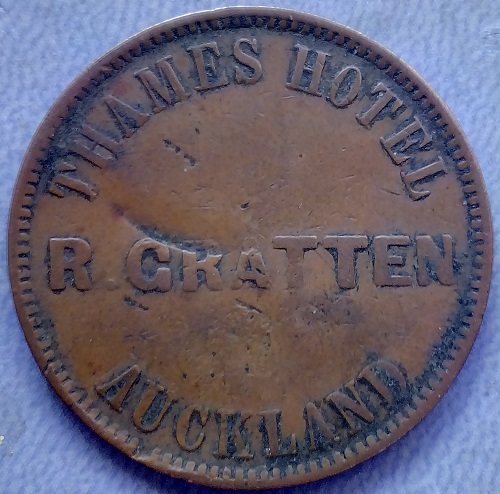 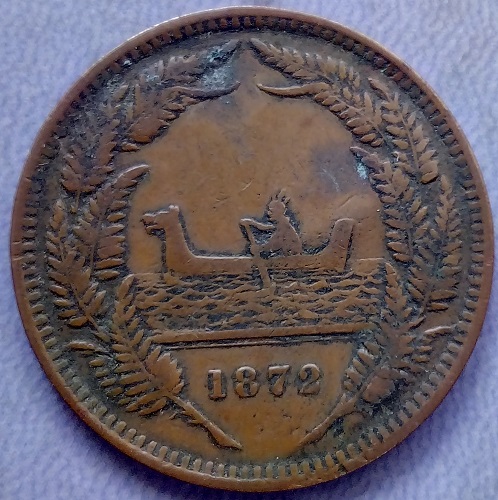 Grattan - Thames Hotel Token, 1872 - One Penny Bronze, dented but essentially Fine condition. Grattan - Thames Hotel Token, 1872 - One Penny Bronze, dented but essentially Fine condition.This is a standard token which has lettering one side and a weird image on the other. It shows a Maori rowing a dog headed canoe. Never in the history of all things Maori has there been a waka (Canoe) with a dogs head on it or carved into it - was it some misguided idea that Maori's were Vikings of the sunrise. Closed up ferns also add romance to it. The Thames Hotel was anything but Romantic. It sat in downtown Auckland difrectly across from the wharfs that brought in miners from the Goldfields of the Thames region (Coromandel). There was a HUGE goldrush there between 1867 and 1875 and really people hit paydirt there through to the Depression. 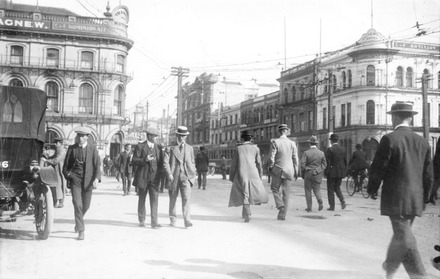 The Thames Hotel, Auckland 1868 - 1925 - Photo Source Auckland Museum. Photo around 1915 possibly by Sidney Smith or Zacharias. It is the 3 story building at left. The Thames Hotel, Auckland 1868 - 1925 - Photo Source Auckland Museum. Photo around 1915 possibly by Sidney Smith or Zacharias. It is the 3 story building at left.Grattan ran the hotel which was notorious for fights and people getting bottled (Hence the munted looking token). Gold miners and wharfies used it a lot and it featured in many police pages. The building was demolished in 1925 to make way for the 10 story Dilworth building still there now. The building shown though may not have been the one there in the 1870s and probably dated from the 1880s or later. Edited by Princetane
08/12/2021 12:37 am
|
|
Pillar of the Community
4628 Posts |
My next token is by George McCaul who was a metalsmith and plumber in Grahamstown, now known as Thames.   Copper Token, 1874 George McCaul, working goldmine and elaborate gothic script, date and location with services. Copper Token, 1874 George McCaul, working goldmine and elaborate gothic script, date and location with services.
Condition is VF - quite high for this type.According to Roker, McCaul was born in Perthshire Scotland in 1835 and tried his luck on the Otago and Westland goldfields having little luck, but decamping to Grahamstown (Thames) in 1868 and succeeding as a blacksmith, a tinsmith and plumber. He made pipes and fittings for the exceedingly complex mining operations in the Coromandel fields. In 1874 it was renamed Thames. Unlike the alluvial gold mostly wrestled from the rivers and banks of Otago and Westland, the Coromandel seams were mostly veins in mountains and required deep tunnel mining and dredging. Gold paid well, but any dreamers soon were repulsed. 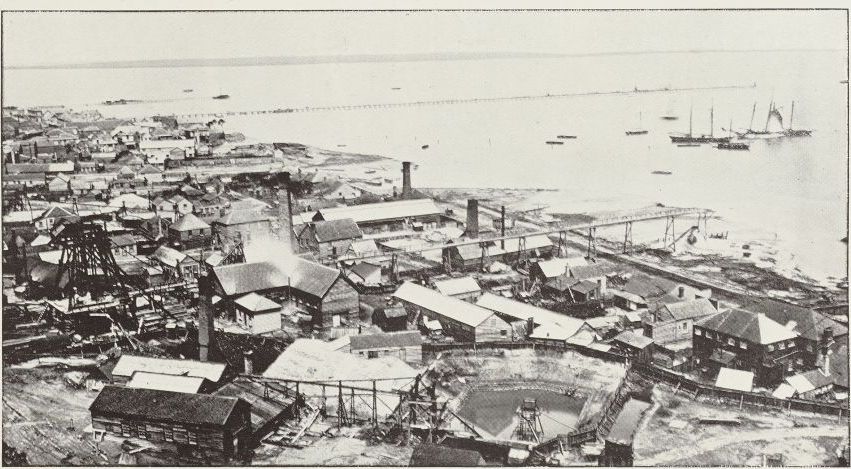 Grahamstown showing mines and the residential area, early 1870s - notice the similar wells and dredges to that on the coin! Source - http://www.firstyearthamesgoldfield.co.nz/2019/08/ Grahamstown showing mines and the residential area, early 1870s - notice the similar wells and dredges to that on the coin! Source - http://www.firstyearthamesgoldfield.co.nz/2019/08/Some excellent tales of these early miners here! The town was established in 1866 with the first real strikes and swelled to 25k people by 1870, the gold dried up around 1875 and it dropped to 10k by 1900 - today Thames is a farming and tourism service centre, although you can visit an old gold mine, the school of mines and immerse yourself in the heritage! It has a population of about 7,000 people. 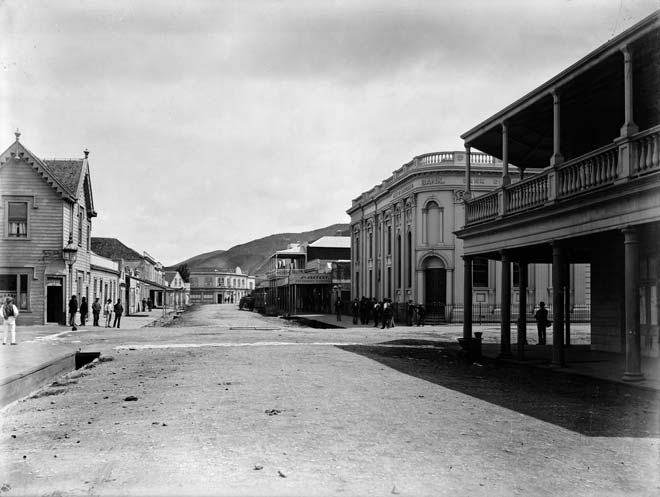 Thames (1880) - Could be the Wild West sans the muddy hills and lack of gunslingers. The roads were not sealed until the 1920s with the arrival of "ottymobiles"! Thames (1880) - Could be the Wild West sans the muddy hills and lack of gunslingers. The roads were not sealed until the 1920s with the arrival of "ottymobiles"!The token itself is quite old in the sense its a large copper token and by 1874 they had been using Bronze for years, this suggests it was minted by some unknown British 3rd party mint. The lettering makes it look nice too and the naive art on the coin is also interesting. The Thames gold rush of 1866 - 1874 was the last of the 3 major rushes in New Zealand and things went quiet on the Global gold front until the Klondike in 1897! Gold however continued to be produced in the Coromandel. A dredge and pump mine in Waihi produced gold right through to the 1960s and there was another rush in the 1890s and 1900s. By this stage the recovery was more mechanical with stampers, batteries and dredgers rather than men with pans. There was also a further goldrush in the 1930s depression and today we have a couple of commercial mines still operating. Edited by Princetane
08/12/2021 11:43 pm
|
|
Pillar of the Community
4628 Posts |
Token ConditionsOne thing you may have noticed about the tokens so far is the condition. Many of the coins were issued in copper rather than bronze and they are heavily worn, add to that corrosion, pitting and verdigris. Bear in mind these are low value, base metal coins that are now some 150 years old on average! It is not your standard blingy gold or silver coin - this is realmoney for real people! In reality most of my tokens are above average examples and have collectible qualities. Many of these tokens were used extensively and most of them are in VG or Good condition. The Bertrand catalogue grades them in VG, Fine and Very Fine, often a VG coin costs 50 - 30% of a Fine and that ratio again for a VF coin. ETC - VG $10, Fine $25, VF $60. Many coins in higher grades like EF are quite rare and a truly EF example of that token would be like $200. Uncirculated are truly unknown. 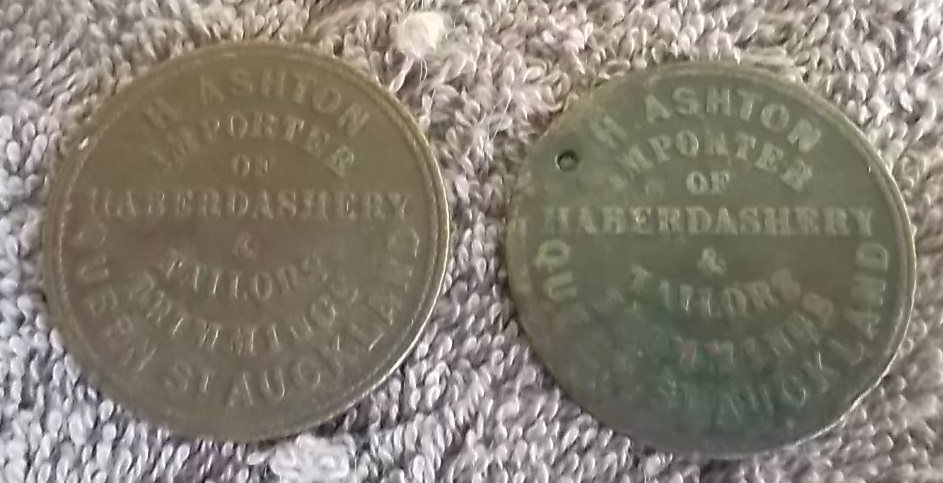 These tokens would grade Fine and good Very Good, even with darkening and corrosion. These tokens would grade Fine and good Very Good, even with darkening and corrosion.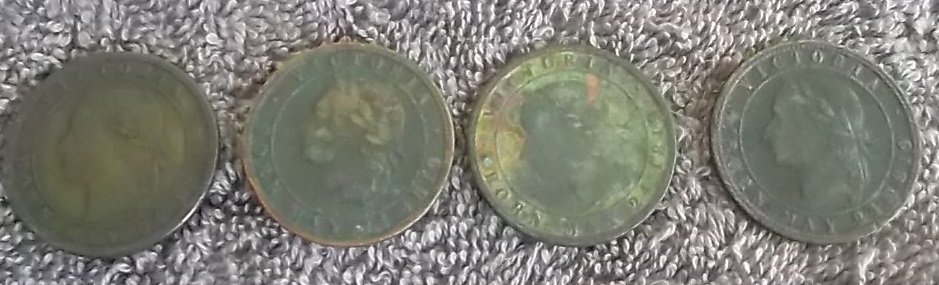 These for Victuallers tokens would grade left to right - Fine, VG, Good corroded and about Fine - I have long since sold these coins. These for Victuallers tokens would grade left to right - Fine, VG, Good corroded and about Fine - I have long since sold these coins.As the coins were minted privately, no one knows actual numbers minted, but guesses suggest no more than a few thousands to 10 thousand of the most common (Advance New Zealand, Auckland Licensed Victuallers) to just a few hundred of the rare ones. Holloways and Australian ones are much more common (Possibly 1 million Holloways in total). Generally stained coins are less desirable but not as penalised as for standard coins given these tokens saw heavy used, were brown (Lots of mud on those 19th century roads and dirt), low value and low mintage. My Milner and Thompson coin is stained, but still a VF coin. Most tokens in VG or even Good (Worn and corroded) are worth a few bucks, but Fine and VF coins like mine are worth real cash. Except for the Thames Hotel which is damaged about Fine, mine are all VF or better, the 1858 coin is a high Fine - but relatively clean by standards of the time. The next coin is a common token, but because its almost EF, it is scarce in that condition and almost unique for these tokens. You will love it. General rules Good - The token will have the lettering quite faded and weak, but apart from the centre should be readable, corrosion and pitting common. Not nice, but better than nothing and good for a rare piece. VG - All lettering is clear but weak, any images will be a weak outline with limited detail. Weak strikes may have blank letters. An acceptable coin. Fine - Lettering should be very clear and sharp in parts, all major detail is clear and some fine detail - etc harilines and lines on boxes, scales, leaves etc. A decent piece. VF - All lettering and major detail sharp, most minor details are clear or at least visible, coin can have no shine or lustre and be dark. Intricate details can be blurred or weak. A desirable example. EF - A token in this condition is a delight, there should be lustre, sharp details of all types, bold lettering and great eye appeal. Such a token should show light wear in parts - but essentially a nice piece that is very collectible.
Edited by Princetane
08/14/2021 12:45 am
|
|
Bedrock of the Community
United Kingdom
18069 Posts |
Princetane - thanks for the information! This is fascinating for me as I visited Thames in December 2018. I stayed at the Lady Bowen Hotel, which is an old Victorian building. I hope you don't mind me posting a few photos! 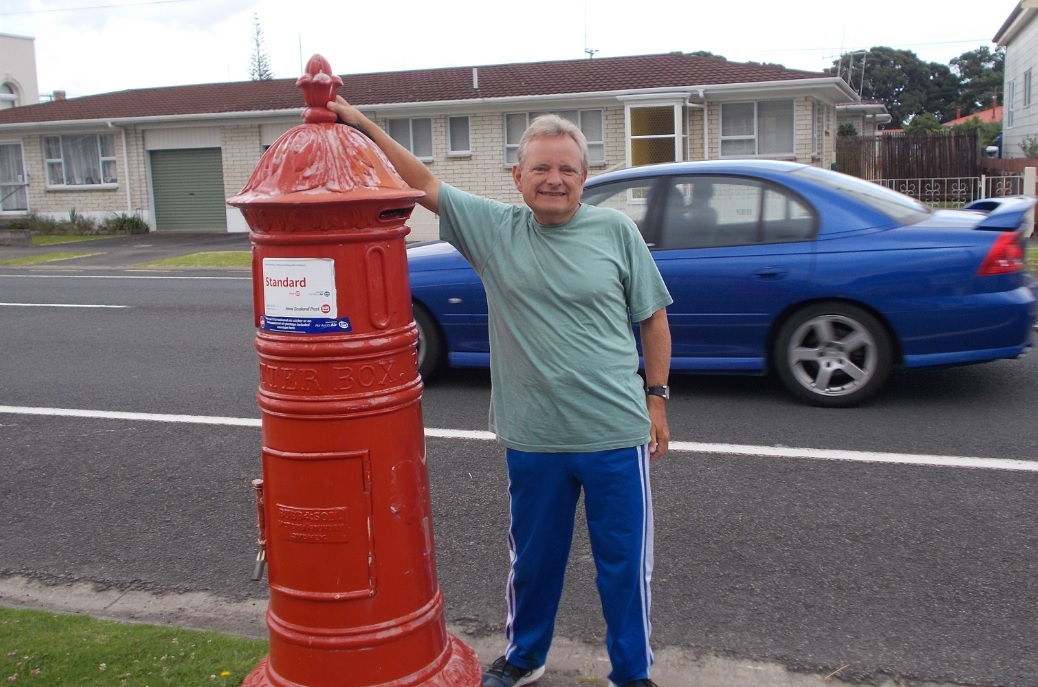 NumisRob by a lovely old letterbox 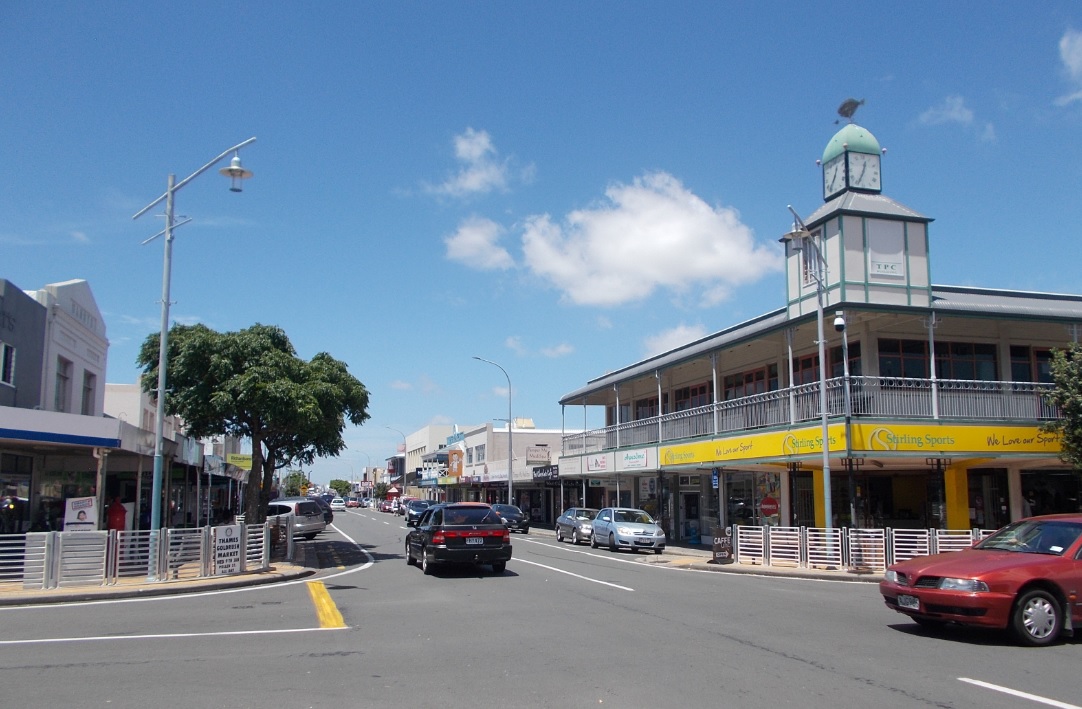 Downtown Thames 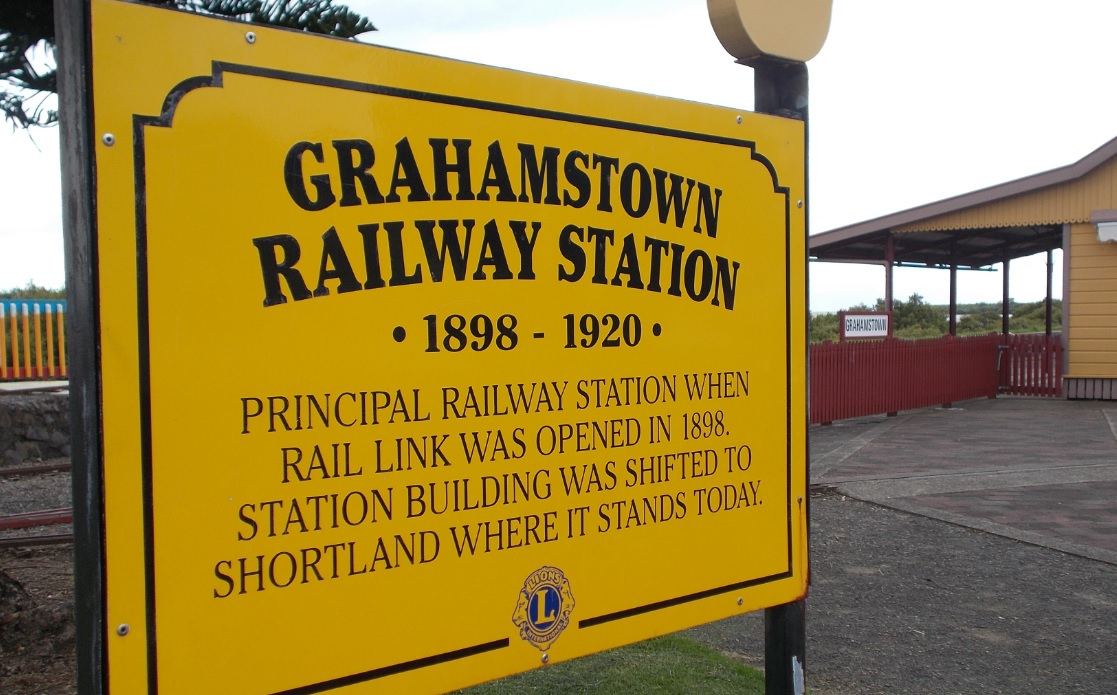 Grahamstown Train Station - now used by a little miniature railroad. 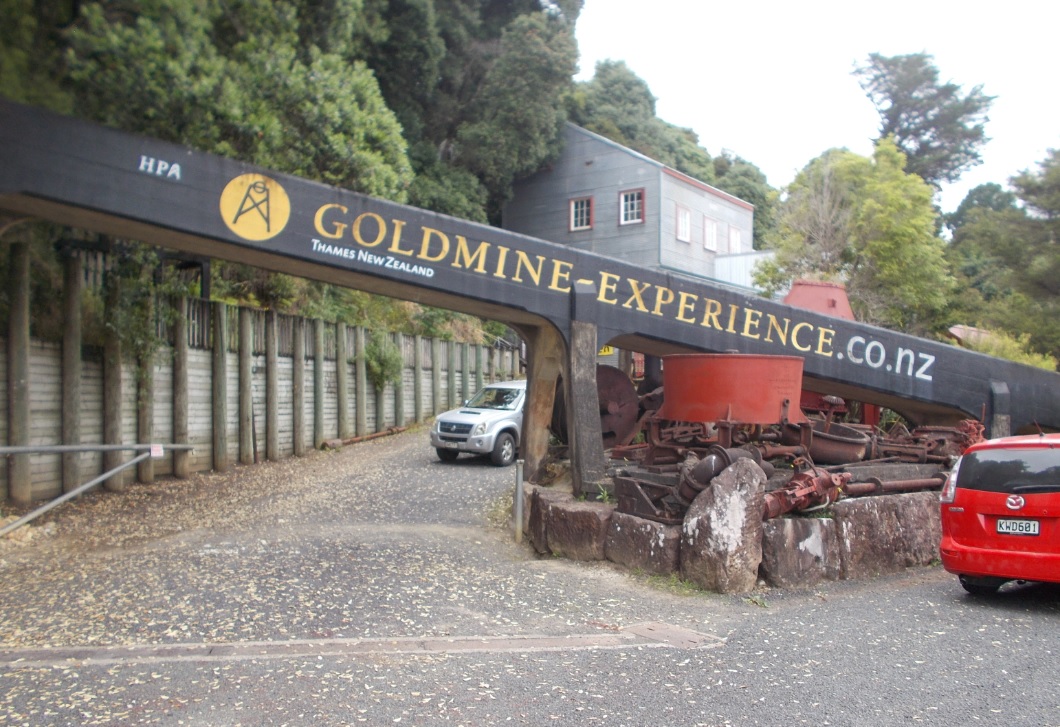 The Gold Mine that I visited - fascinating! |
| |
Replies: 105 / Views: 11,055 |
To participate in the forum you must log in or register.
Disclaimer: While a tremendous amount of effort goes into ensuring the accuracy of the information contained in this site, Coin Community assumes no liability for errors. Copyright 2005 - 2026 Coin Community Family- all rights reserved worldwide. Use of any images or content on this website without prior written permission of Coin Community or the original lender is strictly prohibited.
Contact Us | Advertise Here | Privacy Policy / Terms of Use
|
| Coin Community Forum |
© 2005 - 2026 Coin Community Forums |
| It took 0.56 seconds to rattle this change. |
 |
|
| |
| |







 Posted 08/11/2021 07:10 am


