| Author |
 Replies: 14 / Views: 3,209 Replies: 14 / Views: 3,209 |
|
|
New Member
Canada
24 Posts |
Came across this just now. Yes the scale is calibrated. I even re calibrated and made sure my surface support was level. Thoughts on this? 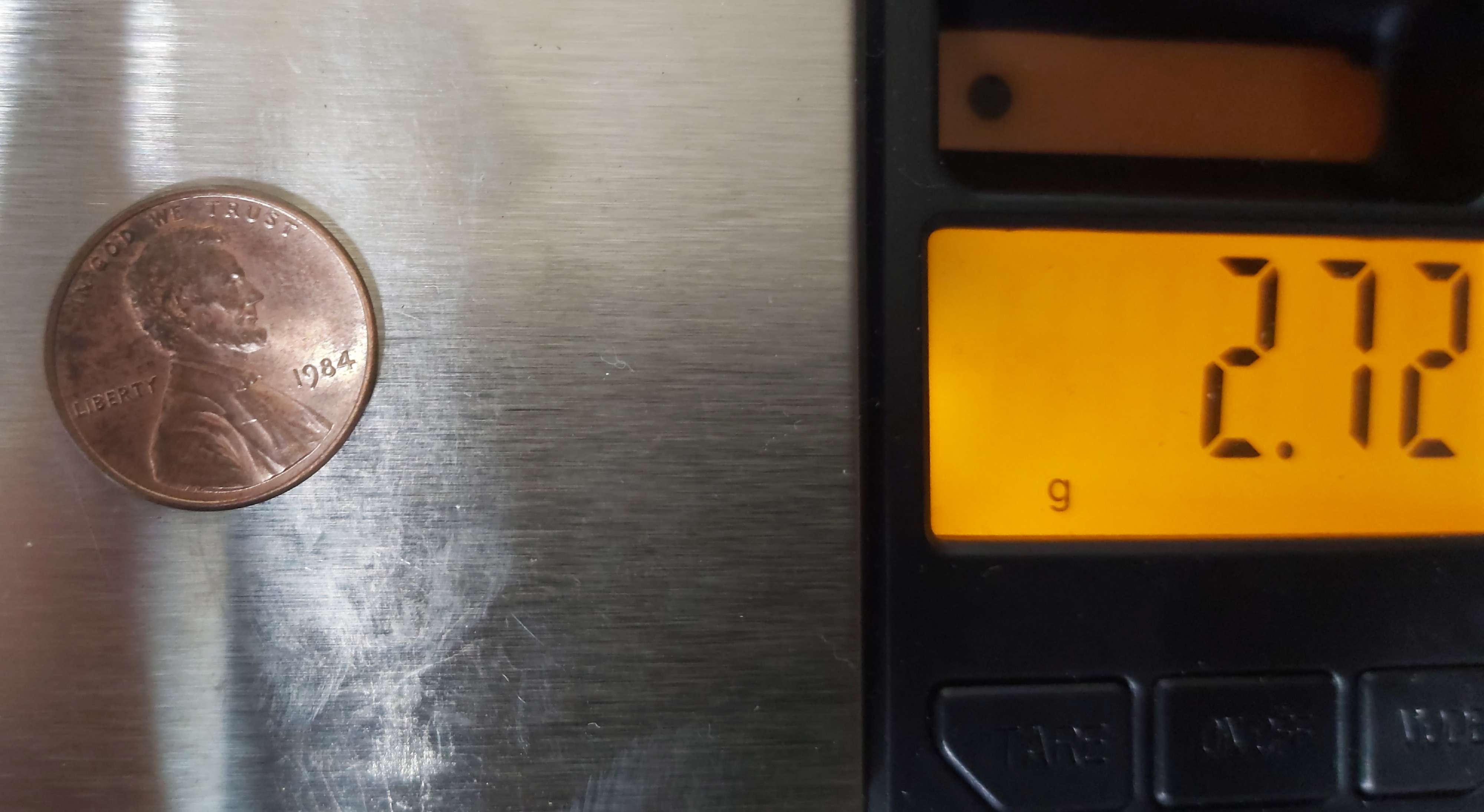 Edited by M TeK 9
07/17/2022 1:13 pm
|
|
|
|
Pillar of the Community
United States
3207 Posts |
what's the tolerance? if it's outside the range it's not by much
|
|
Moderator
 United States
34550 Posts |
Here are the mint tolerances (thx to @halo1st):
+/- .13 grams, (1873 - 1982) for copper/bronze. same tolerance for the 1943 zinc-plated steel cents.
+/- .10 grams, (1982 - present) for copper-plated zinc.
thx for ensuring your balance is in cal. Your cent seems a bit heavy.
"If you climb a good tree, you get a push."
-----Ghanaian proverb
"The danger we all now face is distinguishing between what is authentic and what is performed."
-----King Adz
|
|
Bedrock of the Community
United States
94367 Posts |
 to the CCF! |
|
Moderator
United States
106908 Posts |
Is it thicker than another zinc cent? |
|
Pillar of the Community
United States
7174 Posts |
Probably a heavy planchet. Would be way outside a copper planchet.
|
|
New Member
 Canada
24 Posts |
Its not thicker than any other 1984 penny I hace.
What should I do with it?
|
|
Pillar of the Community
United States
1648 Posts |
Weight should be 2.5g, or up to 2.6g within tolerance normally. A 1983 and 83-D were found on 3.11 gram planchet instead of the 2.5g zinc planchet. One weighed 3.06g and based on tolerance might allow one to be down to 2.98g normally. There are no known 1984 found on 3.11 gram planchets and the weight is lower than within that tolerance of 2.98g which suggests it is not on a copper planchet which would be a possibility if it were over 2.98g. A 1989-d was found on a 3.1g copper planchet so great job on weighing your coins as its always a possibility to uncover a yet unknown coin like that. In general there are also some coins struck on foreign planchets that will weigh different amounts you can research for the year its found to see if it matches any known findings. A couple 1984s were struck in error onto a dime planchet weighing 2.3g but none match what you found here. t could be a rolled thick planchet https://www.error-ref.com/rolled-thick-planchets/ Diameter should be 19.00 millimeters so it just may be struck on a slightly thicker planchet depending on the diameter of yours. Thick planchets on zinc cents are also more unusual than on copper cents, but certainly not unheard of and how many people weigh all their coins out .there? I don't think it's anything other than thick rolled planchet stock and might therefore be a keeper for the collection, but unknown to me about any value at 2.72g. |
|
Bedrock of the Community
United States
62064 Posts |
Tolerance chart for weights of circulating coins: 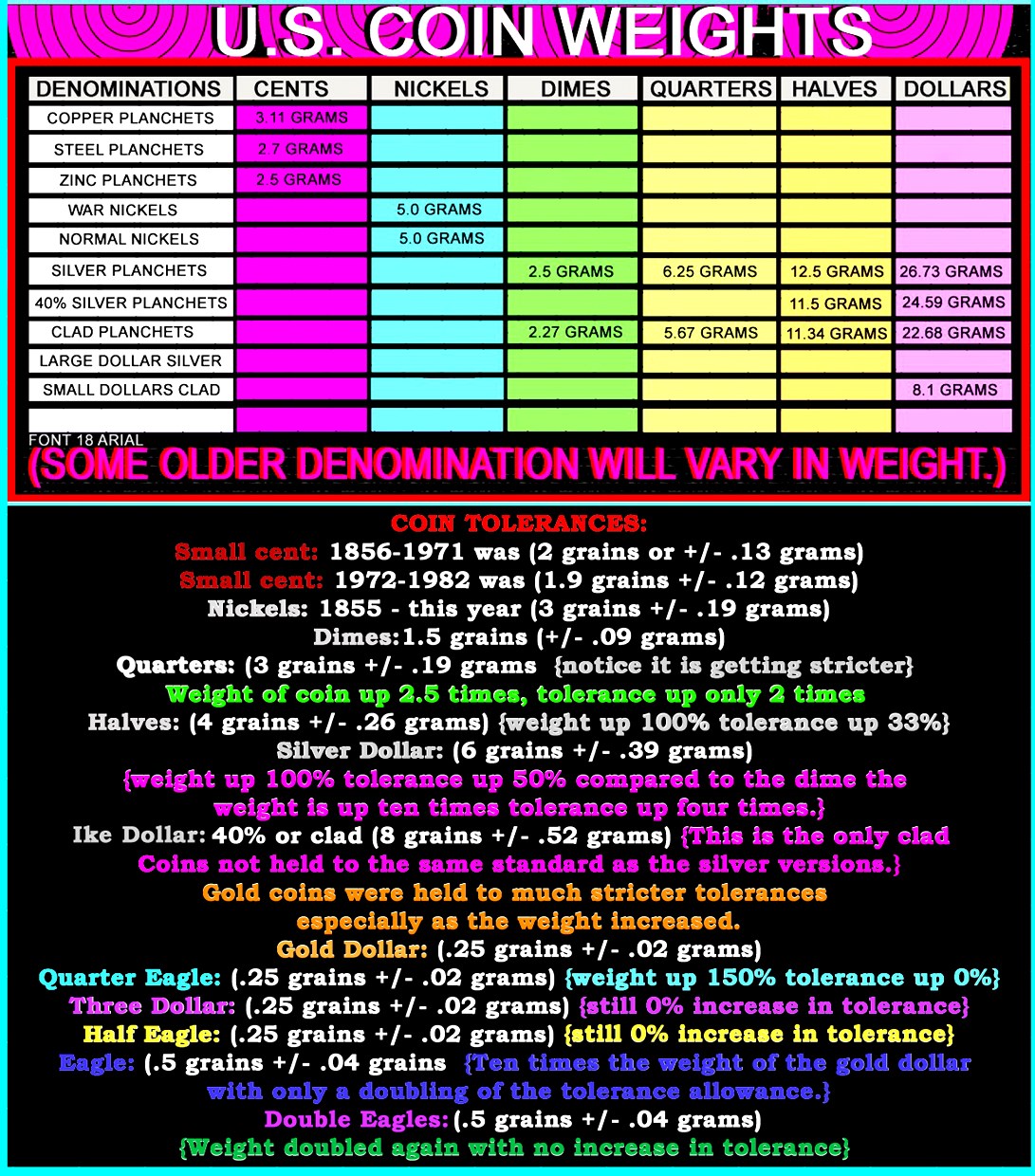 Save this for your personal image files. |
|
Pillar of the Community
United States
1648 Posts |
Thanks Coop and Spence, the info coop posted differs slightly from spence on tolerance in the 1972-1982 date range ( .13 vs .12g) and Spence mentioned 1982 - present tolerance that isn't in coops image, so perhaps doubling checking the accuracy at some point would be helpful to many. Regardless, this coin is not heavy enough to be a copper planchet although those again might still be out there in the 83-89 date range, but certainly could be a rolled thick planchet error or some similar reason for a heavy planchet weight that could be looked into further by those with more knowledge if desired with unknown value.
Edited by datadragon
07/21/2022 1:46 pm
|
|
Bedrock of the Community
United States
62064 Posts |
The mint only weight the Gold coins. So it these are over or under, they don't care on the business strikes. It the Gold coins that make the real difference in weight. The collectors are the only ones who notice the differences. (and it pretty much ends there)
|
|
Pillar of the Community
United States
1648 Posts |
Quote:
The mint only weight the Gold coins. So it these are over or under, they don't care on the business strikes. It the Gold coins that make the real difference in weight. The collectors are the only ones who notice the differences. (and it pretty much ends there) Makes sense to me Coop... Just consider that a copper planchet error like on the 83 sold around $20,000 dollars and other wrong planchet errors are valuable, so just pointing out for others that looking might potentially turn up something once in awhile and so doesn't hurt to weigh coins and learning what they should weigh and what coins have been found with different weight otherwise for a given year. Edited by datadragon
07/21/2022 2:02 pm
|
|
New Member
Canada
24 Posts |
@datadragon
What do you suggest I do to find out if this coin has any value? Ive quadruple checked the weight on three scales now and on two of them it fluctuates between 2.72 and 2.73.
Edited by M TeK 9
07/24/2022 12:42 am
|
|
Bedrock of the Community
United States
10635 Posts |
Quote:
what should I do with it? Spend it and keep searching. It's ONE CENT.  |
|
Pillar of the Community
United States
1648 Posts |
Quote:
What do you suggest I do to find out if this coin has any value? Ive quadruple checked the weight on three scales now and on two of them it fluctuates between 2.72 and 2.73. In general to find out value you can go to auction sites like heritage auctions, great collections etc and search through the past sales (and current in some cases when there are regular listings) for 'rolled thick planchet' in this case. ebay also has sold listings you can check. Its not an error type that is regularly listed or known which is why its not discussed often. I just did a brief search on heritage auctions and there are only some older wheat cents from the 1940s that sold for more than a hundred so on the right coin it does add some decent value and worth looking for, but those are also over 4.1 g with obvious thick planchets and on wheat cents, as well as a quarter and a dime all in grades au53-mint state. Without prior sales of 1984 or modern cents with rolled thick planchet errors to even compare to, the estimated value is unknown but is a known error if this is determined to be a rolled thick planchet by a grading company such as anacs (less expensive), PCGS, or ngc even at that weight as is the only current suggestion so your welcome to try anacs or email a error coin dealer. Come back if its graded so others can see since its uncommon regardless. Example https://coins.ha.com/itm/errors/194...ption-071515The sheets, (13 inches wide and 1,500 feet long) are created by rolling out metal into the sheets. Sometimes mistakes are made, and the resulting sheets may be too thick or thin. As US coins are supposed to weigh a certain amount, and the variation within any mintage is quite narrow, if the planchets are incorrect, this is an error. Edited by datadragon
07/24/2022 07:53 am
|
| |
Replies: 14 / Views: 3,209 |
|










 Posted 07/17/2022 2:05 pm


