|
This page may contain links that result in small commissions to keep this free site up and running.

Welcome Guest! Registering and/or logging in will remove the anchor (bottom) ads and the security checks. It's Free!
To participate in the forum you must log in or register. | Author |
 Replies: 7 / Views: 890  |
|
|
Pillar of the Community
United Kingdom
2950 Posts |
I have a denier issued from the Viscountcy of Albi (1100-1250). My understanding is that this "immobilised" coin design was issued by Viscount Bernard Aton IV Trencavel or one of his direct descendants. According to Numista one of the central designs shows a V under a crozier between two I. Degenerate legend. https://en.numista.com/catalogue/pieces45556.htmlMy example 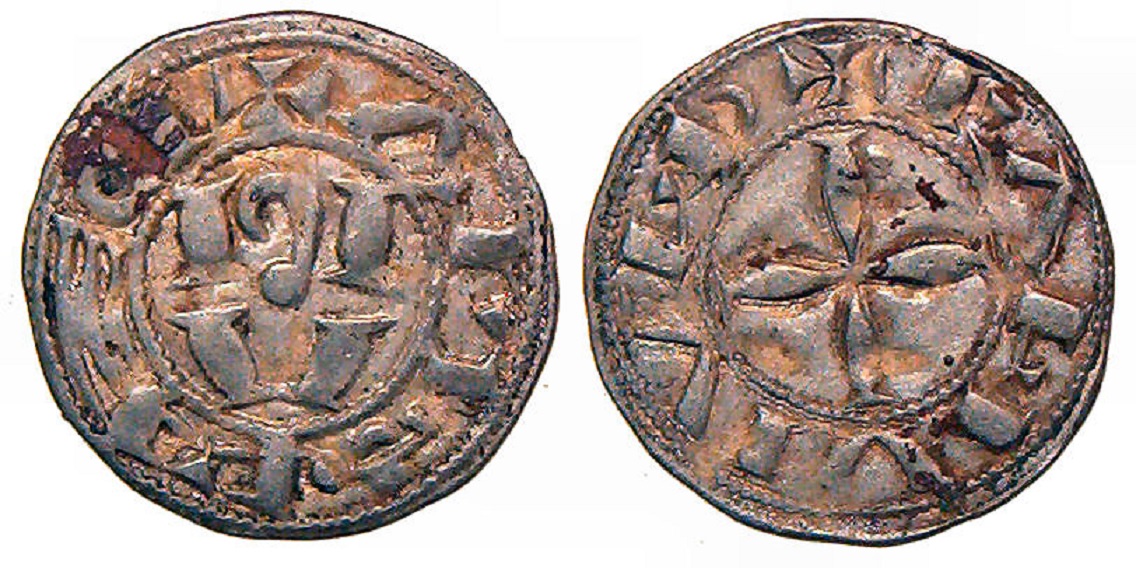 While the design certainly does look like that, my question is why would a Viscount issue a design (a crozier) that was normally only issued under bishoprics? I understand that there was a lot of blurring of the lines at the time where rulers tried to muster authority from anywhere they could - but this just seems odd. Thanks for any insights |
|
|
|
Moderator
 United States
200007 Posts |
Nice example!   |
|
Pillar of the Community
 United States
8087 Posts |
First, it is nice to see another obscure (at least to me) medieval. I've seen those capped cylindrical objects (both sides as they also form the arms of the cross) also called spindles. Apparently there was a rapidly growing textile industry in southern France from the mid-13th century. A slightly off-the-wall hypothesis is that the curved object is NOT a bishop's crozier, but is some other hook-shaped tool used in textile manufacture.  Catalogs tend to copy one another on such things. If the first one calls it a crozier (probably Poey d'Avant in this case?) most later ones just follow, without questioning. Of course, your speculation on both a bishop and a noble (who issued a coin) being in positions of authority also makes sense. I don't know much about the history of the south of France, but I understand that in Italy the bishops ruled the towns in the early medieval period, followed by "communes" or republics in some places (Florence being the most obvious example), and then those famous local noble families starting from the 13th-14th century (Visconti/Sforza, Este, Scaliger, Malatesta, Gonzaga, Medici etc.). So I suppose there could have been a period when there was a sort of shared authority. Edited by tdziemia
09/18/2025 5:02 pm
|
|
Moderator
Australia
17048 Posts |
I don't have facts, only speculation. Three unrelated speculations, to be precise:
1. The literal translation of the name of the noble house in question, Trencavel, is apparently "nutcracker". Perhaps this is intended to be such an implement, to physically represent the noble house.
2. The Trencavel family not only held the viscounty, but also the bishopric - ususally, the younger brother of the viscount of the day was the bishop. Perhaps it is a crozier, to indicate this family connection between church and state.
3. The city of Albi was, of course, at the heart of the Cathar heresy, and the resultant Albigensian Crusade to exterminate the Cathars. The Trencavel family were deposed during the Crusade (despite Viscount Bernard Aton IV Trencavel himself being a Crusader in the Holy Land), indicating at least an assumption that they were supporters of or participants in the Cathar sect. Very little is known for certain about Cathar symbolism, as their own writings have largely not survived and such knowledge as we have about them was written by the Catholic victors. But it seems possible to me that the hook might be some kind of Cathar symbol.
Don't say "infinitely" when you mean "very"; otherwise, you'll have no word left when you want to talk about something really infinite. - C. S. Lewis
|
|
Pillar of the Community
 United Kingdom
2950 Posts |
Many thanks for the responses. I hadn't considered many of those possibilities.
My gut feeling is that is is NOT a bishop's crozier as it just doesn't sit right with the surrounding artifacts of the design which are not religious looking at all. The Cathar link is an interesting one and it's something I know nothing about - I must investigate that further.
I had wondered if it was some sort of degenerate monogram for viscount, vicecomes is the Latin for "viscount" given the state of the surrounding legend, but I can't think of any other example that has that.
Thanks again for the thoughtful replies.
|
|
Pillar of the Community
United States
8087 Posts |
A wealth of possibilities! Quote:
1. The literal translation of the name of the noble house in question, Trencavel, is apparently "nutcracker". Perhaps this is intended to be such an implement, to physically represent the noble house. I really like this one. That probably means the engraver meant the coin to be read from the cross side to the other side, to give RAIMVNDVS (legend around cross) TRENCAVEL (nutcracler) VICECOMES (V) ALBIGENSIS (legend around the V) ...for Raymond Trencavel, Viscount of Albi. The Trencavel coat of arms feature a motif that, when inverted has a similar shape to that "crozier" (presumably a nutcracker): 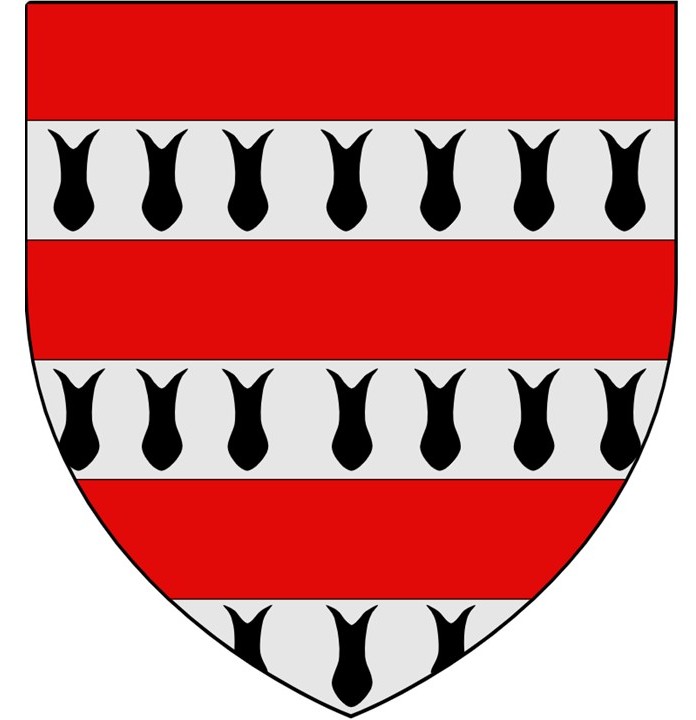 The Carrara family of Padova did something similar using the small cart ("carro") which is on their coat of arms in their coin designs. Edited by tdziemia
09/19/2025 07:16 am
|
|
Pillar of the Community
United Kingdom
2950 Posts |
Quote:
The Trencavel coat of arms feature a motif that, when inverted has a similar shape to that "crozier" (presumably a nutcracker) I think that is much more likely and the imagery is certainly more in keeping with what should be expected. Great detective work. Even if it were, on balance, more likely to be a nutcracker emblem it's hard to shake the legacy of a long-standing and respected reference works though . I suspect it will continue be labelled as a crozier for a long time. |
|
Pillar of the Community
United States
8087 Posts |
I haven't gone looking, but my guess is that Poey d'Avant called it a crozier and everyone else followed suit.
|
| |
Replies: 7 / Views: 890 |
|
To participate in the forum you must log in or register.
 
- Post Your Coins And Medals With Trees
- Post Your Coins With Coats Of Arms, Shields, Crests, Crowns, Etc.
- Post Your Coins With Hats
- Around The World With Banknotes - A Banknote Geography Game
- Nickel #3: 2022 P Jefferson Nickel With WDDR-005
- 1939 P Jefferson Nickel Doubled Die Reverse DDO-007, FS-101
- 1961 D Jefferson Bar Nickel
- Does Split Plating Doom Zincoln Cents?
- How Far Back Can We Go? Ninth Edition!
- My New Purchase: A Litra From Syracuse
- Jbuck's Ikestraveganza - The 100,000th Post Countdown!
- Post Your Tiny Coins!
- 1879 Schoolgirl Silver Dollar Pattern, PCGS PR-65, J-1608, Pogue Collection
- Around The World With Coins - A Coin Geography Game
- 1914 $100 Federal Reserve Blue Seal Star Note, PCGS EF40, Low Serial Number
- My Mint Order Just Came In - Proof Gold 4-Coin Set
- 20 Questions! (Forum Game) 11/04/24
- Commems Collection Classic: Quick Bits 169 - A Brief Look At Joseph Cochran
- Lincoln Wheat Cent 1910-S For Grading
- Nicest Counterfeit 1914-D Lincolon Cents On Ebay This Week
Disclaimer: While a tremendous amount of effort goes into ensuring the accuracy of the information contained in this site, Coin Community assumes no liability for errors. Copyright 2005 - 2026 Coin Community Family- all rights reserved worldwide. Use of any images or content on this website without prior written permission of Coin Community or the original lender is strictly prohibited.
Contact Us | Advertise Here | Privacy Policy / Terms of Use
|
| Coin Community Forum |
© 2005 - 2026 Coin Community Forums |
| It took 0.31 seconds to rattle this change. |
 |
|
| |
| |




 Posted 09/18/2025 4:55 pm


