PCGS - The
Roosevelt dime has been a fixture in United States circulation since 1946. Honoring four-term United States President Franklin Delano Roosevelt, this long-running coin is not only widely familiar with Americans but also to collectors in many regions around the world. When understanding Roosevelt's far-ranging achievements both within the White House and beyond, it's clear to grasp why Roosevelt, who died in office in 1945, is worthy of recognition on a United States coin.
He led the nation out of the Great Depression in the 1930s and through World War II in the 1940s. The former New York governor and distant cousin of President Theodore Roosevelt also helped construct Social Security, established important banking acts, and formed the New Deal, which helped keep millions of Americans working during the toughest economic times of the mid-1930s. But why is he on the dime?
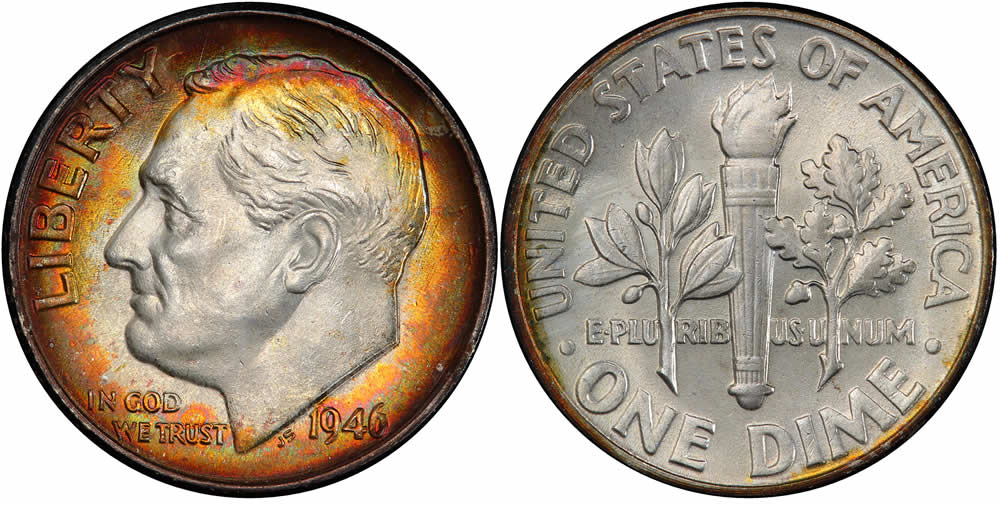
Roosevelt dime, 1946 10C, FB, PCGS MS68FBA Frightening DiagnosisThe dime carries a special significance when referencing Roosevelt's life and particularly one of the major causes he spearheaded in his latter years. At the age of 39, the future 32nd president was diagnosed with infantile paralysis - a disease better known as polio - following a stay at his family's cottage in New Brunswick, Canada in 1921.
How he contracted the diseases is unclear. He may have contracted the virus, which affects the nervous system, while visiting a New York Boy Scout camp; however, the crippling symptoms leading to his diagnosis set in during the hours immediately after his accidental plunge into the chilly Bay of Fundy waters while yachting. Following the incident, he fell ill and over the course of a few days his legs weakened to the point that he could no longer support himself while standing.
Polio had no known cure in the 1920s, and Roosevelt, suddenly dealing with lower-body paralysis, confronted the very real possibility that he might experience complete paralysis. He eventually found swimming in the waters of an estate in Warm Springs, Georgia, to be highly therapeutic and bought the property in 1926, converting it into the Warm Springs Foundation, which served as a leading care center for those afflicted by polio.
Read the Entire Article 





 Posted 11/07/2020 2:19 pm





