quote:
Originally posted by toast
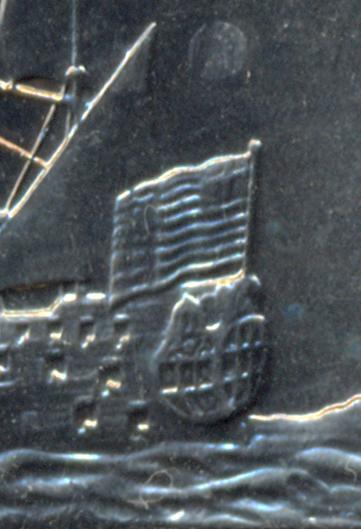
So, what colors are the other four small flags on the ship?
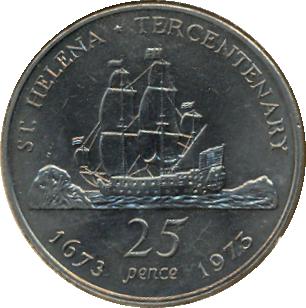
two are striped (mizzenmast and bowsprit), the one on the mainmast is the English flag (cross of St George) and the other (foremast) is either plain or indecipherable.
quote:
Originally posted by toast
BTW, Is it an actual ship being deplicted on the coin? If so, did you find out the name of the ship?
Toast's questions prompted me to do a bit more research... and I found I may well have been mistaken in my conclusions.

Toasts' question about the ship set me researching more into
the history of the capture of St Helena. The commander of the English fleet was one
Captain Richard Munden. His ship at the time was either the
Princess, a 3rd rate ship of the line, 54 guns, or the
Assistance, a slightly smaller ship. I was thinking this may be his ship.
However, I then googled the coin itself. I find on the
Chard Coins website that Leslie Durbin chose to portray "a vessel of the type used by the East India Company at the time", rather than a Navy ship - St Helena was placed under Company control once the invasion was complete and the political situation settled down. Curious, I checked what the Company flag would have looked like at the time. Lo and behold, it looks like this:

Stripes! If that website is correct (and there's no reason to doubt it - they're presumably copying off some kind of information card released with the coin), then it looks like this is a much better candidate for our flag and ship...
So it's most likely not a British Navy battleship, rather a Company armed merchantman. And the flag doesn't show Petra-Sancta blue after all, but real stripes. Ah well.
It's still not an American ship... though why the American Revolutionaries would choose a naval flag so closely matching the one used on British merchant ships is a mystery to me. Here's what the Company flag looked like in 1776:
.svg/200px-Flag_of_the_British_East_India_Company_(1707).svg.png)
To conclude my lengthy and embarrassing post with a couple of coins that really do illustrate the Petra-Sancta system of colour (just to prove I'm not talking through my hat
). First, here's the coat of arms off a British halfcrown of 1887:
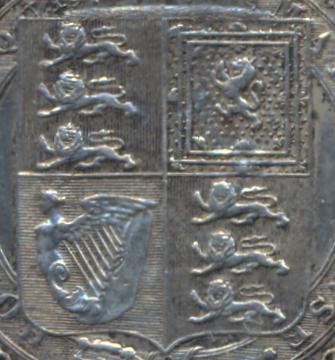
In this instance, the coat of arms is: English lions (top left and bottom right quarters) red background, Scottish lion (top right) yellow background and Irish harp (bottom left) blue background.

And here's a more modern coin, with coloured flags:
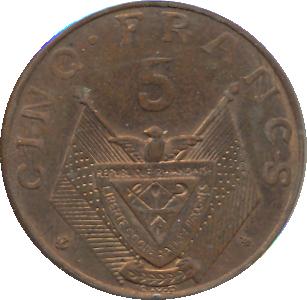
Rwanda 5 francs 1964. As you can see, the flag of Rwanda at the time was red, yellow and green:

later Rwandan coins actually have a "colour error" - one of the flags is shown red, yellow and purple!
Don't say "infinitely" when you mean "very"; otherwise, you'll have no word left when you want to talk about something really infinite. - C. S. Lewis









 Posted 12/23/2006 10:40 am





