| Author |
 Replies: 8 / Views: 1,519 Replies: 8 / Views: 1,519 |
|
|
Pillar of the Community
United States
1315 Posts |
Here's a coin I picked up recently. The seller and no attribution and the photos were not too good. It turned out to be better than I thought. I have attributed it as..... Claudius II Gothicus AE Antoninianus. Siscia mint. IMP CLAVDIVS AVG, radiate draped bust right / SPES AVG, Spes walking left holding flower and hem of robe. Cohen 276. 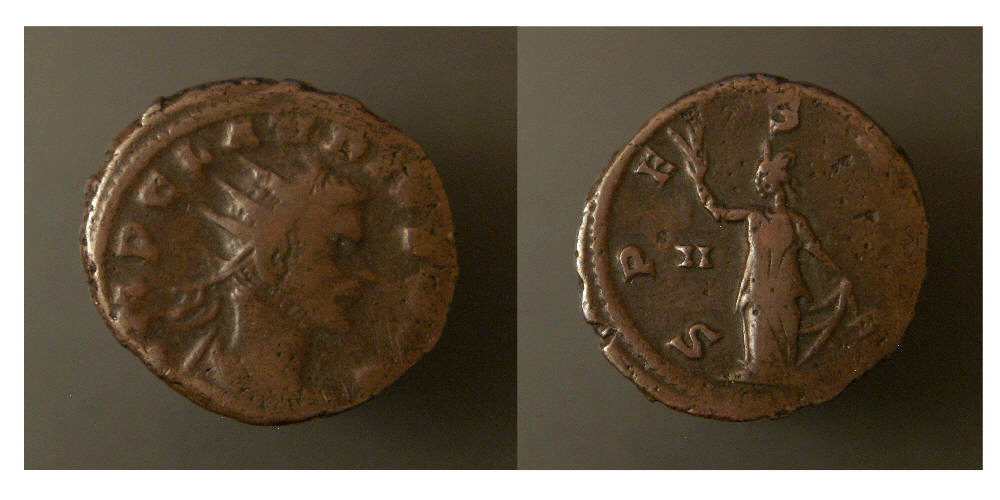 The AVG seems to be missing except for maybe a trace of the G at 4 o'clock. I was wondering how you tell this coin is from Siscia, and what are the two II marks the the left field. This coin was 2.68 w/4.00 shipping.  Thanks |
|
|
|
Pillar of the Community
United Kingdom
2838 Posts |
Excellent reverse, very emotive.
I would guess comparison studies (of known Siscia styles) and frequency distribution (of finds) are what has tied this coin to that mint. In truth a number of Archaeology tools could have been used.
It would appear that Siscia used PSTQ for its workshops at this time. I / II in left and right field (mutually exclusive) was only used on the SPES issues here so I'm not too sure. It could just be another way of differentiating workshops or issues but I'm not convinced - someone will know-doubt have a theory somewhere on the web.
Good price btw.
Edited by bobbyhelmet
11/10/2011 11:04 pm
|
|
Pillar of the Community
United States
1549 Posts |
The II indicates the second workshop at the mint made the coin. Various issues used different number systems including these Roman numerals and Roman ordinals P for Primus and S for Secundus. Other places also used Greek numbers A and B. Siscia at the time was using 2 shops but there are coins of other times and places with up to 15 shops. RIC editors listed the coin as Siscia comparing it to other issues based mostly on the style of the die work but exactly how the process pinned down this city for this issue, I do not know. In a few years some mints would start listing city initials on the coins but that did not strike them as needed at that time.
|
|
Pillar of the Community
United Kingdom
2838 Posts |
One interesting thing I have just noticed is that Siscia is only listed as producing I / II variants. Rome has a number of listings for III / IV coins but I can only find 5 references to I / II marks from Rome, all of these are classed as scarce or rare. I'm sure there is a satisfactory explanation for this but I can't help but form wild conclusions  |
|
Pillar of the Community
 United States
1315 Posts |
I am somewhat familiar with MM's used on later on later coins but did not know how these coins were placed at different mints.
I saw a similar coin on vcoins described as SPES 'reaching upward' but it had a smaller head and was called 'petite head'
Thanks
|
|
Pillar of the Community
United States
4778 Posts |
Didn't really think Siscia made coins this early in time. Probably since I'm so used to seeing 4th century Siscia coins. Anyways nice coin and thanks for posting it.
|
|
Pillar of the Community
United States
4253 Posts |
In looking at all the replies, I didn't see a RIC attribution. So here it is just in case you were wondering:
RIC 191f Antoninianus Obv: IMP CLAVDIVS AVG - Radiate, cuirassed bust right.
Rev: SPES AVG - Spes standing left, holding flower and raising skirt; I or II in left field or II in right field. 268-270 (Siscia)
|
|
Pillar of the Community
United States
1315 Posts |
Thanks JW
I had copied the attribution from wildwinds description and neglected to mention the RIC number in the left hand column.
When first trying to ID the coin I tossed a little between RIC 102 and 191 but but settled on 191 because of the spacing of the letters. My Sear book only mentions 102.
Now that I'm checking these RIC numbers again I see that the coin I mentioned above at Vcoins might well be an RIC V-1 191 variant (small bust) mentioned at wildwinds. I think it's a pretty coin.
btw.. what is the small f after 191 in your attribution?
Thanks again
|
|
Pillar of the Community
United States
4253 Posts |
The small "f" is an identifier for a variant of RIC 191. I found this in one of my resources I look to when I'm trying to attribute any particular coin. Take a look about half way down the page on: http://dirtyoldcoins.com/roman/id/C...udius-II.htmI believe this is your coin, or one like it that is. This is not my first goto resource, but it is an easy resource to navigate through. |
| |
Replies: 8 / Views: 1,519 |
|










 Posted 11/10/2011 11:09 pm


