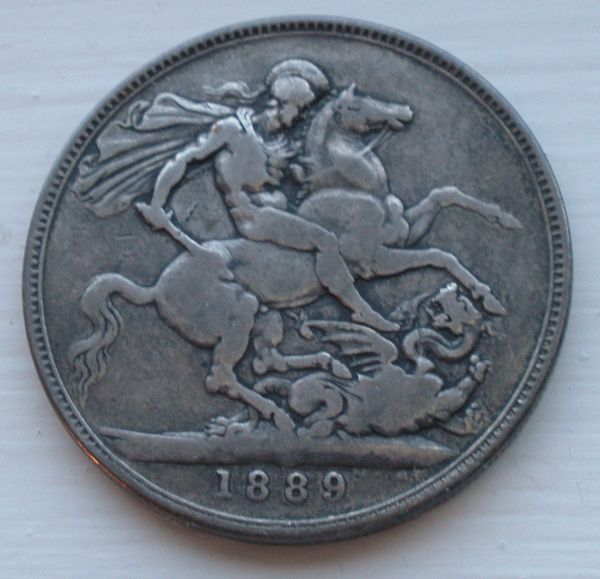
actually Sap, Pistrucci did two versions: the first with a lance, broken into three pieces.
George is holding the stump of his lance; there is a piece on the ground (under the horse's rump); and the third piece (difficult to see) protrudes from the dragon's thorax. So, at this point of the story, George has already got a good blow in, and it now remains for him to finish the job, albeit with a poor choice of weapons.
The second version has two pieces of the lance visible: the bit protruding from the dragon; and the piece on the ground. The stump, however, is nowhere to be seen (cast away, perhaps ?), and George has his gladius in hand.
You'll need to look at near-Unc coins to discern the differences which I am referring to.
As far as I am aware, the first version was only used on the "Garter Sovereigns" 1817 to 1820 (KG3).
The second version was used on all Crowns from 1818; and on sovereigns from 1821 (KG4).
If you want a petty detail, the Wikipedia article, cited above, says:
"Traditionally, the sword with which St. George slew the dragon was called Ascalon, a name recalling the city of Ashkelon, Israel. From this tradition, the name Ascalon was used by Winston Churchill for his personal aircraft during World War II (records at Bletchley Park), since St. George is the Patron Saint of England."
I have seen another narrative which spells it Askeleon; and which says that this is the name of the lance, not the sword.
There is another Wiki-entry about St George,
http://en.wikipedia.org/wiki/Saint_Georgewhich says -
"In the medieval romances, the lance with which St George slew the dragon was called Ascalon, named after the city of Ashkelon in Israel."
and for continuing interest in the subject, see -
http://www.perthcathedral.org/News/...pletion.htmland the link at the bottom of that.
Sel: interesting story - do you have a source for that ?
Apparently, the design-concept belonged to Joseph BANKS.
St George was a metaphor for England, or King George, or Prince George, or perhaps, all of the above;
the dragon was a metaphor for Napoleon BONAPARTE, finally defeated in 1815; and this design first appeared on coinage in 1817.
Ahhh, what stories our coins can tell us ...











 Posted 11/13/2011 9:45 pm


