Coin Community Family of Web Sites Join Thousands of Coin, Bullion, & Money Collectors
Coin, Banknote and Medal Collectors's Online Mall Specializing in Modern Numismatics Royal Canadian Mint products, Canadian, Polish, American, and world coins and banknotes. Join Thousands of Coin, Bullion, & Money Collectors Vancouvers #1 Coin and Paper Money Dealer 300,000 items to help build your collection! Royal Estate Auctions - $1 Coin Auctions


Username:
Password:
Save Password
Forgot your Password?


This page may contain links that result in small commissions to keep this free site up and running.

Welcome Guest! Registering and/or logging in will remove the anchor (bottom) ads. It's Free!

US Proof Sets Compared To Canadian Prooflike & Specimen Sets

To participate in the forum you must log in or register.
Author Previous TopicReplies: 13 / Views: 6,394Next Topic  
Pillar of the Community
RPT's Avatar
United States
924 Posts
 Posted 11/15/2011  3:01 pm Show Profile   Bookmark this topic Add RPT to your friends list Get a Link to this Message Number of Subscribers
Can someone explain how US Proof Sets compare to Canadian ProofLike & Specimen Sets?

Are ProofLike and Proof synonymous?

Are Specimen Sets synonymous to US Uncirculated Sets or are they higher quality?
Pillar of the Community
canuck1us's Avatar
United States
1002 Posts
 Posted 11/15/2011  10:41 pm  Show Profile   Bookmark this reply Add canuck1us to your friends list Get a Link to this Reply
Here are my observations but someone correct me if I am mistaken.

U.S. Proof sets are available in either "clad" or silver varieties. Both have the same type of finish which are similar to the Canadian Proof sets. The clad coins are composed of the regular metals (mostly Cupro-Nickel - but it depends on the denomination.) The U.S. silver Proof sets are mostly composed of silver as are the Canadian Proof sets. Proof finishes have a mirrored background and a frosted relief.

The U.S. Uncirculated Sets are comparable to the Canadian Brilliant Uncirculated Sets - basically business strikes. Maybe they are handled a little more carefully than coins produced for circulation but the finish and the composition is the same.

Proof-Like and Proof aren't synonymous. Proof-Like finishes were found on Canadian sets produced between 1954 and 1967. Proof sets started in Canada in 1981.

Specimen Sets don't have a U.S. counterpart although some U.S. coins such as the $1 Silver Eagle Bullion is available in a "Reverse Proof" finish which is similar to the more modern Canadian Specimen finish. (The field or background is frosted but the relief has a mirror finish.)

Not to confuse things further but some of the older specimen finishes, such as those on Canadian Prestige sets and Canadian Specimen sets between 1971 and 1996, were brilliant relief on a brilliant background.

Hope this answers your question.
CCF Master Historian of USA Commemoratives
Learn More...
commems's Avatar
United States
12283 Posts
 Posted 11/15/2011  11:03 pm  Show Profile   Bookmark this reply Add commems to your friends list Get a Link to this Reply
Your questions are great ones -- many collectors have the same or similar questions. I'll offer a few thoughts, but please understand that the US Mint (USM) and Royal Canadian Mint ( RCM) have made changes to the finish on the coins they include in their annual sets over the years and so a simple "one answer fits all" response unfortunately won't suffice -- I'll focus my comments mostly on current products.

I would say that US Mint Proof Sets and RCM Proof sets are fairly similar in terms of the finish of the included coins, they both feature frosted devices on brilliant, mirror-like fields. Current RCM sets feature mostly silver coins and a silver dollar with selective gold-plating (this wasn't always the case); the USM sets are available with either all base metal coins or with three silver coins -- neither set features any gold-plated coins.

Regarding "proof vs. proof-like": No, they are not synonymous. Proof coins are struck from specially-prepared planchets using specially-prepared/polished dies and are typically struck multiple times to ensure the greatest level of detail on the coins. As mentioned above, these coins have frosted devices (for example, the Queen's portrait) set against mirror-like surfaces and exhibit significant contrast between the two. While the finish on Proof-like coins is generally better than that on coins meant for circulation, P-L coins do not typically exhibit the level of detail or contrast of proof coins, though coins produced from "fresh" dies can sometimes come close.

Are Specimen Sets synonymous to US Uncirculated Sets? No. Current Specimen sets of the RCM feature brilliant or frosted devices on a finely lined field (sometimes called a "linen" field); the technique produces a nice contrast between the devices and fields but not nearly the contrast of proof coins. Current US Mint Uncirculated Sets are struck "on special presses using greater force than circulating coins" to produce a sharper, more detailed design on each coin; the coins feature a satin finish over the entire coin (devices and fields). [Source: US Mint website] So, the coins in these sets are produced differently and have a different look. Both Mints produce high-quality coins for their respective sets, I'll leave it to you to decide which (if either) is of higher quality.

BTW, beginning in 2011, RCM Uncirculated Sets contain "circulation quality" coins vs. previous sets which featured coins with a better quality finish.

I would recommend picking up a current Charlton's Guide (Numismatic Issues) to better understand all that had happened to these sets over the years.

Hope that helps!
Collecting history one coin or medal at a time! (c) commems. All rights reserved.
Pillar of the Community
SilverBug's Avatar
Canada
862 Posts
 Posted 11/16/2011  01:34 am  Show Profile   Bookmark this reply Add SilverBug to your friends list Get a Link to this Reply
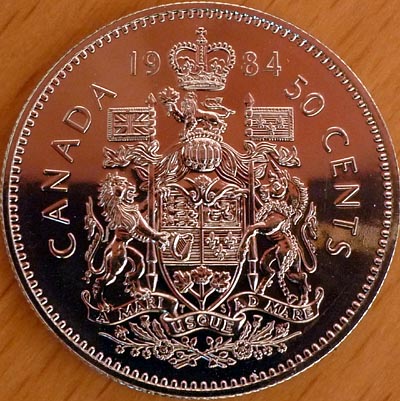
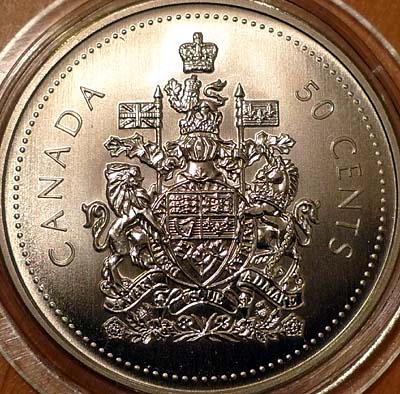
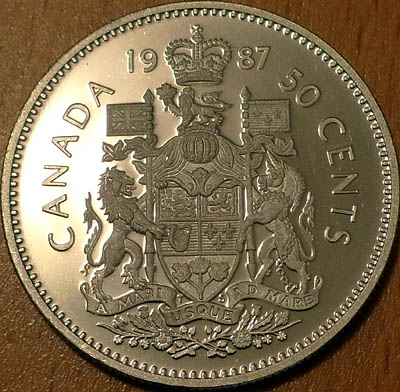
I was confused by RCM's finish too. here are some sample

proof like
US-Proof-Sets-Compared-To-Canadian-Prooflike-&-Specimen-Sets

specimen (you can see brushed line at the background)
US-Proof-Sets-Compared-To-Canadian-Prooflike-&-Specimen-Sets

proof
US-Proof-Sets-Compared-To-Canadian-Prooflike-&-Specimen-Sets
Pillar of the Community
canuck1us's Avatar
United States
1002 Posts
 Posted 11/16/2011  09:14 am  Show Profile   Bookmark this reply Add canuck1us to your friends list Get a Link to this Reply
Silverbug: Wouldn't the 1984 half dollar you pictured technically be a brilliant uncirculated finish instead of Proof-Like although they are similar in appearance?
Pillar of the Community
RPT's Avatar
United States
924 Posts
 Posted 11/16/2011  11:04 am  Show Profile   Bookmark this reply Add RPT to your friends list Get a Link to this Reply
Thanks for the replies.

I didn't expect to hear from people in the southern US.

I'm just starting to collect Canadian Coins and I bought a lot of 23 mint sets on ebay. I'm assuming they are business strike.
Pillar of the Community
canuck1us's Avatar
United States
1002 Posts
 Posted 11/16/2011  12:18 pm  Show Profile   Bookmark this reply Add canuck1us to your friends list Get a Link to this Reply
RPT - If the sets you purchased on ebay were in paper envelopes and 1968 or later , then yes, they would be the brilliant uncirculated type which would be similar to the U.S. Philadelphia/Denver mint sets.
Pillar of the Community
SilverBug's Avatar
Canada
862 Posts
 Posted 11/16/2011  1:33 pm  Show Profile   Bookmark this reply Add SilverBug to your friends list Get a Link to this Reply

Quote:
Silverbug: Wouldn't the 1984 half dollar you pictured technically be a brilliant uncirculated finish instead of Proof-Like although they are similar in appearance?


PL is what dealer told me:)

So PL should come from a set with plastic seal by mint? I have some, I really can't tell the difference between PL and mint roll coins, except PL is a little bit shinnier
Pillar of the Community
canuck1us's Avatar
United States
1002 Posts
 Posted 11/16/2011  3:19 pm  Show Profile   Bookmark this reply Add canuck1us to your friends list Get a Link to this Reply
I think the term "Proof-Like" is often used by several people (including dealers)to describe the coins coming from the brilliant uncirculated sets produced from 1968 though the current date. The finish on these sets is more often better than bagged or rolled coins produced for circulation.

Having said that, I still think the proper terminology is not to refer them as PL or Proof-Like. The grading of these coins would be MS-NC (non-circulating) rather than PL.

There is very likely a fine line in determining whether a coin is a very high-grade mint state coin that escaped bag marks, etc. that was produced for circulation versus one that came from a non-circulating mint state set, however there is grading for both types with the ones produced for circulation commanding a higher catalogue value.

Pillar of the Community
SilverBug's Avatar
Canada
862 Posts
 Posted 11/16/2011  4:10 pm  Show Profile   Bookmark this reply Add SilverBug to your friends list Get a Link to this Reply
I got it. I think RCM used the term "proof-like" first. basically both device and field are polished and shinning

PL coins comes from sets like this:
http://colonialacres.com/products.p...434&ref=1140

proof sets (ususally silver coin)
http://colonialacres.com/products.p...513&ref=1140

specimen sets
http://colonialacres.com/products.p...512&ref=1140
Pillar of the Community
RPT's Avatar
United States
924 Posts
 Posted 11/16/2011  6:38 pm  Show Profile   Bookmark this reply Add RPT to your friends list Get a Link to this Reply
I'm still a bit confused.

To me the proof like (1984) posted by SliverBug looks like a US Proof.

The specimen posted by SliverBug looks like the US satin/burnished finish.

The proof (1987) posted by SilverBug looks more like a US high grade uncirculated but that may be lighting and because it's silver.

The 23 sets I bought are in paper envelopes so I guess they are brilliant uncirculated.

For the money you get quite a few less Canadian Coins in the sets compared to US coins.
Pillar of the Community
canuck1us's Avatar
United States
1002 Posts
 Posted 11/16/2011  9:21 pm  Show Profile   Bookmark this reply Add canuck1us to your friends list Get a Link to this Reply
It is a little hard to go by the pictures.

I have examples of each type in hand and the Proof's of each country are comparable.

The burnished satin/finish doesn't compare too closely at all to the specimen finish.

I just pulled out a 1972 Canadian set and the finish is very nice, but again not comparable to a U.S. or Canadian Proof because there is not the contrast between the background and relief.

As far as coins for the money, it varies for year to year and has to do with mintage amounts but an example from my own collection comparing the basic uncirculated mint sets
from the year 2000:

Canada:
Mintage: 186,985 Cost: $15.00 Catalog Value: $15.00 Face Value: 7 coins with a face value of $3.91

USA:
Mintage: 1,490,160 Cost: $10.00 Catalog Value: $15.00 Face Value: 20 coins with a face value of $5.82

Of course in the U.S. for many years, there was no dollar coin included in the sets. In Canada, since 1937 (except 1944) you always got a dollar coin and since 1997 a two-dollar coin in the sets!
Pillar of the Community
RPT's Avatar
United States
924 Posts
 Posted 11/17/2011  09:41 am  Show Profile   Bookmark this reply Add RPT to your friends list Get a Link to this Reply
canuck1us: What are you using to get the catalog/current value of the Canadian Sets? I asked on another thread if there was a way to get that info online but didn't get any replies.

When I said more coins for the money I wasn't really looking at mintage numbers but for 2011 the US set has 28 coins ($13.82 face) for $31.95 and the Canadian Set has 7 coins ($3.91 face) for $23.95.
Pillar of the Community
canuck1us's Avatar
United States
1002 Posts
 Posted 11/17/2011  10:10 am  Show Profile   Bookmark this reply Add canuck1us to your friends list Get a Link to this Reply
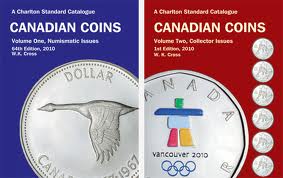
I use the Charlton Catalogs. There are two volumes - one for Circulation issues and one for Non-Circulation (Collector Issue). These are pictured below. The Collector issue lists all the sets as well as all the other special issues, etc. I use the Red Book for the U.S. coins.


US-Proof-Sets-Compared-To-Canadian-Prooflike-&-Specimen-Sets
  Previous TopicReplies: 13 / Views: 6,394Next Topic  

To participate in the forum you must log in or register.


Disclaimer: While a tremendous amount of effort goes into ensuring the accuracy of the information contained in this site, Coin Community assumes no liability for errors. Copyright 2005 - 2026 Coin Community Family- all rights reserved worldwide. Use of any images or content on this website without prior written permission of Coin Community or the original lender is strictly prohibited.
Contact Us  |  Advertise Here  |  Privacy Policy / Terms of Use

Coin Community Forum © 2005 - 2026 Coin Community Forums
It took 0.36 seconds to rattle this change. Forums