| Author |
 Replies: 14 / Views: 6,111 Replies: 14 / Views: 6,111 |
|
|
New Member
Ireland
12 Posts |
Can anyone give me a full description of this piece? I think it is called Spade Money. It is bronze, weight 25.1 grams, 57mm high x 36mm wide. There is a lion in high relief on one side and a series of characters on the other. It looks to be cast metal to me , not struck. Any ideas what period it dates from, and what the inscription translates as? Thanks for any insights.   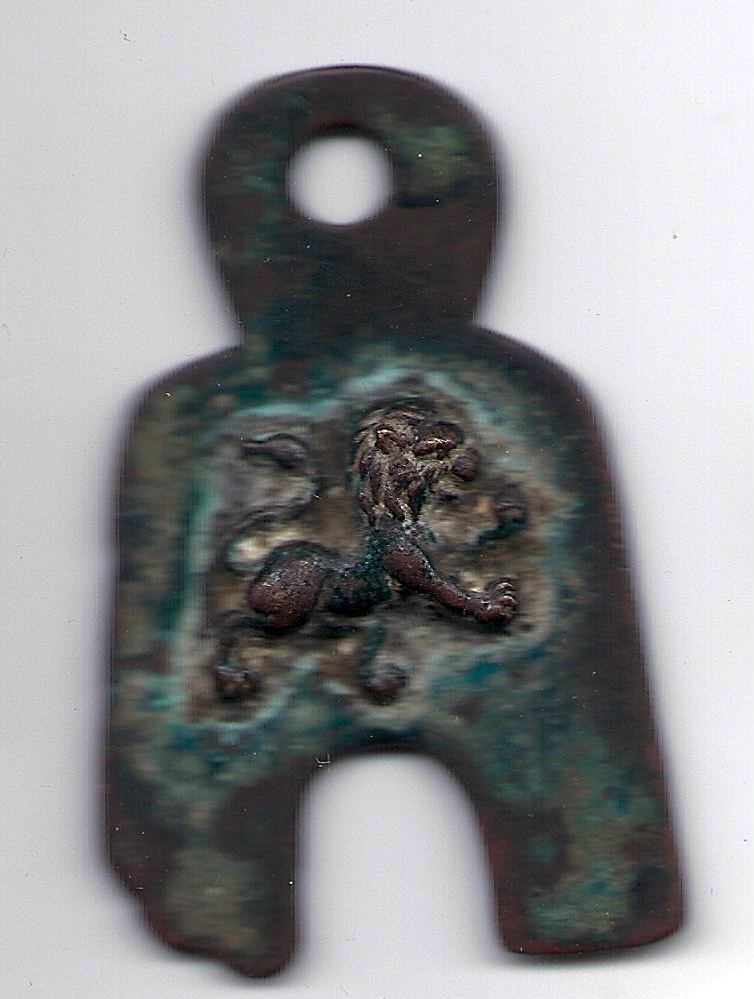 Identified - moved to Exonumia forum - Sap Identified - moved to Exonumia forum - Sap |
|
|
|
Pillar of the Community
Canada
1610 Posts |
|
|
Valued Member
Canada
480 Posts |
I am going to call it a modern fake. I am nmot aware of any with the design on the back, and not with a top like this one (which should be roughly triangular). It is similar (with the 2 exceptions) as Schjoth 12A.
|
|
Bedrock of the Community
United States
10045 Posts |
I know little about "spade money", but the style of the lion looks very European to my eyes. I would be curious to know if any spade money contained European-style images. Please correct me if I'm wrong, but Chinese art (and coins) strongly follow cultural traditions--from what I've seen in museums. So, anything with a Western image would not be received well as money.
That said, the style/appearance of the lion and patina doesn't look like a recent casting or knock-off. Granted, many things, even verdigris, are faked these days, but I'm curious for the reason of the lion and the old, mineralized surfaces. The lion could easily be on a buried European coin from the 17th-18th C. That is intriguing, if only to satisfy my curiosity.
Edited by DVCollector
11/23/2011 1:05 pm
|
|
Moderator
 Australia
16982 Posts |
The lion is definitely not 2000-year-old Chinese in style. Chinese spade coinage never had anything "pictorial" in any kind of style, only early Chinese script, the translation of which is often a matter of debate. The particular class of spades this is a copy of is the "flat handled spade" type from the State of Liang, c.400-300 BC; they have blank reverses. Zeno.ru example. Don't say "infinitely" when you mean "very"; otherwise, you'll have no word left when you want to talk about something really infinite. - C. S. Lewis
|
|
Pillar of the Community
Thailand
1509 Posts |
Could the piece actually be original? The lion looks to have been added, perhaps soldered, on?
|
|
Moderator
Australia
16982 Posts |
I doubt it. It looks all of one piece, though the background is out of focus. The yellow stuff in the crevices around the lion looks to be the same fake "sand patina" as on the obverse, and the green patina on the lion seems to match the colour of the stuff in the background.
Don't say "infinitely" when you mean "very"; otherwise, you'll have no word left when you want to talk about something really infinite. - C. S. Lewis
|
|
New Member
 Ireland
12 Posts |
First of all, thanks to all who responded to my request for information.
Based on the points raised, I have had another close look at this piece. I now think that this piece of spade money is of two part construction, the lion having been cast separately, and the sand around it used to cover up the join (the line of sand around where the lion joins the piece is complete, with no breaks, which is a little suspicious). This being the case, there are only two options. This is an original piece of spade money that has had the lion added at a later date, with a view to making it more interesting numismatically and more saleable (i.e. for a higher price than the original was worth), or it is a modern concoction / fantasy piece, again produced with a view to selling for a high price.
Once again, your comments would be much appreciated.
Pete.
|
|
Pillar of the Community
United States
511 Posts |
I think it would be easier to make an entire fake coin, than to acquire a genuine ancient coin and add a fake portion to it. If you were in the business of making fake coins, wouldn't you rather make them 100% fake, as opposed to altering genuine coins that were valuable in the first place? If you acquired 100 or 1000 spade money, why not sell them as is? Or would you rather take the time to add a European lion that takes time and money and makes your spade money easily identifiable as a fake and LESS valuable... |
|
New Member
Ireland
12 Posts |
Dear Wheatifan
many thanks for your input. Makes great sense. So this is probably a 19th century or later concoction. Although I do think there is a slight possibility that it is an original piece that has had the lion added later (by using an original piece, obviously you would have a better feel overall as regards the finished product, since most of it would be genuine and only the lion added to make it more exciting).
Once again, many thanks for your input.
Pete
|
|
Valued Member
United States
62 Posts |
Hello,
What you have is a poorly imitation, counterfeit, Liang (Wei) Spade Money.
It was an attempt to imatate the "HEAVY FLAT SPADES OF THE STATE OF LIANG (Wei)", ca.100BC. Chinese would never depict a lion or tiger so Euro-styled. The following is borrowed text so I quote....
"Around 400 BC flat spades revolutionized the spade currency. Unlike the hollow-handled spades which required a complex multi-piece mold with a casting core in the handle, the flat spades required only a simple two-piece mold, allowing for larger mintages in shorter periods of time. They were sturdy, easier to store and were cast in the three denominations of 1/2, 1 and 2 "jin", making them very suitable for use in everyday transactions. Most of the the early issues name the city of Anyi which was the State of Liang capital early in this period. The later issues usually name the city of Liang to which the capital of the stater of Liang was moved later in the period. There are some very scarce types which name other cities. The denomination can be expressed either directly in jin, or as fractions of the LI with 100 to the LI equal a Jin. This is probably the period when coins came into common use over a wide area of China. Early flat foot spades were called "CH'IEN, which later became a generic term for all types of money."
|
|
New Member
Ireland
12 Posts |
Hello Jadespear
very interesting outline. Thanks for educating me.
Regards
Pete
|
|
Valued Member
United States
62 Posts |
You are very welcome Pete. Any time I can help.
|
|
Valued Member
Canada
480 Posts |
From what I know, I would place it as post 1990 manufacture. It is not the right inscription, or the correct shape.
|
|
New Member
United States
7 Posts |
From the pictures, I would say the body of the spade money may be a copy made in the early to mid 1900s, but the lion is very modern.
|
| |
Replies: 14 / Views: 6,111 |
|










 Posted 11/23/2011 02:45 am


