| Author |
 Replies: 13 / Views: 1,938 Replies: 13 / Views: 1,938 |
|
|
Valued Member
Australia
124 Posts |
Howdy all, I remembered seeing a documentary years ago on how we make our polymer notes and though other members might find this interesting. Here's the link from youtube.. http://www.youtube.com/watch?v=YTggA4jVPj0Cheers |
|
|
|
Valued Member
Australia
56 Posts |
Interesting process. Thanks for the link!
|
|
Pillar of the Community
Australia
762 Posts |
Thanks Fish, made me proud to be a Melbournian.   Last weekend I got some notes at the ATM and discovered that they were 6 x 2009 $50 notes in mint condition and consecutive serial numbers. I got into a panic about what I should do  . In the end I just kept 2 with consecutive serial numbers which have now formed part of my collection. Probably won't be much of an investment but I still like to look at them and feel satisfied that I caught them in the wild.  |
|
Pillar of the Community
Australia
841 Posts |
Last weekend I got some notes at the ATM and discovered that they were 6 x 2009 $50 notes in mint condition and consecutive serial numbers.  be nice to see even if you only have 2 left |
|
Pillar of the Community
Australia
762 Posts |
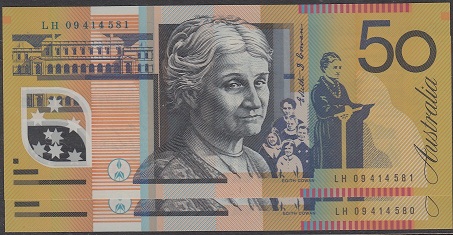 Hi Ausjack. Took a while for me to scan the notes but here they are.  |
|
Pillar of the Community
Australia
841 Posts |
Sweet, thank for that roo, shame you could keep them all but still a good score. Would be nice to get first or last prefix in that nick. But it's funny how all these notes just come from no where, this is what I was talking about in another post where I found heaps of $5 notes the same..where do they hide, LOL
|
|
Pillar of the Community
Australia
762 Posts |
I think you'll find that even though these notes were printed 2 years ago they have been sitting in the Reserve Bank vaults up until now. These brand new notes were then used to fill the ATM. It was quite a dilemma. If I had kept all 6 notes I would have had to withdraw another $300 from the ATM which would have given me another 6 consecutive notes. If they had been $20 I would have kept them all |
|
Pillar of the Community
Australia
841 Posts |
You should have just milked that cash cow
|
|
Valued Member
United States
113 Posts |
Are the older (decimal) paper notes worth anything more than face value? I bought a couple ones and a five from my coin guy before I moved to New Zealand from the States, in case I went to Oz for a trip. They're not unc but they're not in bad shape either.
|
|
Valued Member
United States
113 Posts |
awesome video by the way!
|
|
Pillar of the Community
Australia
762 Posts |
Quote:
Are the older (decimal) paper notes worth anything more than face value? Assuming there aren't any first or last prefixes (or star notes  ) and the notes are from the 70s or 80s then you are unlikely to get much more than a small premium over the face value. |
|
Valued Member
United States
113 Posts |
they're definitely not star notes (as I determined from research on this forum) but I'm having trouble understanding first and last prefix notes. what does that mean.
|
|
Pillar of the Community
Australia
762 Posts |
On paper notes the prefix is the three letters before the serial number. The first and last prefix refers to the first and last prefix of the signature combination on the note. If your $1 note has the signatures of Johnston and Stone then DGJ is the first prefix and DPS is the last prefix. Before that was the signature combination of Knight and Stone. First prefix was CPK and Last prefix was DGH. So check the prefix on your notes and check the signature combinations. I hope this makes sense. |
|
Pillar of the Community
Australia
841 Posts |
Hey samboyellowsub, I replied to another of in2fish2's post about first and last prefix called "Polymer First and Last issue. Test notes" if your interested in our polly notes, Cheers
|
| |
Replies: 13 / Views: 1,938 |
|










 Posted 12/13/2011 05:34 am


