











 Posted 12/30/2011 9:43 pm


Quite an interesting collection!
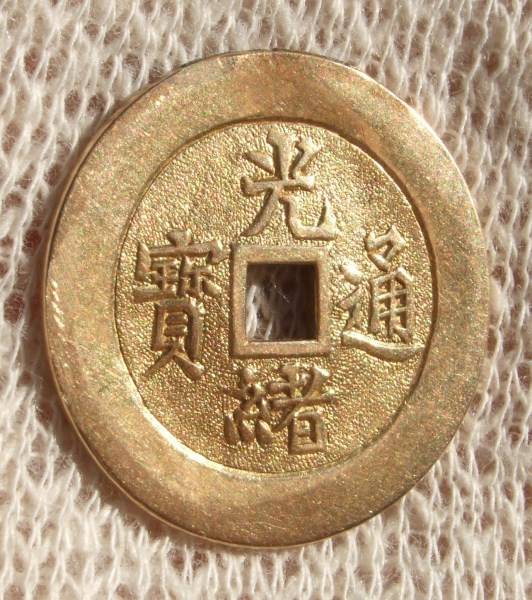
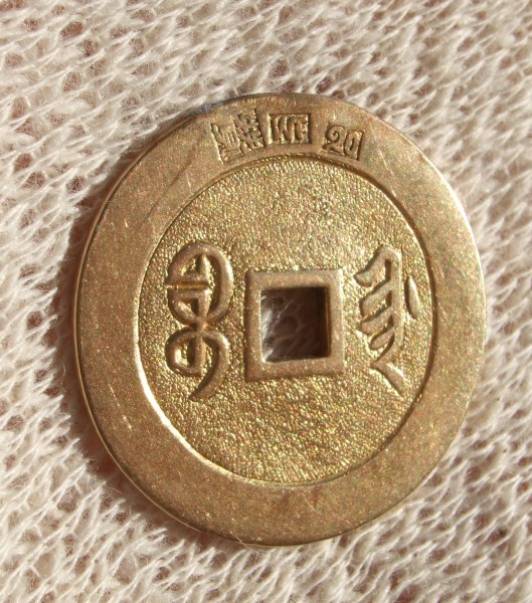
The inscription is guang xu tong bao (å.‰ç»ªe€šå®�) which was used on coins of Emperor De Zong (1875-1908). The reverse side indicates that the coin was made at the Tianjin mint.
This piece was almost certainly made at a later date and at some other place since I am not aware of any gold coins from this period that resemble a common struck copper coin.
Also, I am unclear as to the meaning "in the style of 10 cash". The diameter of the coin is about the same as a standard cash coin. "Ten cash" coins were larger in diameter. Also, all the "10 cash" coins from the Guangxu period were zhong bao (e‡�å®�) and not tong bao (e€šå®�).
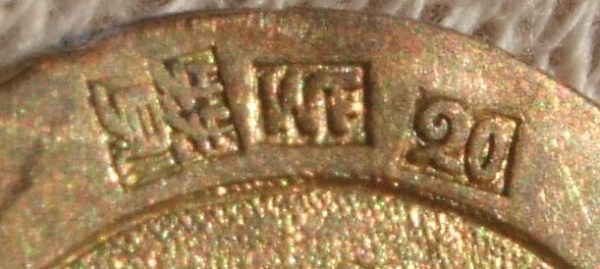
I know nothing about hallmarks but the Chinese character at the left may be zan (è´Š) which has various meanings including "support", "praise", "eulogy", etc.
Incidentally, the calligraphy on the coin looks odd to me. It certainly is not in the same style as the official coins issued during the Guangxu reign.
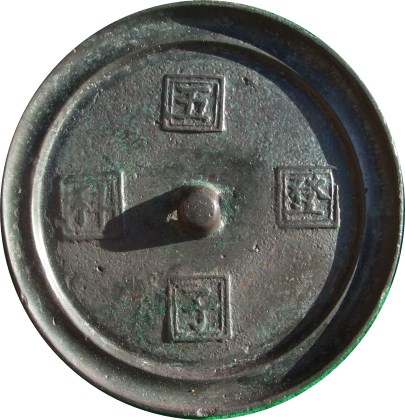
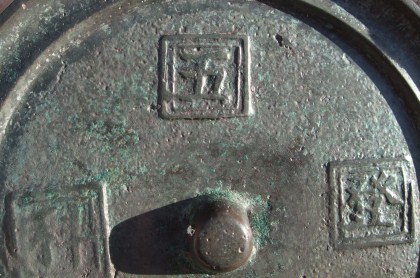
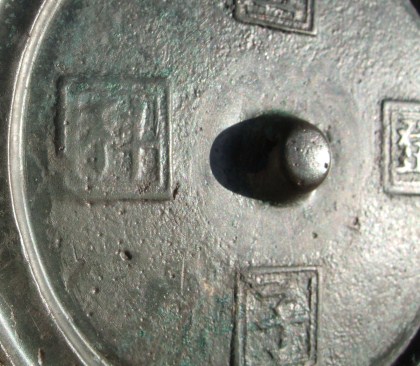
These are not charms but bronze mirrors.
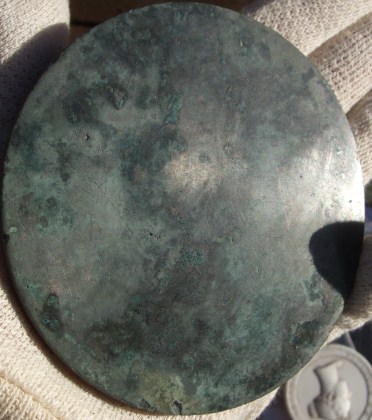
The reverse side would be polished so that one could see his/her reflection.
The side with the inscription has a knob in the center through which a cord could be attached to facilitate holding and carrying the mirror.
The first bronze mirror has the inscription "wu zi deng ke" (äº"å�ç™»ç§') which translates as "May your five sons achieve great success in the imperial examinations".
In ancient China, the ideal family was believed to consist of five sons and two daughters. It was every family's wish that their son(s) would be successful in the examinations resulting in a high government position with honor and wealth.
If interested, you may see a Chinese charm with this inscription here.
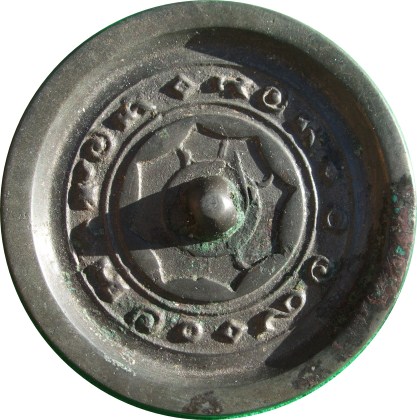
I know nothing about Chinese bronze mirrors but the second mirror looks vaguely familiar. I think it is modeled after a Western Han Dynasty mirror which I read about some time ago. The center octagon design, I think, is supposed to represent the sun with its rays extending outwards. The symbols in the band near the perimeter represent stars, the moon, clouds and other celestial objects. Actually, you can probably disregard everything I just wrote because I just cannot remember enough to really say anything with confidence.
This appears to be a very nice reproduction of an official charm issued in 1894 by the court to commemorate the 60th birthday of the Empress Dowager Cixi who was the real power behind the throne in the final years of the Qing Dynasty.
To the ancient Chinese, attaining an age of 60 was a major milestone in life.
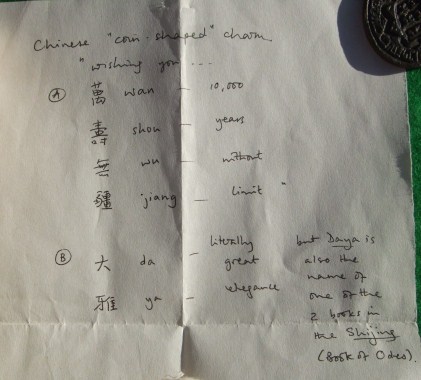
You have the correct translation "wan shou wu jiang" (万寿æ- ç-†) meaning "ten thousand years without limit". This was an auspicious way to wish the Empress Dowager Cixi a long life.
The inscription on the reverse is "da ya" (大e›.) which means "great elegance".
The reference is to the Empress Dowager Cixi who was well-educated and a patron of the arts.
She lived in a palace called the "Palace of Gathered Elegance".
There was also an imperial workshop named the "Studio of Great Elegance" where porcelain and other fine works of art were created for her.
There are many reproductions of this charm. Some are well-made and some are fairly crude. Some are "old" while many more are "modern".
If you look at the first charm at this Chinese website, you will see what is considered to be a rare, authentic version of the official palace charm. The strokes in the characters are very thin and finely sculptured.
If you scroll down, you will see reproductions of the charm in varying degrees of excellence and age.
I learned something very interesting in reading this article (actually a thread in a forum).
In the very first image, please look very closely at the "wu" (ç„¡) character, meaning "without", which is to the right of the square hole. There are four vertical lines in the center of the character. If you look at the third vertical line from the left, you will notice that it is slightly shorter than the others.
Apparently, only the authentic pieces have this characteristic. In all the reproductions this stroke is the same length as the others.
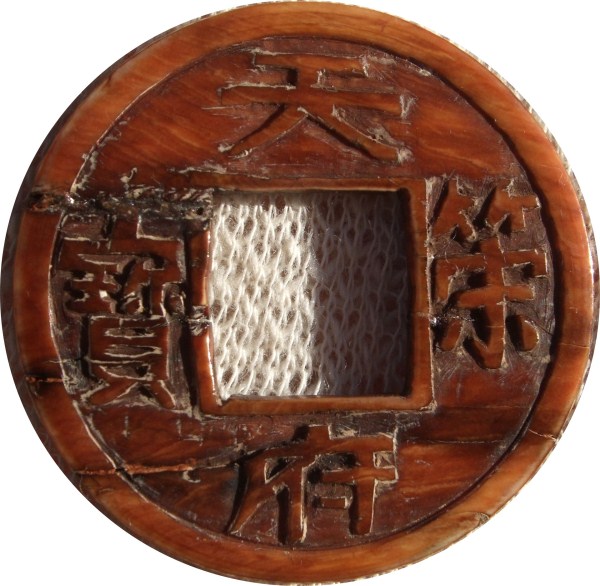
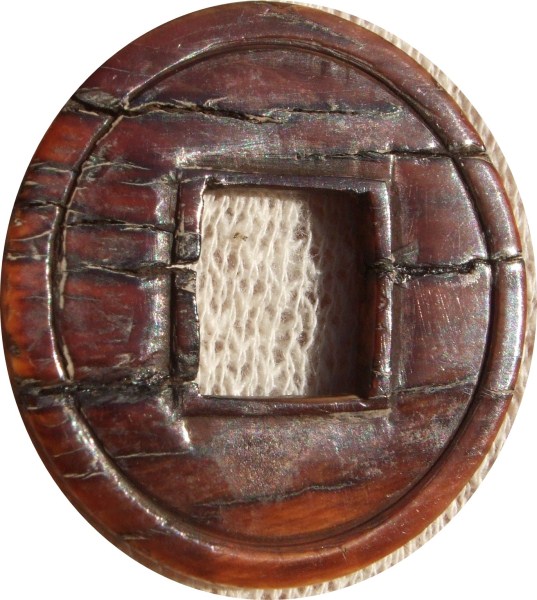
This is actually a reproduction of an ancient Chinese coin. The inscription reads "tian ce fu bao" (天ç-府å®�).
This inscription was used on a very rare iron coin cast in 911 by "Supreme Commander Ma Yin" of the Kingdom of Chu (907-951) during the "Ten Kingdoms" period.
I cannot date or give values for any of the pieces in your collection but I hope you find the above information helpful.
(Unfortunately, the software on this site will not display certain Chinese characters.)
Gary
Quote:
1. gold charm in the style of 10 cash. Interestign hallmarks,...
1. gold charm in the style of 10 cash. Interestign hallmarks,...
The inscription is guang xu tong bao (å.‰ç»ªe€šå®�) which was used on coins of Emperor De Zong (1875-1908). The reverse side indicates that the coin was made at the Tianjin mint.
This piece was almost certainly made at a later date and at some other place since I am not aware of any gold coins from this period that resemble a common struck copper coin.
Also, I am unclear as to the meaning "in the style of 10 cash". The diameter of the coin is about the same as a standard cash coin. "Ten cash" coins were larger in diameter. Also, all the "10 cash" coins from the Guangxu period were zhong bao (e‡�å®�) and not tong bao (e€šå®�).
I know nothing about hallmarks but the Chinese character at the left may be zan (è´Š) which has various meanings including "support", "praise", "eulogy", etc.
Incidentally, the calligraphy on the coin looks odd to me. It certainly is not in the same style as the official coins issued during the Guangxu reign.
Quote:
2 + 3. a Pair of HUGE charm - type bronze pieces.
2 + 3. a Pair of HUGE charm - type bronze pieces.
These are not charms but bronze mirrors.
The reverse side would be polished so that one could see his/her reflection.
The side with the inscription has a knob in the center through which a cord could be attached to facilitate holding and carrying the mirror.
The first bronze mirror has the inscription "wu zi deng ke" (äº"å�ç™»ç§') which translates as "May your five sons achieve great success in the imperial examinations".
In ancient China, the ideal family was believed to consist of five sons and two daughters. It was every family's wish that their son(s) would be successful in the examinations resulting in a high government position with honor and wealth.
If interested, you may see a Chinese charm with this inscription here.
I know nothing about Chinese bronze mirrors but the second mirror looks vaguely familiar. I think it is modeled after a Western Han Dynasty mirror which I read about some time ago. The center octagon design, I think, is supposed to represent the sun with its rays extending outwards. The symbols in the band near the perimeter represent stars, the moon, clouds and other celestial objects. Actually, you can probably disregard everything I just wrote because I just cannot remember enough to really say anything with confidence.
Quote:
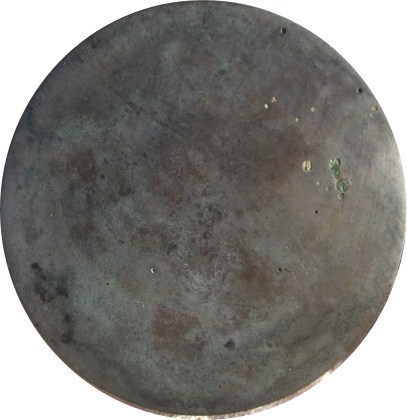
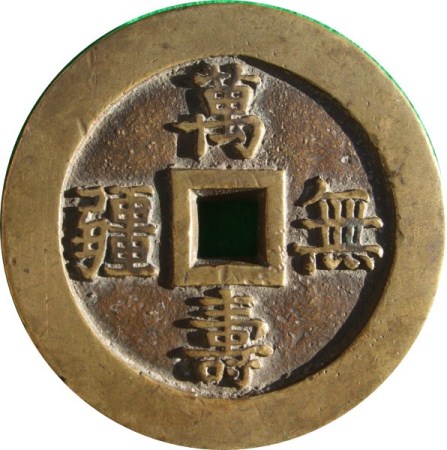
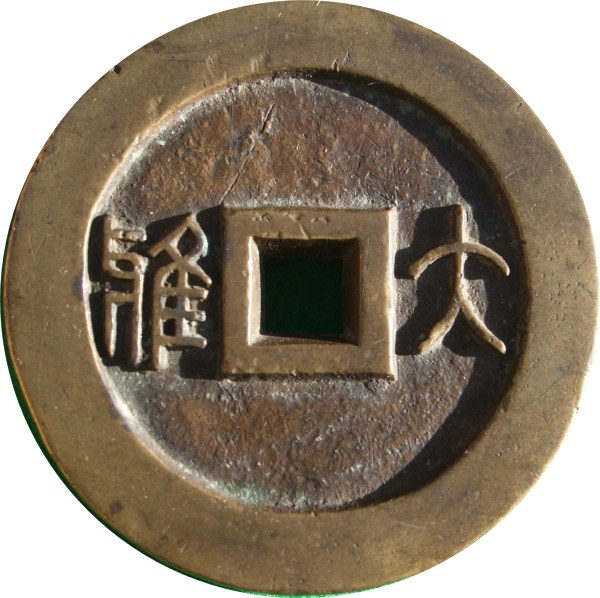
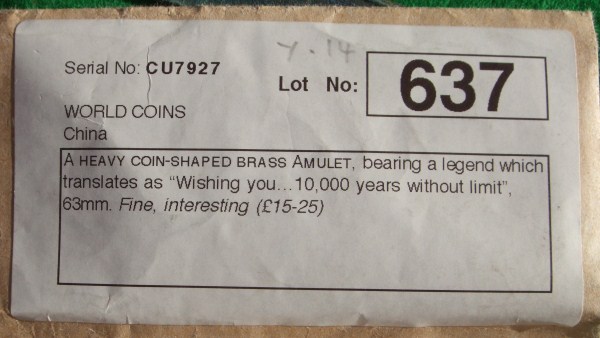
4. A very interesting Large Charm in the form of cash....
4. A very interesting Large Charm in the form of cash....
This appears to be a very nice reproduction of an official charm issued in 1894 by the court to commemorate the 60th birthday of the Empress Dowager Cixi who was the real power behind the throne in the final years of the Qing Dynasty.
To the ancient Chinese, attaining an age of 60 was a major milestone in life.
You have the correct translation "wan shou wu jiang" (万寿æ- ç-†) meaning "ten thousand years without limit". This was an auspicious way to wish the Empress Dowager Cixi a long life.
The inscription on the reverse is "da ya" (大e›.) which means "great elegance".
The reference is to the Empress Dowager Cixi who was well-educated and a patron of the arts.
She lived in a palace called the "Palace of Gathered Elegance".
There was also an imperial workshop named the "Studio of Great Elegance" where porcelain and other fine works of art were created for her.
There are many reproductions of this charm. Some are well-made and some are fairly crude. Some are "old" while many more are "modern".
If you look at the first charm at this Chinese website, you will see what is considered to be a rare, authentic version of the official palace charm. The strokes in the characters are very thin and finely sculptured.
If you scroll down, you will see reproductions of the charm in varying degrees of excellence and age.
I learned something very interesting in reading this article (actually a thread in a forum).
In the very first image, please look very closely at the "wu" (ç„¡) character, meaning "without", which is to the right of the square hole. There are four vertical lines in the center of the character. If you look at the third vertical line from the left, you will notice that it is slightly shorter than the others.
Apparently, only the authentic pieces have this characteristic. In all the reproductions this stroke is the same length as the others.
Quote:
5. Last one for now though I've still several more to work on. Appears to be made of bone! Rather interesting, not seen anything like it.
5. Last one for now though I've still several more to work on. Appears to be made of bone! Rather interesting, not seen anything like it.
This is actually a reproduction of an ancient Chinese coin. The inscription reads "tian ce fu bao" (天ç-府å®�).
This inscription was used on a very rare iron coin cast in 911 by "Supreme Commander Ma Yin" of the Kingdom of Chu (907-951) during the "Ten Kingdoms" period.
I cannot date or give values for any of the pieces in your collection but I hope you find the above information helpful.
(Unfortunately, the software on this site will not display certain Chinese characters.)
Gary


