| Author |
 Replies: 18 / Views: 3,142 Replies: 18 / Views: 3,142 |
|
New Member
United States
27 Posts |
A few years back I purchased a large can of Lincoln wheat cents off an elderly fellow who's wife died in a car crash. She collected them when she worked at the bank way back in the 1960's. I'm pretty sure she was into collecting the oddities because the can had all that plus a 55 Double Die. Well anyways... I picked through the booty and came across these strange looking Lincoln's of what looks to be of the Jam Strike type. But then again I'm not know. It does look like an edge of a coin could do this. The refrence guide I use shows two examples. There is only a semi-resemblance to what I have here as appose to those in the book. the dates are 1946, 1951, 1955, and 2 1957D's. 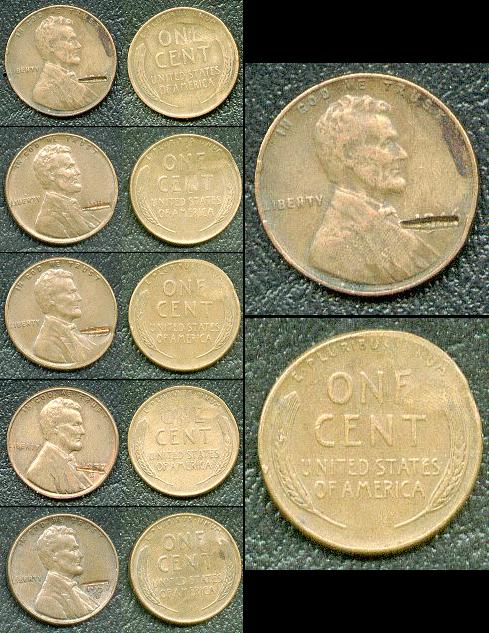 Here is where I get lost: 1. The questioned "jam?" coins seem only to appear at the date. Maybe this was more obvious to the lady who pulled them, thats why so many. 2. Three coins where filed, showing filing marks on the 1946, 1951 and 1955. Okay I'm just quessing but were these coins filed out of a stuck position to get them off the pess? On the 1946, 1951 and 1955's edges, it looks as though there may have been some sort of impact causing the planchet to go out of round seen near the dates. Or lets re-discribe this as a dented edge. On the two 1957D edges there appears to be probable impacts of lighter proportions because those areas to look flatend rather than dented. Here there is no filing marks. These descriptions I give do not match up with in the Jam Strike section of the book. Are there multiple thing going on here including human error? 3. The questionable Jams and filing appear to blend in finely " tone well " with the age of the coins, and all are of various colors. So I would think these things where done sometime during the minting proccess, and open mindedly or very shorlty there after. 4. If these are Jam Strikes, what is the rarity level or value of this type. I know, judging from the number I have they don't look so scarce. :) |
|
|
|
Pillar of the Community
United States
7629 Posts |
There is no such thing as a "jam strike" in numismatic terminology. I'm not certain what you're asking about.
Your images show a few coins that were hit outside the mint with a chisel or screwdriver to 'cancel' out the date. They are considered damaged coins. They are not errors.
|
|
New Member
 United States
27 Posts |
Official Price Guide - Minting Varieties and Errors 5th Ed. 1991 - by Alan Herbert, Page 228 - III-5 JAM STRIKE (IE). This is where the terminology came from. Not that I made it up or anything. If you haven't heard of the terminology, nor know what a coin of this type would look like, what makes you think there's no such thing and that mine was hit with a chisel or screw driver? A far as it not being a terminology in the numismatic relm, the book says different.
|
|
Valued Member
United States
382 Posts |
jim in wmas I've got 'alan herbert's 'sixth'edition of;"the offical Price Guide to MINT ERRORS.how I got is a side line ; went to 'club' coin show in scottsdale ,AZ.,and he was there .. he allowed me to secure one from him 'on my word' that I would send him the 'monies' which I did.graciously he also signed it personally to me. what an experience.what an admirably kind soul...on pages 239+2409sixth ED.) the 'same'at least mention of: jam strike info is covered ,the definition contains the use of: "planchet" which is an unstruck coin..before a 'coin is struck'='s no design elements ,just plain,smooth.to keep this to the point; your coins show full 'design elements' ..as to what they show i'd go with CD's (coppercions0 response..
|
|
New Member
United States
27 Posts |
Hi errorfinder,
I think we are looking at two different definitions as the info supplied through clear state that the design is pushe through to the poin of the die.
Here is Alan Herberts
A jam strike is defined as : A planchet lying flat in the coining chamber , struck with a second planchet standing on edge on top of it causing it to be driven into the object planchet. This in turn, is driven into the die only at that point, showing on the struck coin as an indention in one side of the planchet and a small portion of the die design on the opposite side at that point.
It is obvious in these photo tha a strike effected a small portion of the design on the opposite side. And my descriptions of the indentation follows the rule of the description.
The reason why you see an example that is blank is because Herbert had examined only two. Probalbly in my quesstamation two the layed on the floor of the mint or some one connected. He does go on to state that he has seen only two examples of this "Jam Strike". He further goes on to state that only one or two have been reported. Well I think I might be reporting some unknown jam strikes.
Did you know that the first 1955 double die was found in the little known town of Greenfield Mass. This is where I live.
Who's to say that five of these "questioned Jam Strikes" did not make it this way by a collector?
What I did not like and I respect your opinion, is that you said there is no such thing a s Jam Strike in numismatic terminology, but now there is, and cut the coins to the mat.
Apparently not many have seen a Jam Stike coin.
|
|
New Member
United States
27 Posts |
I need to add one more thing to this. I looked all the way back into the hallow of the questioned strikes. Clearly seen in the lage picture is the date the 1946. All the way back I can see the date strectched out and goes all the way to the base. A blank planchet, prior to pre-strike would leave a rounded edge all the way to the base. Obviusly its rounding inside because the date can be seen
One dose'nt have to be a rocket scientist to know a screw driver of squared edge and a chisel of Squared edge and beveled can't creat the same impressions seen on these coins without leaving squared edges and obscuring the detail. I would think one would see a a sqared impression or lines, on the back of the coin if a chisel or screwdriver were used. This it clearly dose'nt show.
Edited by jim in wmass
01/09/2007 02:47 am
|
|
Pillar of the Community
United States
7123 Posts |
Hi Jim One of the cool things about errors is the opinions that can be presented and then discuss with hopefully a concenus of opinion being formed . so I will throw my Two Cents in just for good measure. In the description that you have given(Im using this because I have never heard of the error before today )Im also assuming that it is a verbatum rendition of the book. In the description, there is no description as to which die is the obverse and which die is the reverse,, this simple piece of information is needed to determine on which surface the dent would occur and on which surface the flattening would occur . In most cases the obverse die would be the anvil die,(fixed ) or in this case the bottom die,, would this not require the indented portion of the coin to be the Reverse and lightly srtruck portion to be the obverse ? thus causing the flattening to be present on the obverse . I bring this point up because it had not been mentioned ,and in fact needs to be considered when trying to define attributes of the jam strike. secondly does a cent edge fit in the indented area ? and go to the bottom ? it seems to me that if the indentation was caused by a cent edge then a cent edge should fit at least very closely into the dent . My third and final point has to do with both surfaces being struck,, if the next cent was struck on the edge and driven into the planchet below would that surface even show any design of the die ? or would the design be for the most part perfectly struck as your coin demonstrates ? Just some food for thought. Rick |
|
New Member
United States
27 Posts |
Good morning Metalman, Been up all night trying to take some close-up pics of a couple of my pieces. Now I'm not saying these are the types of strike mentioned in the book, but the description and my coins surely relate well to each other. But it might be something else and will explain a little in a minute. Yes I thought about a coin being place on it's rim an aligning it to the jam, but then thought it would be fair because of the rim as oppose to the no rim planchet. The metal of the planchet in the rim area would expand greatly I would think, sinc the metal is push out to the rim. Hebert's book reads it on page 225 - III-I-1 Die Adjustment Strike (IE). Herbert defines it as a coin struck during a die adjustment, then showing on the struck coin, weakly struck parts of the design appearing on the 2 side of the coin and the rest missing due to the low striking pressure used. This description does not fit my coins because they are strongly struck. But I would think they could use different pressures and real coins, depending on the circumstances. Continuing onto the next page showing a die adjustment strike (obv.) Ike Half Dollar with only an outline of his face showing. Then there is a deep indentation of a slightly different shapes. This indentation is explained because it was under a jam strike. Herbert goes onto mention that the Jam Strike was deliberately struck by the die setter, and for collectors to have them were probably accidental. Suppose my coins might be something like those those? This would make even more scence then just a jam strike alone. Does'nt a die setter work with tools like files? People in manufacturing are always taking short cuts. I would suppose the die setters could just reach for some pennies to do the same thing and of course not tell the boss. Or maybe the boss told him to take a short cut. Or maybe they were allowed to use any coin they wanted. Here are some more rederings I did this morning. 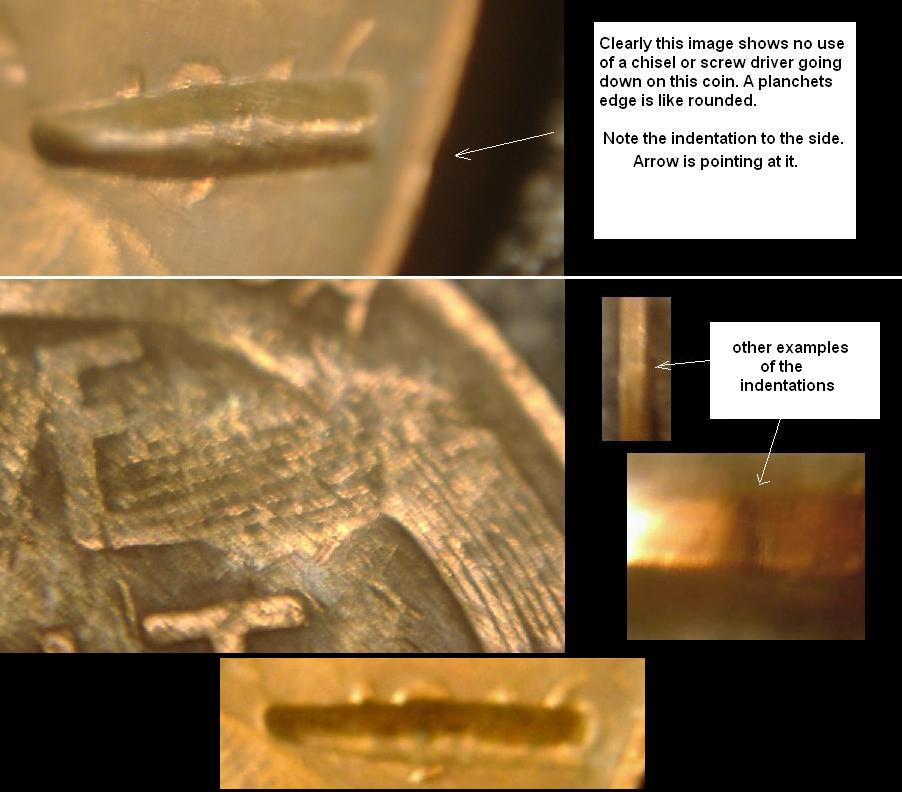 Going to bed now Take care the both of you Metalman and errorfinder Jim |
|
Pillar of the Community
United States
577 Posts |
If they are real jam strikes, that would be really great. However, I think that since there are only have been two reported so far, the odds of the woman finding five of them, and all having the jam in the date, are pretty high. I'll be watching this post!
|
|
Pillar of the Community
United States
7629 Posts |
So jam strike is a real term, just never heard of it myself. That doesn't change the fact that the indentions on all your coins are post-mint and caused by hammering some tool into the date of the coins.
1. All of them are on the date. Doesn't that seem sort of fishy to you?
2. None of them are the right thickness for a cent, nor do they appear to be caused by something rounded. All of them were caused by something squared off.
3. All of them show evidence of the pounding on the reverse. If a true 'jam strike', these would have happened in the coining chamber and would be sitting against the reverse die. The reverse wouldn't show any sign of the problem on the obverse.
4. As pointed out before, evidently jam strikes are very rare. You have nearly a half dozen coins, all from different dates, and all of them damaged at the date. If these are so rare, your chances of hitting that many of them in one change jar would be astronomical. Maybe a career in lottery tickets is looming?
All logic points to these being damaged coins, hit by someone who was bored with a chisel or screwdriver and had nothing better to do, probably very long after the coins left the mint. They were saved because they looked odd to the non-collector who saved them.
|
|
New Member
United States
27 Posts |
Greatings madhandles761991, That would be nice if they where some sort of Jam strike. One thing though my 1st post was for the Jam Die only. That's the one I asked about in the beginning. The number he examined were two and only a couple have bee reported since. This was prior to his 1991 publication. But then there is a second The Intentional Die Jam. A Die setter can creat one anywhere on a coin. He does not state anything about the number he has examined, but the rarity scale drop one to two notches down the scale. Who knows it could be a 4. The intentional is the one mine resembles mpre closely. Good Day Coppercoins, Yes I'll agree with your point about what you reguard as hammering since you insist on using the term. But to say a hammer or hammered is far fetched since there is no evidence of a true hammer, mallet, a stone ever hitting these pieces; except for that indentation that may have been caused from an intensional Jam Strike on the side and the place at the date where a planchet may have hammered into all may have been the cause of a Jam Strike of a sort. When I look at these coins, I don't judge them for what I see, but for what they might be. That's what a variety collector should truely do, he looks for everything. Take away the Errors as defined by the Error collector and you still have a VARIETY of issue within the coining process. And most with a rarity scale. Machanical issues are known to happen such as a mechanically damaged planchets. You probably don't collect those though because they were chewed by a machine used in the mint process. If the machine blundered, that's an ERROR on the machines part. I'm looking for it all, the suspicious, even the ugly in the coining process. I believe my coins may have issues done to it by a die setter at the mint. If so it was done during the minting process. But instead of you looking at these as ERROR coins as you called it earlier, why not look at it a VARIETY since this is a " VARIETY" and ERROR board. I never said it was an ERROR. All I said is they were found in a can with a lot of errors including the 55 Double Die. About your points. " All of them are on the date. Doesn't that seem sort of fishy to you? " 1. I could argue the fact that there seems to have been a lot of problems going on in the date area of the Lincoln Cent in those periods, especially with breaks. If the date area was a target of an intentional Jam Strike during a die alignment, then obviously that is where the die setter would place the planchet on edge. So no I don't think that's fishy at all to be placed in the same areas. " None of them are the right thickness for a cent, nor do they appear to be caused by something rounded. All of them were caused by something squared off." 2. How can you judge from where you are that my coins are not of the right thickness, the 1st batch of pics are laying flat ? The second batch of pictures are different sizes is that's your logic? I never stated they were'nt the right thickness? There you go again you make a statement about something you know nothing about. "All of them show evidence of the pounding on the reverse. If a true 'jam strike', these would have happened in the coining chamber and would be sitting against the reverse die. The reverse wouldn't show any sign of the problem on the obverse." 3. All reverses show pertrusions coming out of them, not something pounding on them as you so eliquently state. Since you have never heard of a "Jam Strike" you insist on defining the process. Why do you insist on defining the process, at least quote the source of your information. Find some images of an intentional jam strike, and show them to every one. I would love to see one. "As pointed out before, evidently jam strikes are very rare. You have nearly a half dozen coins, all from different dates, and all of them damaged at the date. If these are so rare, your chances of hitting that many of them in one change jar would be astronomical. Maybe a career in lottery tickets is looming?" 4. I wished I could win the lottery, but then again I do not play with the odds game. But there are three types of Jam Strikes A. an intentional Jam Strike is done during a die adjustment by the die setter. Rarity 5-6 according to the. This might be something like mine B. There is the Jam Strike, nearly similar but of the accidental type and denoting the Die Adjusting - Rarity 7. This one I'm to be backing away from, and am seeing lots more simalarity's with that of 1 the Die Adjustment Jam Strike. So my odd as you look at it have come up a couple notches, meaning a greater possibility. Much more possible than one might think maybe. C. The Jammed Edge Die Strike does not relate to my coins but is a Rarity 7. I throw this in there because it sound the same as the other to but is related to the rim only. So now we have 3 types of jam strikes done by the U.S. Mint, that are not terminology's found in the numismatic world. Who knows there may be other ways of creating a Jam Strike not yet explained. Many collectors may have passed these up when searching thinking it was damage done outside the mint like yourself. The collector may have been told by an ERROR collector like yourself, that they were hammered and held no real value. Believing you were the knowledgable one, they spent them. Maybe this hasn't be reported because some ERROR collectors send the wrong message. That's what I'm trying to say. They may be damaged, but they might be damages from the minting proceess coupled with the human factor or dies setters damages. Since you never actually seen one or heard of one, your points are mute. On page 227. of in The Official Price Guide - Minting Variety and Errors 5th ed, By Alan Hebert III-1-2 Edge Strike (E) section it shows two bent planchets, and the planchet on the left certainly fits the criteria I am looking for when it comes to a intentional jam strike. |
|
New Member
United States
27 Posts |
Quote:Originally posted by jim in wmassGreatings madhandles761991, That would be nice if they where some sort of Jam strike. One thing though my 1st post was for the Jam Die only. That's the one I asked about in the beginning. The number he examined were two and only a couple have bee reported since. This was prior to his 1991 publication. But then there is a second The Intentional Die Jam. A Die setter can creat one anywhere on a coin. He does not state anything about the number he has examined, but the rarity scale drop one to two notches down the scale. Who knows it could be a 4. The intentional is the one mine resembles mine more closely. Good Day Coppercoins, Yes I'll agree with your point about what you reguard as hammering since you insist on using the term. But to say a hammer or hammered is far fetched since there is no evidence of a true hammer, mallet, a stone ever hitting these pieces; except for that indentation that may have been caused from an intensional Jam Strike on the side and the place at the date where a planchet may have hammered into all may have been the cause of a Jam Strike of a sort. When I look at these coins, I don't judge them for what I see, but for what they might be. That's what a variety collector should truely do, he looks for everything. Take away the Errors as defined by the Error collector and you still have a VARIETY of issue within the coining process. And most with a rarity scale. Machanical issues are known to happen such as a mechanically damaged planchets. You probably don't collect those though because they were chewed by a machine used in the mint process. If the machine blundered, that's an ERROR on the machines part. I'm looking for it all, the suspicious, even the ugly in the coining process. I believe my coins may have issues done to it by a die setter at the mint. If so it was done during the minting process. But instead of you looking at these as ERROR coins as you called it earlier, why not look at it a VARIETY since this is a " VARIETY" and ERROR board. I never said it was an ERROR. All I said is they were found in a can with a lot of errors including the 55 Double Die. About your points. " All of them are on the date. Doesn't that seem sort of fishy to you? " 1. I could argue the fact that there seems to have been a lot of problems going on in the date area of the Lincoln Cent in those periods, especially with breaks. If the date area was a target of an intentional Jam Strike during a die alignment, then obviously that is where the die setter would place the planchet on edge. So no I don't think that's fishy at all to be placed in the same areas. " None of them are the right thickness for a cent, nor do they appear to be caused by something rounded. All of them were caused by something squared off." 2. How can you judge from where you are that my coins are not of the right thickness, the 1st batch of pics are laying flat ? The second batch of pictures are different sizes is that's your logic? I never stated they were'nt the right thickness? There you go again you make a statement about something you know nothing about. "All of them show evidence of the pounding on the reverse. If a true 'jam strike', these would have happened in the coining chamber and would be sitting against the reverse die. The reverse wouldn't show any sign of the problem on the obverse." 3. All reverses show pertrusions coming out of them, not something pounding on them as you so eliquently state. Since you have never heard of a "Jam Strike" you insist on defining the process. Why do you insist on defining the process, at least quote the source of your information. Find some images of an intentional jam strike, and show them to every one. I would love to see one. "As pointed out before, evidently jam strikes are very rare. You have nearly a half dozen coins, all from different dates, and all of them damaged at the date. If these are so rare, your chances of hitting that many of them in one change jar would be astronomical. Maybe a career in lottery tickets is looming?" 4. I wished I could win the lottery, but then again I do not play with the odds game. But there are three types of Jam Strikes A. An intentional Jam Strike is done during a die adjustment by the die setter. Rarity 5-6 according to the. This might be something like mine B. There is the Jam Strike, nearly similar but of the accidental type and denoting the Die Adjusting - Rarity 7. This one I'm to be backing away from, and am seeing lots more simalarity's with that of 1 the Die Adjustment Jam Strike. So my odd as you look at it have come up a couple notches, meaning a greater possibility. Much more possible than one might think maybe. C. The Jammed Edge Die Strike does not relate to my coins but is a Rarity 7. I throw this in there because it sound the same as the other to but is related to the rim only. So now we have 3 types of jam strikes done by the U.S. Mint, that are not terminology's found in the numismatic world. Who knows there may be other ways of creating a Jam Strike not yet explained. Many collectors may have passed these up when searching thinking it was damage done outside the mint like yourself. The collector may have been told by an ERROR collector like yourself, that they were hammered and held no real value. Believing you were the knowledgable one, they spent them. Maybe this hasn't be reported because some ERROR collectors send the wrong message. That's what I'm trying to say. They may be damaged, but they might be damages from the minting proceess coupled with the human factor or dies setters damages. Since you never actually seen one or heard of one, your points are mute. On page 227. of in The Official Price Guide - Minting Variety and Errors 5th ed, By Alan Hebert III-1-2 Edge Strike (E) section it shows two bent planchets, and the planchet on the left certainly fits the criteria I am looking for when it comes to a intentional jam strike. |
|
Valued Member
United States
382 Posts |
jin in wmass, "to err is human ,to forgive 'tis devine".first not that coppercoins 'needs' or even wants my defense ,let me point out he is a "coppercoin' variety expert . this coin under disscussion is an 'error'.two different critters.secondly I've made mistakes and after being made aware of them; made efforts to correct them. I have done so-and will continue to do so..as far as i'am aware we are here to learn and share knowledge .. the sharing and learning is done with the intentions of "our best"."our best" changes; as we learn more;from others sharing with us and through our efforts in sharing with others. " Hi errorfinder,
at two different definitions as the info supplied through clear state that the design is pushe through to the poin of the die.
Here is Alan Herberts
A jam strike is defined as : A planchet lying flat in the coining chamber , struck with a second planchet standing on edge on top of it causing it to be driven into the object planchet. This in turn, is driven into the die only at that point, showing on the struck coin as an indention in one side of the planchet and a small portion of the die design on the opposite side at that point.
It is obvious in these photo tha a strike effected a small portion of the design on the opposite side. And my descriptions of the indentation follows the rule of the description.
The reason why you see an example that is blank is because Herbert had examined only two. Probalbly in my quesstamation two the layed on the floor of the mint or some one connected. He does go on to state that he has seen only two examples of this "Jam Strike". He further goes on to state that only one or two have been reported. Well I think I might be reporting some unknown jam strikes.
Did you know that the first 1955 double die was found in the little known town of Greenfield Mass. This is where I live.
Who's to say that five of these "questioned Jam Strikes" did not make it this way by a collector?
What I did not like and I respect your opinion, is that you said there is no such thing a s Jam Strike in numismatic terminology, but now there is, and cut the coins to the mat.
Apparently not many have seen a Jam Stike coin."first I have to wonder how we could be looking at two different definitions of: jam strike" as the same author,same book (other than)editions being one apart.as in my previous post " quote:
on pages 239+2409sixth ED.) the 'same'at least mention of: jam strike info is covered ,the definition contains the use of: "planchet" which is an unstruck coin..before a 'coin is struck'='s no design elements ,just plain,smooth.to keep this to the point; your coins show full 'design elements'
" ..the reason alan herbert's pictures show faint design elements, is that, a jam strike starts with a planchet; a planchet is a blank that has only the rim 'edges'added to it.thus it still smooth ie. plain.your coins show full design elements so in my thinking they would not be included in this 'class'based one alan's current definition , thats all I'm in difference about (your possible reporting of "new" jam strike examples.in my own defense it was not me that wrote. " is that you said there is no such thing a s Jam Strike in numismatic terminology," .as where die adjustment strikes being part of the puzzle. based on again allan's definition of a die adjustment strike ;such coins would be weakly struck as they are part of the set up process beginning with lower pressure *(thus weakly struck ,equaling weak design features)*my words* in doing the setup the setter gradually increases the pressure till both sides of the coin metal in the design of the dies are filled.referencing your coins which so far you've shown appear to be of 'full design' elements showing. for me would not fit in as part of the puzzle,as the solving of it , anyways , which is why we are here responding to your post ." A jam strike is defined as : A planchet lying flat in the coining chamber , struck with a second planchet standing on edge on top of it causing it to be driven into the object planchet. This in turn, is driven into the die only at that point, showing on the struck coin as an indention in one side of the planchet and a small portion of the die design on the opposite side at that point.
It is obvious in these photo tha a strike effected a small portion of the design on the opposite side. And my descriptions of the indentation follows the rule of the description " in effort to help you ,i'll give you my interpretation of this;#1 ; a planchet read as:an unstruck coin 'a coin blank's second stage' second stage being the edge; ie. rim being(rolled) onto. #2 the setter "may have set a planchet on top of a planchet [in the coining chamber]again according to alan's book.so the 'rule of the description'starts with a planchet ie. a plain ie. smooth ;void of any design elements piece of (punched out round metal having been run through a "upsetting machine [which is a drum like round tumbler]compare to a concrete truck or smaller mixer,rolling an 'uppset rim' (raised)above normal blank thickness ,thus now a planchet ready for striking.back to the def,:A jam strike is defined as : A planchet lying flat in the coining chamber , struck with a second planchet standing on edge on top of it causing it to be driven into the object planchet. This in turn, is driven into the die only at that point, showing on the struck coin as an indention in one side of the planchet and a small portion of the die design on the opposite side at that point. It is obvious in these photo tha a strike effected a small portion of the design on the opposite side. And my descriptions of the indentation follows the rule of the description" .the showing in mind is the 'design elements only showing 'up' at the point of impact of the (second)jamming coin on the jammed coin's opposite side ; the "and a small portion of the die design on the opposite side at that point" ie opposite of the indentation .with 'best'intentions; that we all progress, in our sharing and in our learn'ins. |
|
Pillar of the Community
United States
7629 Posts |
I'll give one last try at it then leave this one alone for good.
1. I said nothing regarding the thickness of the coins. What I mentioned is that the slots cut into your coins are not the correct shape or thickness to have been caused by an on-edge planchet.
2. I see obvious flattening on the reverse of all of the coins. This means that whatever struck the grooves into the obverse of the coins in question struck said coins out of the minting chamber, thus out of the mint. In other words, post-mint damage.
3. All of the coins in question were completely struck and THEN hit with whatever they were hit with. By your own description a jam strike wouldn't affect the coins in this manner. They would not be completely struck.
4. You have five coins that were obviously hit with the same tool around the same time period outside the mint. I don't know what's difficult about believing they are damaged, having been hit with what appears the right size and shape for a straight tip screwdriver...possibly a chisel.
5. I am not an expert in errors, this much is well known and I say so myself; but I do have a lot of experience looking at coins people find, and have gained a good deal of knowledge in determining what is a genuine error versus what is damaged goods.
6. Since I know Alan Herbert personally, I will forward your image to him and get his answer directly - but I assure you it will be the same as mine.
Good Day.
|
|
New Member
United States
27 Posts |
Okay but remember I am no longer looking for a jam strike, it is a deliberate or intentional jam stike I'm catering to. There's a difference. On page 227. of in The Official Price Guide - Minting Variety and Errors 5th ed, By Alan Hebert III-1-2 Edge Strike (E) section shows two bent planchets, and the planchet on the left certainly fits the criteria I am looking for when it comes to an intentional jam strike at least in looks. The flange pertruding off the planchet is nowhere near as thickness of a cent itself, and one could venture to guess that the particular pertrusion would be able to easily fit into the grove properly. I understand what you are talking about when it come to the thickness of the gap as oppose to the thickness of a coin to fit into it. So that is one I will conceed. Sorry about that one. All said, I look forward to hearing from Mr. Herbert should he come. I'm pretty sure his opinion will be respected and accepted by me. Here is the coin I believe you are talking about. This dose not look to me to be something struck with a hammer outside the Mint. It look like either part of a design or a planchet defect. This is my 3rd edit about this image: Actually it's an up side down Lincoln coming through. I went to the original image on my hard drive, and flipped the image around and this is what I see. A ghost image of backwards Lincoln maybe, probably a coin pressed onto the surface. But it looks as though the Wheat back was struck over that. The letters in ONE would clearly show some effect of a hammer strike and I don't see it. I see a distorted E in one, which may be a result of an deliberate jam by the die setter. 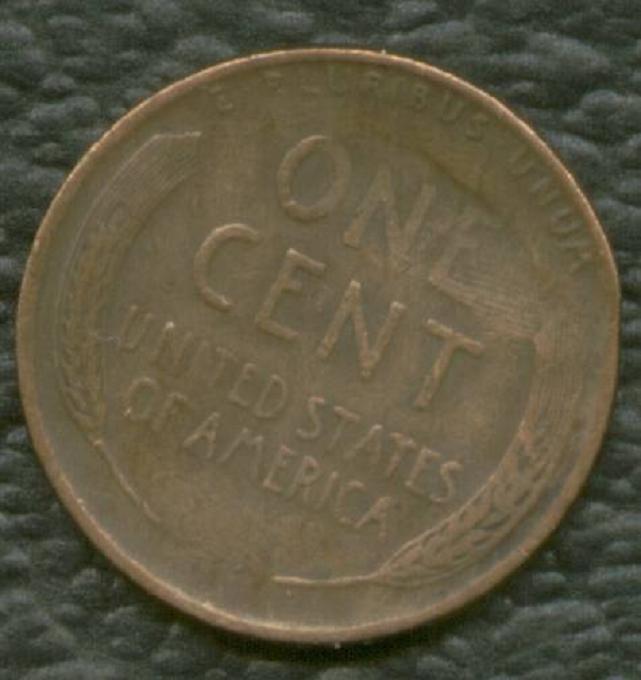 Next I see a weakly struck ONE press over some forgien material, maybe grease. Something that might happen during a die alignment? 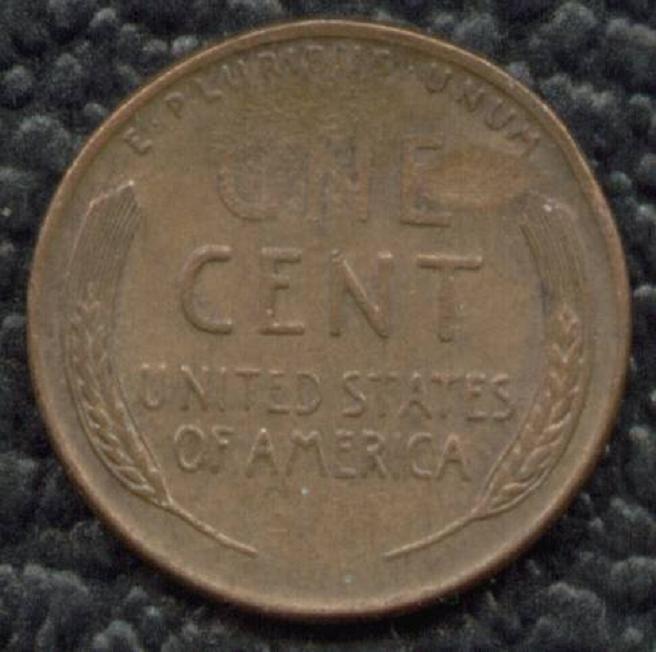 Here I see a break in the tip of the grain in the wheat twist over into the lines of the wheat, A break on the rim, both on the lest side. 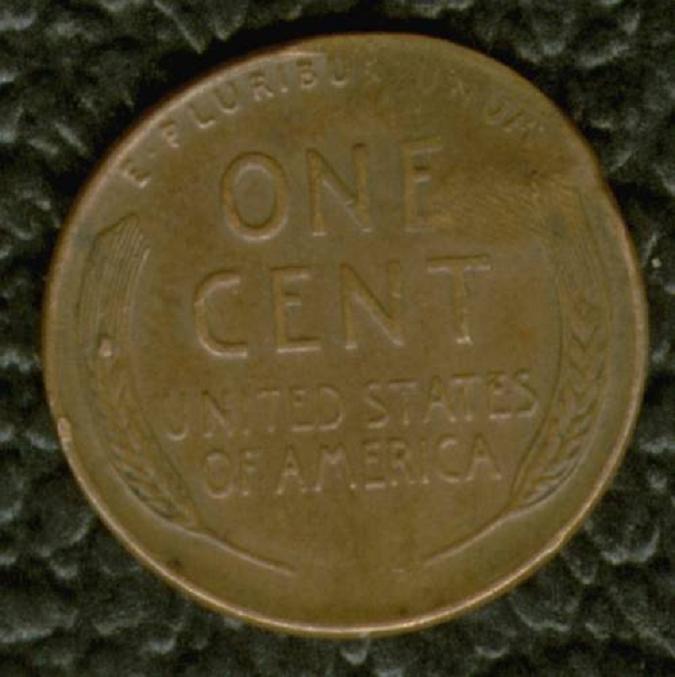 Obviously to me anyways, something was going on with the dies. Three of the five show the effects of what might call for a die adjustment. Edited by jim in wmass
01/10/2007 12:16 am
|
|
Pillar of the Community
United States
7629 Posts |
The email from Alan Herbert, exactly as I received it:
Hi Chuck:
This is definitely damage after the strike. The portions of the date digits in the hole clearly show, driven down in by whatever made the hole. Since the coin is well worn it's going to be difficult, if not impossible to authenticate the piece. I don't have pictures of a jam strike, other than the one with the class in the book. Actually that's the only one I've seen,although I've had a report or two. A jam strike shows none of the design on either side, except for the small area opposite the point of impact from the other planchet, driving that part against the die. Since this coin has full design on both sides it cannot be a jam strike.
Regards,
Alan
|
| |
Replies: 18 / Views: 3,142 |
To participate in the forum you must log in or register.
 
- How Dan O'dowd Built One Of The World's Greatest Ancient Coin Collections
- Top Coin Collecting Stories For The Week Of September 18, 2026
- 1949 Lincoln 1c Damaged 4?
- Help With Identification Please.
- 1969-S Lincoln Cent Machine Doubling Or Double Die Obverse
- 1999 Lincoln Cent - Die Clash
- 1809 Half Cent For Grading
- 1987 - D Lincoln Cent Grade Check
- 1987- D Lhc Possible RPM Or DDO In Date
- You Know What I Want That Final Number To Be
- Bronze Coin To Id. Greek Or Roman?
- A Ridiculously Badly Written Computer Aided Book, Coin Collecting Bible, 2024
- Liberty Head 10/11 Stars Obverse With A Sick Looking Eagle On The Reverse Holed 0.59g 13.06mm
- The Tyrant Collector - PCGS Youtube Interview
- Counterfeit Detection: ANA Video - Introduction, With Brian Silliman And Jim Robinson Ep. 1
- Counterfeit Detection: ANA Video - Mistakes, Risk Factors, And Counterfeits & Alterations, Ep. 2
- Counterfeit Detection: ANA Video - Pimples And Pits, Looking At Cast Counterfeits, Ep. 4
- Counterfeit Detection: ANA Video - What Year Is That Cent? Key Date Coins, Ep. 5
- Counterfeit Detection: ANA Video - Diagnostics Of The 3, 5, And 10 Cent Coins, Ep. 6
- Counterfeit Detection: ANA Video, Counterfeit Quarter Dollar Diagnostics, Ep. 7
Disclaimer: While a tremendous amount of effort goes into ensuring the accuracy of the information contained in this site, Coin Community assumes no liability for errors. Copyright 2005 - 2026 Coin Community Family- all rights reserved worldwide. Use of any images or content on this website without prior written permission of Coin Community or the original lender is strictly prohibited.
Contact Us | Advertise Here | Privacy Policy / Terms of Use
|
| Coin Community Forum |
© 2005 - 2026 Coin Community Forums |
| It took 0.54 seconds to rattle this change. |
 |
|










 Posted 01/08/2007 11:43 pm


