| Author |
 Replies: 7 / Views: 2,758 Replies: 7 / Views: 2,758 |
|
|
Bedrock of the Community
United States
10045 Posts |
This coin exhibit had an interesting section on a king that exhibited a physical abnormality, and an explanation as to the cause. What follows is a translation of the exhibit, which I have embellished slightly for clarity in English. If the theory is correct, it could be the earliest depiction of a medical condition on a coin. Did King Øystein have Grave's Disease? Can Øystein coins be identified?A stunning bust of King Øystein is preserved, where the king's name and title are clearly shown (as well as his bulging eyes). The sculpture was probably made shortly after his death in 1123. This group of pennies can be placed to the time when Øystein reigned together with his two brothers. The coins have all the king's pictures, sometimes on both sides. Unfortunately there are none with a legible king's title. However, some of the coins depict the king with unusually large eyes. This is not a stylistic trait. As an example, there is a coin with two royal heads, of which only one has big eyes. The nearest analogy is the bust of Øystein, which also has distinctive, large protruding eyes. If we look at patients with hyperthyroidism, also known as Grave's Disease, we find many people with "King Øystein -eyes" - strongly wide-open and bulging. Could there be a connection? The king's picture on coins of this period are not realistic portraits, but certain physical characteristics can be seen on coins of the same king. When a distinguishing feature is found on a sculpture that is clearly King Øystein, it opens the possibility to speculate as to the cause. Here is King Øystein's bust, clearly showing the protruding eyes.  And here are drawings of coins from this period, some showing the bulging eyes, including an actual coin.  Edited by DVCollector
12/31/2011 12:26 pm
|
|
|
|
Pillar of the Community
United States
2605 Posts |
Very interesting, DV, thank you. Here's the "numismatic medical history" of George III put together on a single coin: 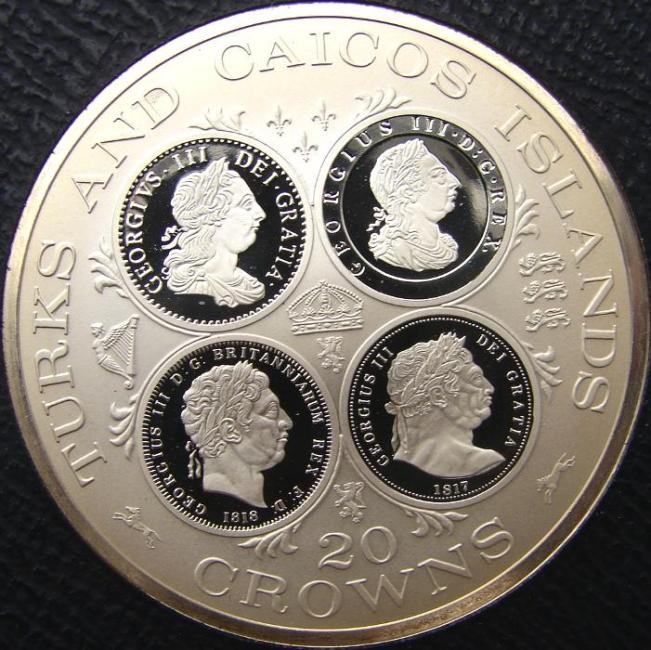 |
|
Pillar of the Community
Canada
1610 Posts |
He looks constipated in the 1817 one.
|
|
Bedrock of the Community
Australia
21794 Posts |
No wonder George 1V didn't like Pistrucci's work, and was instrumental in relieving him of his duties!
For most people's tastes, the portraiture is too brutal.
Nevertheless, Pistrucci made 'Moonshine While the Hay Grows' with his famous work of St George and the Dragon.
Unfortunately, I had a friend who died of hyperthyroidism, caused by an unidentified infection. Very sad.
|
|
Bedrock of the Community
 United States
10045 Posts |
Yes, I've read how serious Grave's disease can be. I'm sorry about your friend.
Whatever the cause, King Øystein's life was brief--only 35 years.
|
|
Moderator
 Australia
17031 Posts |
Quote:
If we look at patients with hyperthyroidism, also known as Grave's Disease, we find many people with "King Øystein -eyes" - strongly wide-open and bulging. Could there be a connection? The king's picture on coins of this period are not realistic portraits, but certain physical characteristics can be seen on coins of the same king. I an always wary of speculation that attempts to definitively link unusual artistic representations with some kind of modern medical diagnosis. I'm reminded of the people that find all sorts of "diseases" that Egyptian pharaoh Akhenaten was allegedly afflicted with, judgements based solely on the radically different artwork used to portray him compared with the pharaohs before and after. When in truth a more mundane explanation is far more likely: Akhenaten abolished the old order of things and drove their practitioners into hiding - including all the artisans and craftsmen. New ones had to be trained up or imported, who would logically have no artistic connection to those who came before. After Akhenaten was got rid of, the old knowledge came back out of hiding once more. I liken it to "Soviet art": as soon as the Soviet Union collapsed, everybody re-remembered their old artistic traditions. In the Øystein/Sigurd case, the problem is lack of evidence one way or the other. The "bug-eyes" are only found on a single carved head, which dates from a decade or two after the king had died. If more busts or other clearly identifiable artistic portrayals were found with the feature, and if similarly carved busts were found of Sigurd or any other Norwegian king from the same time period and/or artistic tradition that clearly didn't have bulging eyes, that might be a more persuasive argument. Quote:
If the theory is correct, it could be the earliest depiction of a medical condition on a coin. Royal portraits of the ancient and mediaeval period are intended to show the ruler as strong and capable. If the ruler was actually weak and deformed, the portraits never showed this - that would be seen as an open invitation for their neighbours to attack and conquer a defenceless country. Some medical conditions, however, came to be seen as evidence to true-bred nobility, and would therefore be included in the portraiture. The Hapsburg Jaw is a more modern example that comes to mind. An example I can think of on ancient coinage is the Royal Wart on the coins of Parthia. The "wart" is generally assumed to be a trichoepithelioma, a mole-like lesion that hereditarily forms in much the same place on the face. The first king to prominently display the disfigurement on his coinage was Mithridates II (c. 123 BC). One can assume that his father Artabanus I or one of his predecessors has such a wart (which, in the Greek perfectionist art tradition of the day, was omitted from the coinage of that king) but was noticed and remembered, and included on Mithridates II's coinage as proof of his legitimate succession. And it was a continued (if not entirely consistent) feature of royal portraits until the overthrow of the empire several hundred years later, long after the genetic line that carried susceptibility to trichoepithelioma formation should have gone extinct. Apparently the later claimants to the throne that lacked a genuine tumour even took to wearing a wax prosthetic wart in an effort to boost their claims to legitimacy. Don't say "infinitely" when you mean "very"; otherwise, you'll have no word left when you want to talk about something really infinite. - C. S. Lewis
|
|
Bedrock of the Community
United States
10045 Posts |
Quote:
In the Øystein/Sigurd case, the problem is lack of evidence one way or the other. The "bug-eyes" are only found on a single carved head, which dates from a decade or two after the king had died. If more busts or other clearly identifiable artistic portrayals were found with the feature, and if similarly carved busts were found of Sigurd or any other Norwegian king from the same time period and/or artistic tradition that clearly didn't have bulging eyes, that might be a more persuasive argument. Sap, what I quoted above was translated from the exhibit at the Cultural History Museum in Oslo, a branch of Oslo University. Perhaps I glossed over the details in my translation, which basically said there was not a stylistic convention for showing such eyes on the king, and depictions of King Øystein with others did not show the same, bulging eyes. While it sounds speculative to me too, I cannot personally confirm or deny the body of evidence for such a conclusion--because this museum exhibit does not provide all those details. I'm unqualified in that regard. Thanks for the interesting details on other documented, genetic abnormalities. So this post is what it is--a museum exhibit. I translated for the benefit of collectors here to enjoy and decide for themselves.  Edited by DVCollector
01/01/2012 12:10 pm
|
|
Bedrock of the Community
Australia
21794 Posts |
The Hapsburg Emperors suffered from the heredity problem of 'hogsmouth', which is obviously displayed on the coins.
|
| |
Replies: 7 / Views: 2,758 |
|




 Posted 12/31/2011 9:23 pm





