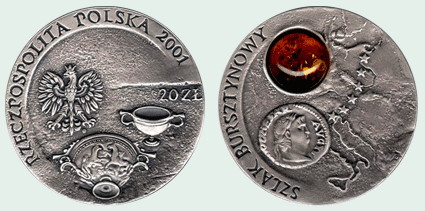
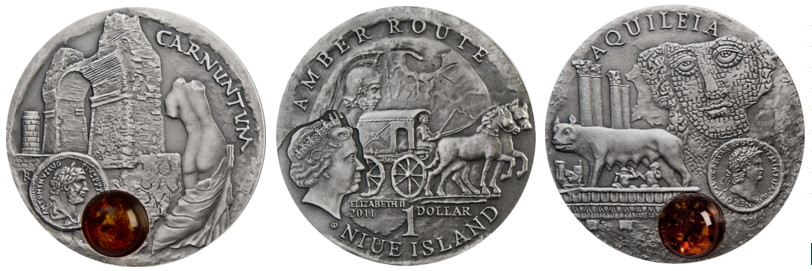
Is not this beautiful coin that deserves attention?
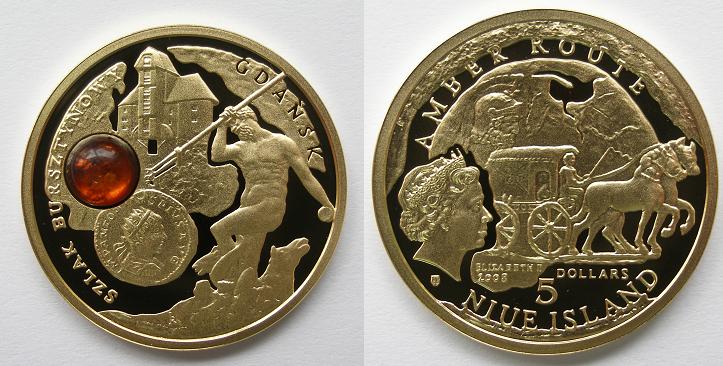
Denomination: 5 dollars
Issue: 2008
Stamp: Mirror
Material: Gold Au 900, amber 6mm
Diameter: 27mm
Weight: 15.5g
Issue: 2 000
Status: Menniczy
Gdańsk - the city in Poland on the Baltic Sea, founded in 997, the capital of Pomerania and Gdansk archdiocese. Gdańsk is also a royal city and Hanseatic, its time the most populous and richest in the Commonwealth. Today Gdańsk is one of the largest Polish cities. It is situated at the mouth of the Vistula Motława the Gulf of Gdansk, together with Gdynia and Sopot forms Classifieds, broadly along with Pruszcz Gdansk, Reda, Rumi and Wejherowo is part of the agglomeration of Gdansk. Important cultural and scientific center and hub of Polish. In its history, also bore the name of Gdańsk: Gyddanyzc, Kdansk, Gdanzc, Dantzk, Dantzig, Dantzigk, Danzig, and Gedanum Dantiscum.
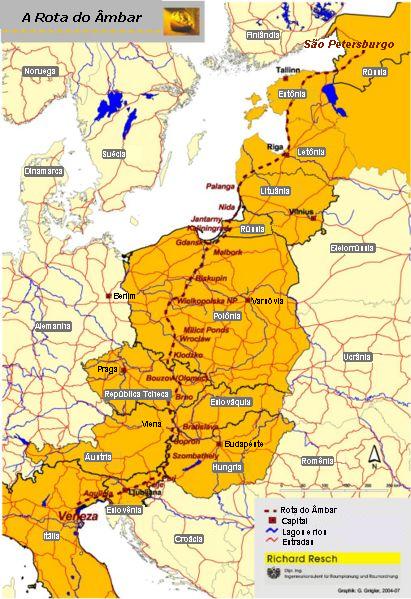
Amber Trail - in the broadest sense - is a term of trade links between European Mediterranean countries, and the lands lying on the southern coast of the Baltic Sea. However, in the narrower sense - the amber route means route mileage trips organized by amber, severe from the first century of our era.
Initially, amber was traded, in which the agents were Celts. The first organized expedition took place after the electron in the fifth century BC However, they did not reach the shores of the Baltic, making transactions with the Celtic intermediaries.
Only after the conquest of land on the middle Danube, the Romans developed from the first century AD amber trade on a large scale by organizing a number of ways of Pannon expedition to the Baltic Sea, particularly the Sambia. Peak development of this trade falls on the third century, and since the mid-fourth century, gradually change to a halt. The main center of the amber trade in the Roman Empire was Aquileia.
The exact course of the trail has not been clearly defined. We only know that initially led by the Moravian Gate, then turning to the north and through Silesia and Kujawa of the ford across the Vistula River near Torun in Otłoczynie led to the Baltic. His course almost exactly coincides with the A1 motorway being built today. Its variants are reconstructed on the basis of ancient writers mention, but mainly by the results of archaeological research.
Route significant finds of Roman coins, articles of bronze, Roman pottery (terra sigillata) and amber treasures. On the trail lay certainly present Wrocław. In the area of his estate Partynice in the nineteenth century found a large treasure of amber dating from the first century of our era, weighing about 500 pounds. Although as it happens in such cases, some people say about 2 750 kg. With high probability, you can venture to say that the main thread of the trail, from the turn of the millennium ran from Vienna (Vindobony) through Brno, Klodzko, Wroclaw, Kalisz, Torun, world




 Posted 01/06/2012 4:34 pm