| Author |
 Replies: 12 / Views: 2,305 Replies: 12 / Views: 2,305 |
|
|
New Member
United States
30 Posts |
Until recently, I've only collected coins from circulation. This PCGS MS-67 1996-W dime is the first high grade coin I've purchased. I bought it online, but now in person I've noticed that it has a large mark/gouge on the reverse to the upper-left of the olive branch. I expected that in MS-67, there would be no such marks. On the other hand, it is the only large mark on the coin. The photo isn't too good because my camera captured dust and scratches on the holder, but here is a picture: Is this normal for this high of a grade? Thanks for your input. ( Large resolution photos) 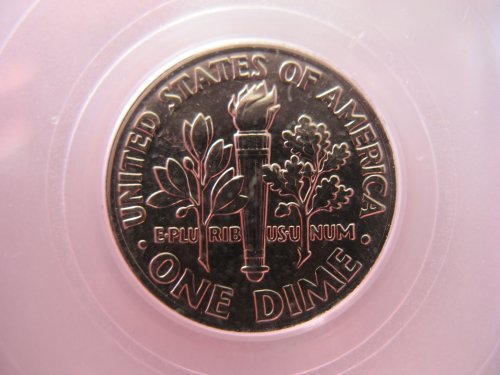 |
|
|
|
Pillar of the Community
United States
7841 Posts |
 The 1996-W 50th Anniversary Roosevelt (like most other modern strikes) are fairly common (not trying to demean yours) to have higher grades across the board. The determining factor for rarity would be the Full Torch (FT) designation on Third Party Grading ( TPG) slabs. Dings and scratches can deduct points from any coin, it all depends on where and to what extent. And TPGers have bad days as well, it may have slipped through the cracks. If you don't like the details of your coin, send it back to whoever you got it from, provided you are still in the return window. I am using my 96-W as the clad Roosevelt in my 7070. Edited by oih82w8
01/10/2012 10:45 am
|
|
Pillar of the Community
United States
1302 Posts |
It looks well struck to me. Remember 5x magnification only comes into play in MS69/MS70. If the problem is not distracting to the naked eye and is the only minor problem it could very well be graded correctly.
|
|
Bedrock of the Community
United States
12437 Posts |
It is a minor struck-through error, caused by unknown debris between the die and planchet when the coin was struck. A TPG would not note something like that on a slab unless the submitter paid extra for error attribution. It also does not really add any value to the coin and might actually lower the value slightly for some collectors as it could be seen as a distraction. |
|
Pillar of the Community
United States
5888 Posts |
Also I'd like to add that modern day high grades are more common than classic coins. |
|
Pillar of the Community
United States
4132 Posts |
I agree with biokemist6. It can be difficult to distinguish damage from struck-through errors in some cases, and it can be confusing as errors generally don't count against the technical grade (though they may affect the desirability of the coin, depending on the collector).
|
|
New Member
 United States
30 Posts |
Thank you all for the replies - this is a very helpful place! Interesting that errors don't affect the grade, but it makes sense. In any case, I got a good deal on the coin so I am happy to keep it, and the error makes it all the more interesting. Thank you for teaching me something about grading!
|
|
Pillar of the Community
United States
937 Posts |
I guess I am just cynical tonight. I would think that a strike error would degrade the rating of a coin so I suspect that the TPG took this into account when they graded it (at least I hope they would have). I am not sure I am seeing what you are talking about unless it is the mark below the "D" in "United". The only thing I can see beyond that in your photos appears to be marks on the case (like the one by the "O" in "OF") which are currently inevitable. I don't know what you paid for this or what you expect to gain, if anything, from your purchase. I can only offer this... I bought my wife a diamond engagement ring with a flaw that is noticeable only under a 20x loupe. We knew it when we bought it and we know it is not as valuable in the market as a more flawless diamond. I told the jeweler this when I bought it and he told me "that's why it's not as expensive as a flawless one". It fell out of her setting a few months ago and we thought it gone forever. We found it when cleaning a while later and took it to a jeweler to get re-mounted in a better setting. The other jewler set a value on it well above what we paid for it even though it was flawed (even adjusted for inflation). When we got it back, I had my wife look back through a 20x loupe and she knew right away that it was "her" diamond because of the not non-naked eye noticeable flaw. So - this dime is yours. You would probably be able to recognize it if it were removed from its holder and put in a different holder. My opinion is that it most likely is graded correctly but that is always an arguable point. If you think you should have received one less flawed for the price you paid, you should argue the point with the seller. I think a MS-67 should not have a gouge or die strike error but that is my opinion. |
|
New Member
United States
30 Posts |
PlumCrazy814, thank you for the sage advice. It is indeed the mark below the "D" in "United", which is more noticeable (reflective) in real life than in the photo. You've made me realize that it's more than just whether the coin is correctly graded - I should be happy with the appearance. (Though I really didn't pay much for the dime, so I'm leaning towards keeping it).
|
|
New Member
United States
30 Posts |
Well after sleeping on it, I've decided to return the coin. I think I should get one that I have no reservations about.
|
|
Pillar of the Community
United States
4132 Posts |
You should return any coin you are not happy with. There is probably somebody out there that collects struck-through dimes that will be happy to have a 1996-W with that error. Meanwhile, you can find one that is perfect for you. It's not all that rare, so you can be picky.
|
|
Valued Member
United States
355 Posts |
Was reading this thread and wondering how one tells the difference between a struck through error and a gouge, scratch, or ding.
|
|
Pillar of the Community
United States
3284 Posts |
Seems like a lot of damage for a MS67 coin.
good choice to send it back
|
| |
Replies: 12 / Views: 2,305 |
|










 Posted 01/10/2012 11:11 am


