| Author |
 Replies: 13 / Views: 2,555 Replies: 13 / Views: 2,555 |
|
|
Pillar of the Community
United States
2605 Posts |
Design proclaiming the eternal love friendship for one another. I always find those comparisons, across years or across borders, curious. And the fact is that I'd had one of these coins for decades while I saw the other just a couple of months ago and had to have it.   |
|
|
|
Pillar of the Community
United States
689 Posts |
I'll bet it wasn't Bulgaria's idea :-)
|
|
Bedrock of the Community
United States
10045 Posts |
Interesting pair--the reverse die is exactly the same.  |
|
Pillar of the Community
 United States
2605 Posts |
I suspect they were done at the same mint. No MM's though.
|
|
Pillar of the Community
Germany
1238 Posts |
Why would it not have been the Bulgarian government's idea? In the same year (1300 yrs Bulgaria) they also issued a Bulgarian-Hungarian "combo" featuring two men who were both writers and national revolutionaries: Hristo Botev from Bulgaria and Sándor PetÅ'fi from Hungary. By the way, according to the Schön catalog, the Bulgarian coin depicted above was minted in Sofia while the USSR coin was made by the Leningrad mint.
Joint or "omnibus" issues are more common for stamps, but you find lots of such coins as well, even with (partly) identical designs. Think of the Entente Cordiale coins (FR-UK) or the Ibero-American series for example ...
Christian
|
|
Pillar of the Community
United States
2605 Posts |
Thanks, Christian, for clearing the air. I wasn't sure if Sofia had its own mint. I know that some Bulgarian coins were minted in Hungary, France, Germany, and England.
I've never come across any records of whose coins Soviet mints made.
|
|
Pillar of the Community
United States
689 Posts |
I have good friends from Poland and they absolutely despise the period of soviet rule. I assumed that the Bulgarians would harbor the same negativity towards the USSR and not willingly sponser a friendship (shaking hands) coin. But you know what they say about assuming.
|
|
Pillar of the Community
Germany
1238 Posts |
I understand, but coins are usually issued by governments, or more negatively put, by the "rulers". ;) The Bulgarian government was probably perfectly OK with that coin, especially as it was issued as part of the "1300 years Bulgaria" series (with almost 30 different coin types ...); that is why I think it may well have been their idea. By the way, here is the Bulgarian-Hungarian "double pack" that I mentioned: http://www.ma-shop.com/hardelt/pic/bul-5lk132u.jpghttp://(131231) Not Allowed - Auto-Removed /countries/img13/85-622.jpg Christian |
|
Pillar of the Community
United States
2605 Posts |
Got another example. This time we have different sizes and even different years of issue. Designs do not match 100% but you can see it's the same motif, commemorating an anniversary of the Commonwealth of Independent States (the name of the wreckage of the Soviet Union). On the left we have Belarus (NCLT) 1 ruble of 2006 (15th anniversary), on the right - Russian (circulation) 10 one ruble of 2001 (10th anniversary).  Edit: I made a mistake with the denomination. Edited by svslav
01/16/2012 03:32 am
|
|
Bedrock of the Community
United States
10045 Posts |
Quote:
I assumed that the Bulgarians would harbor the same negativity towards the USSR and not willingly sponser a friendship (shaking hands) coin. Bulgaria was one of the Soviet Union's closest allies in the "cold war". Their first "Soviet" PM was a close friend of Stalin. Naturally, the people's opinion of Stalinism was less optimistic. Edited by DVCollector
01/15/2012 3:56 pm
|
|
Pillar of the Community
Belgium
651 Posts |
As chrisild already stated, there are also omnibus-issues outside the Russian influenced states. He already mentioned the Entente Cordiale issue by France and the United Kingdom. Another omnibus-issue was the 1994 issue by Belgium, the Netherlands and Luxembourg, commemorating the 50th Anniversary of Benelux. 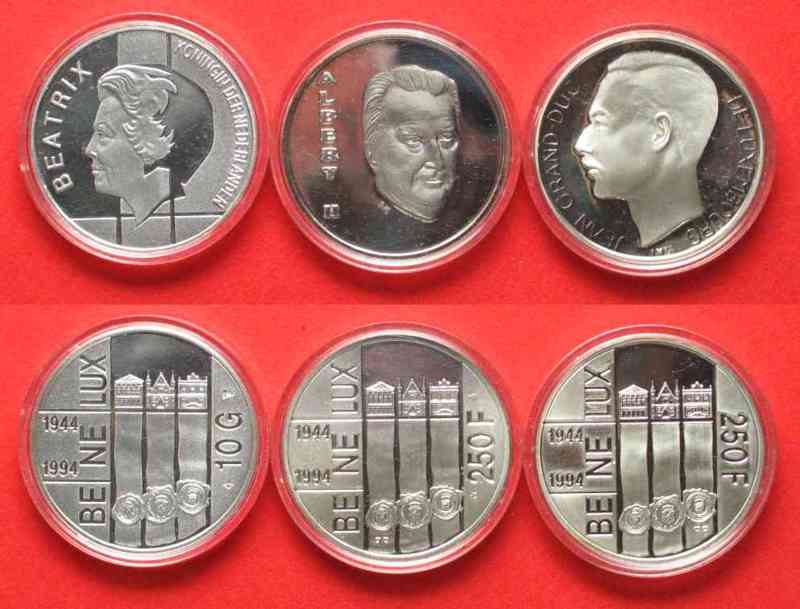 |
|
Pillar of the Community
Germany
1238 Posts |
Those Benelux coins are attractive indeed. :) Out of curiosity, do you happen to know why the "orientation" of the face value is different on the piece from Luxembourg? Portugal and Spain both joined the EC/EU in 1986, and both commemorated that with "omnibus" issues in 2006 and 2011. Here is the '06 set (image: Witte/muenzauktion).  Christian |
|
Pillar of the Community
United States
2605 Posts |
I suppose "LUX" wanted to distinguish itself from "BE", otherwise the reverses would look identical. It'd make more sense if Belgian and Luxembourgian francs valued differently, but they were one-to-one.
Nice examples, everyone, keep 'em coming!
|
|
Pillar of the Community
Germany
1238 Posts |
|
| |
Replies: 13 / Views: 2,555 |
|







 Posted 01/10/2012 8:13 pm





