| Author |
 Replies: 15 / Views: 2,870 Replies: 15 / Views: 2,870 |
|
|
Pillar of the Community
United States
627 Posts |
I have found that many of the very modern proof US coins have absolutely pervading cameo effect. The cameo is above and beyond anything that was observed even in the 1990s and certainly before. The cameo effect is two-fold. Firstly, the fields have a liquid/glassy appearance. Secondly, the devices have a frosty or satiny appearance. This juxtaposition creates a very striking image indeed. I just wanted to share a few images of a 2011-S Lincoln Cent, graded PR70DCAM by PCGS. You can see the cameo effect, and with some zooming (shown) you can see the little "nodules" that give the modern proofs more of a satiny or grainy cameo than their older counterparts. The composite image of the obverse and reverse were shot with the APO-Rodagon-D 75mm f/4 lens with the aperture stopped down to f/8. The lighting was with three Jansjo lamps with Ray's cone deflectors. The close-up images were created using a 2-image focus stack. They were shot with a Rodagon 50mm f/2.8 lens closed down one stop, and focusing on the very top of the date and then further down the edge of the date. The lighting was diffused by means of a paper towel, as this gave much better results than direct lighting (not shown). The transitions to ever more zoomed images are original crops of 2400 x 2400px, 1600 x 1600px, and 800 x 800 pixels. I then resized all three of the zoomed squares to 800x800 pixels. Thus, the fully zoomed image is the full sensor unscaled image.     Edited by brg5658
01/20/2012 01:47 am
|
|
|
|
Pillar of the Community
United States
1431 Posts |
Very interesting. Thanks!
|
|
Pillar of the Community
United States
1374 Posts |
I really wish they would do these in copper!!
|
|
Bedrock of the Community
Australia
21789 Posts |
I dunno if the die for this proof was acid etched or sand blasted, but is obvious that some detail has to be lost in order to bring up the cameo effect.
That is why I prefer a mild cameo effect for proof coins.
|
|
Pillar of the Community
United States
9810 Posts |
So nice, gotta get me one of those Rodagon lenses and a new bellows myself.
I find proof coins a real challenge to shoot. You ot the cameo effect down nicely, but the tiny nodules are simply amazing, I have not looked at much in modern era stuff - WOW!
"Buy the Book Before You Buy the Coin" - Aaron R. Feldman - "And read it" - Me 2013! ANA Life Member #3288 in good standing since 1981, ANS, Early American Coppers Member (EAC), Colonial Coin Collectors Club member (C4), Conder Token Collector Club member (CTCC), Civil War Token Society (CWTS) member, Liberty Seated Collectors Club (LSCC) & Numismatic Bibliomania Society member (NBS), USMex, Member in good standing, 2¢ variety collector. See my want page: http://goccf.com/t/140440 |
|
Moderator
 United States
56855 Posts |
Your photos are  . Maybe it's just me but I think the mint is over doing it with the cameo. There's just way too much of a grainy effect,i don't like it. It looses to much detail being so grainy. IMHO, John1  |
|
Pillar of the Community
 United States
627 Posts |
I got some feedback from Roger Burdette about why these modern coins look like this. The US has been using laser etching to create the frosted look on proof coins since sometime in the mid-2000s. This makes sense, as you can sort of see where the laser beam would have stopped briefly and made a little "nodule" before moving on to the next spot. I'm going to try to do a comparison on some of my dime collection tonight. This happens to be my only Ultra Cameo proof Lincoln Cent, but I have some dimes back to the 1960s graded as Ultra Cameo. I'll try to post results later tonight. |
|
Pillar of the Community
United States
627 Posts |
I took these tonight and compiled them. They are all clad Roosevelt dimes graded PF70UC by NGC. They are years 2000, 2007, and 2011. The "Snakeskin" laser etching is noticeably prominent in 2011, and sadly (as was already noted) this method really takes away from the design detail. The top images are a profile of Roosevelt, the 2nd images are full-size crops of the nostril region put side by side. Also, just for the fun of it, I was able to get a bit more magnification of the "20" part of my original posted 2011 proof cent, so I added that picture here at the end also. This one is a focus-stack of 3 original images. -Brandon 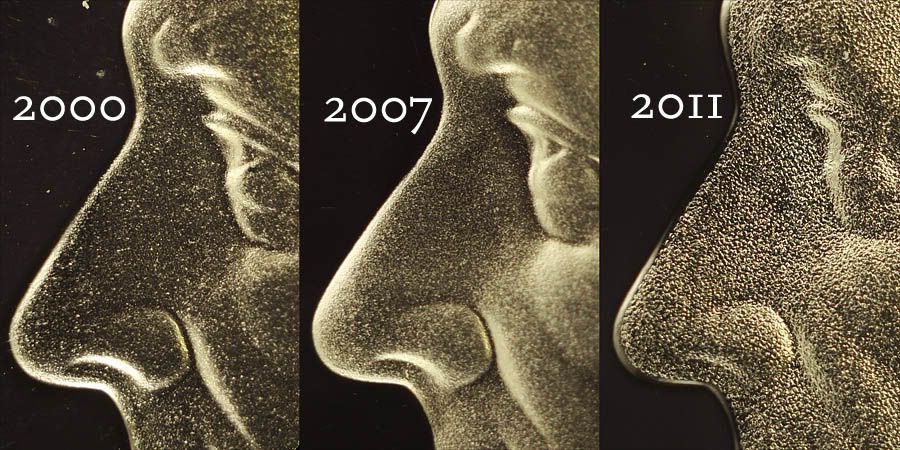   |
|
Bedrock of the Community
Australia
21789 Posts |
brg5658: Your excellent photography explains my preference for a milder cameo effect.
|
|
Pillar of the Community
United States
9810 Posts |
Interesting the way the Mint has changed the Proof coins over time. The laser makes sense, as it is a very controllable tool for cutting or engraving, we use one at work in surgery, they sure make cutting a lot easier and cleaner than the old way of scapels and blades.
"Buy the Book Before You Buy the Coin" - Aaron R. Feldman - "And read it" - Me 2013! ANA Life Member #3288 in good standing since 1981, ANS, Early American Coppers Member (EAC), Colonial Coin Collectors Club member (C4), Conder Token Collector Club member (CTCC), Civil War Token Society (CWTS) member, Liberty Seated Collectors Club (LSCC) & Numismatic Bibliomania Society member (NBS), USMex, Member in good standing, 2¢ variety collector. See my want page: http://goccf.com/t/140440 |
|
Pillar of the Community
United States
4050 Posts |
A simple trick with bellows setups to increase the magnification essentially "for free" is to add a teleconverter between the bellows and the camera.
I'm shocked at the texture on these proofs. I don't own any newer proofs so don't have a good feel for the difference but I can tell I would not like it.
I have never been good at photographing proofs. What is the technique you're using?
Contact me for photographic equipment or visit my home page at: http://macrocoins.com |
|
Pillar of the Community
United States
627 Posts |
Hi Ray, nothing fancy. I just did my normal set up with the cone type diffuser Jansjo lights, and then I simply put a paper towel between the three lights and the slab before taking the image. The exposures were quite long (5 to 8 seconds) for the dime images, so I used the 2-second timer, a remote release, and I made sure everything was stable/solid before taking the shots. The zoomed high-mag images were taken with a Rodagon 50/2.8 and the full Lincoln Proof images were take with my 75ARD1. For the full proof Lincoln Cent image, I didn't use a diffuser, but I moved the cone Jansjo deflectors back from the coin/lens about 2-3 inches. |
|
Pillar of the Community
United States
627 Posts |
Here's one of my favorite older proof coins. You can see how I position the three Jansjos with Ray-diffusers around the coin, and then I simply make certain the coin is well lit. Thes shots were taken with my 75ARD1 and then resized to 900px wide (these are the full-images captured by my sensor).   |
|
Pillar of the Community
United States
548 Posts |
Perhaps I'm in the minority, but I like the 2011 proof coin. The contrast between Lincoln and the field is huge. But therein lies the problem: the transition is sorta abrupt. Still, a gorgeous coin. |
|
Pillar of the Community
United States
4050 Posts |
Love the proof V-Nickel. I'm starting to like nickels more and more in general, but I'm still a Lincoln Cent guy. Contact me for photographic equipment or visit my home page at: http://macrocoins.com |
|
Pillar of the Community
United States
627 Posts |
Thanks Ray. That 1907 Proof V-Nickel is one of my favorite and most prized coins. The 1907 is the smallest mintage of the proofs for the V-Nickel series with just 1,475 coins minted (excepting of course the 1913).
|
| |
Replies: 15 / Views: 2,870 |
|







 Posted 01/20/2012 01:22 am





