| Author |
 Replies: 8 / Views: 8,951 Replies: 8 / Views: 8,951 |
|
|
Valued Member
Sweden
71 Posts |
Hi everyone I've got this coin last month. It's a solidus from Sweden - Livonia (today part of Estonia), minted 16xx. The coin is small, less than 20mm in diameter, and very thin (and light). Quality - vg perhaps.  Can anyone give me more info about this coin? Is grading correct? Thanks in advance |
|
|
|
Valued Member
 Sweden
71 Posts |
I brought this coin to a local coin dealer a couple of days ago and he attributed it as a solidus from Riga, not Livonia, minted under queen Christina reign.
|
|
New Member
United States
1 Posts |
Riga was a major city in Swedish Livonia. In all likelihood, your coin was minted in Riga for circulation in Livonia. Such coins were inscribed "SOLIDVS LIVONIÆ" with a 2-digit date on the reverse and "CHRISTINA D.G.R.S." on the obverse. The D.G.R.S. stands for DEI GRATIA REGINA SVECIÆ (By the Grace of God, Queen of Sweden). The harp-looking thing in the center of the obverse is actually a sheaf of wheat, in reference to the heraldic arms of the Vasa Dynasty, borne since the reign of Gustav Vasa (1523-60). Christina's father, Gustav II Adolf, founded the Swedish empire and died in the Battle of Lützen during the Thirty Years' War. Christina inherited the throne of the Swedish empire at the age of six, but shockingly, 21 years later she abdicated the throne, moved to Rome and converted to Catholicism. Unfortunately, I am having some difficulty making out the reverse of your coin, and I cannot recognize the date. This may negatively affect the value, because I would tend to grade your coin's obverse higher than the reverse. But that's just my two Ã-re. Regards, Wilhelm |
|
Pillar of the Community
Russian Federation
5186 Posts |
Your dealer was correct. It is a coin from Riga and its reverse says SOLIDVS.CIVI.RIG[E?] as expected (it's hard indeed to see most of these letters, but the CIVI part is fairly clear). Alas, the place where the date should be is almost fully cut off by the off-centeredness  maybe with a better-resolution scan (or in hand) one could be able to identify the bottoms of the digits (there should be only two IIRC). PS: Your coin's obverse looks a lot like the one in this link (which is Riga 1651). I can't confirm it, but that probably means your coin is from very late in Christina's reign. Then again, the reverse isn't that similar (and agrees much more with older coins), and DGRS instead of common older DGDRS could be just an error - but maybe it's some intermediate type from 1649 or something: did anyone ever try to survey such minor variations in this series? PPS: I've checked any examples I could find on Google, but only came to a conclusion that I cannot properly attribute this beyond something like "Riga 1630-1655" The reason? The wheat sheaf on your example is noticeably thicker than on any I've seen during my Google search; if any of you comes across any other such thick-sheaf examples, please note what date they had! (Yes, the legend might narrow it down further, but I've seen 1647 examples with both legends, and didn't care enough to check anything earlier.) |
|
Pillar of the Community
United Kingdom
2490 Posts |
I think this has the thicker wheatsheaf: 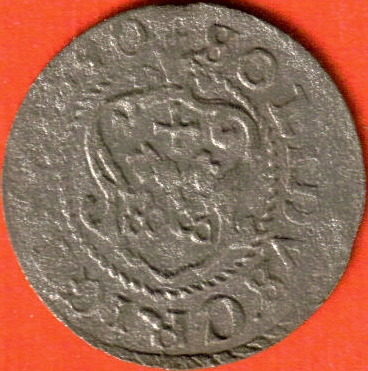 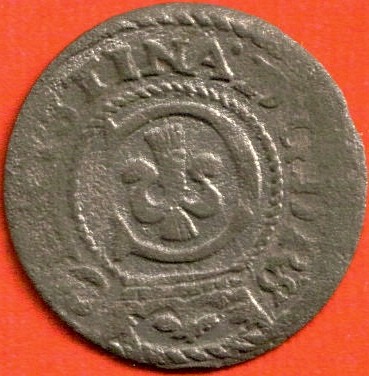 I believe it to be 1640. |
|
Pillar of the Community
Russian Federation
5186 Posts |
Quote:
I think this has the thicker wheatsheaf:
[a bunch of pictures]
I believe it to be 1640. Everything about this one is completely different! For starters, the crown on the obverse doesn't even look close (it's clearly two different versions of crowns). It's also an obvious DGDRS (the OP's coin is DGRS, which was a serious clue in me "attributing" it as 1649-ish). And as for the reverse, it's apparently a different type entirely, as it spells SOLIDVS.C.RIGE[...] (the OP's has a full CIVI). (And no, it doesn't have the wide sheaf, either. But that's probably the least of its differences.) Thanks for the pic though. Now I can be reasonably certain that the OP's coin is from after 1640 (as yours is a clear 1640 indeed); so the revised attribution is 1640-1653 (if 1641 or 1642 examples show the same type as this, that could be nailed down further). I still stand by my guess of 1649 (give or take 2-3 years). Maybe, one day, someone would make a die database of 1640s Riga (and/or Livonia) solidi the way it is done with ancient coins, and we would finally know the true distribution of DGDRS/DGRS (and DGRES, which seems less common than either of the other two). If so, the die with this wide sheaf would jump out immediately because it is so obviously visible; and we would finally know what year this coin is. But before that, I doubt we could pin it down much further than "1640-1653" |
|
New Member
Estonia
4 Posts |
The first coin is a contemporary Suczawa counterfeit.
|
|
New Member
United Kingdom
16 Posts |
Two of mine coins for grading and maybe year considerations ?... 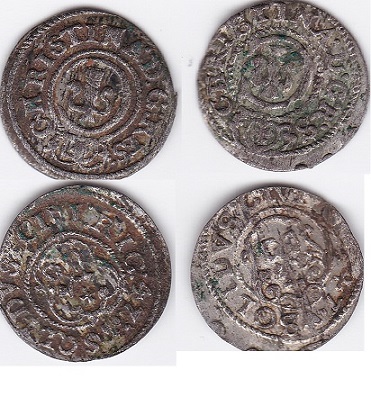 Thanks |
|
New Member
Estonia
4 Posts |
Both are (16)47.
The photos are so small that require almost forensic skills. From what I can see, both of them are quite corroded, especially the left one. Although the right one could even have some mint luster remaining, I would not grade it higher than VF because of corrosion.
Actually, for price considerations the grades do not matter that much in this case. In general, these coins are so common that only near mint or otherwise very beautiful specimen (like absense of corrosion, nice toning, attractive wear, 100% centered etc) cold not be bought for 5 euro or even less, regardless of catalog value.
|
| |
Replies: 8 / Views: 8,951 |
|










 Posted 06/29/2012 8:11 pm


