| Author |
 Replies: 11 / Views: 1,608 Replies: 11 / Views: 1,608 |
|
|
New Member
United States
4 Posts |
Hello. This is my first post. Having collected ancient coins for about ten years, I have accumulated some coins that I cannot attribute. Any help would be greatly appreciated. This coin is 11.6 g, 28mm. The bearded bust makes me think Marcus Aurelius or Septimius Severus or Antoninus Pius. The reverse makes me think Tyche or Asteria or Serapis. The reverse legend N..ON makes me think Nicaea. Lots of thinking, not much attributing. Thank you in advance for any insights you can offer. 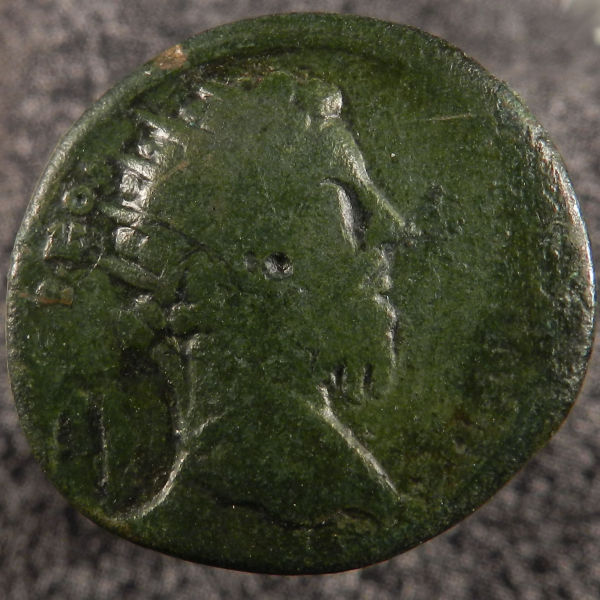 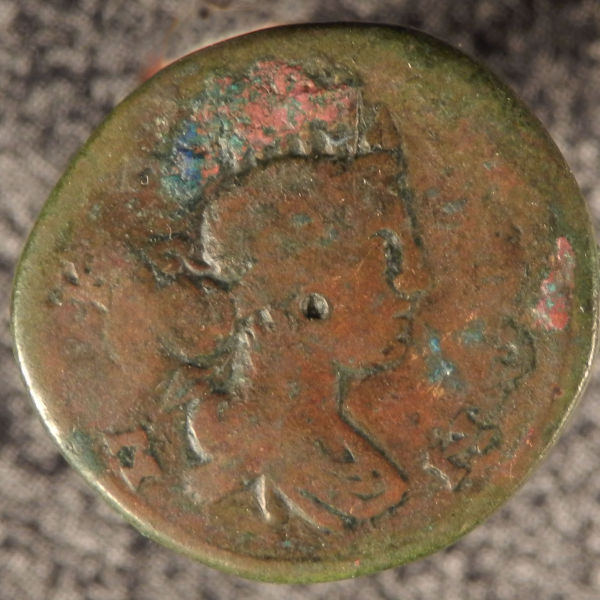 |
|
|
|
Bedrock of the Community
United States
10045 Posts |
|
|
Pillar of the Community
United States
2044 Posts |
I couldn't really say, although the coin does look like a Roman Provincial.
|
|
Moderator
 United States
23731 Posts |
 to the community. Nice to have another collector of ancient coins join us. Looking forward to seeing some of your coins. My first impression from the bust is that it is Marcus Aurelius, beyond that I can't be much more help. |
|
Pillar of the Community
United States
4253 Posts |
 with echizento. Marcus Aurelius and I also believe Tyche even though I've been seeing Tyche where its not there lately. Welcome to our discussion board. Regards, |
|
Pillar of the Community
United States
2044 Posts |
Looks like there is a centration dimple in the middle of the coin.
|
|
Pillar of the Community
United States
1549 Posts |
Definitely Marcus Aurelius or Commodus. Most likely Nicaea.
|
|
Pillar of the Community
United Kingdom
2933 Posts |
I agree with either Marcus Aurelius or Commodus (quite possibliy) Radiate crown. The reverse ends in WN rather than ON (that's an Omega which is usually translated to a W). The reverse type is known as Tyche turreted bust.
|
|
Pillar of the Community
United Kingdom
2838 Posts |
Recently asked this in another thread but as its come up here I'll take the chance to do it again. Does anyone know or can point me to somewhere that can tell me what 'W(Omega)N' stands for?
|
|
Pillar of the Community
United States
1315 Posts |
Quote:
Does anyone know or can point me to somewhere that can tell me what 'W(Omega)N' stands for? I don't understand Greek very well, but here is something I found so far. I think that inscriptions ending with WN indicates 'of the people' where as OY would indicate 'of the King /Emperor'. Scroll down to the fifth paragraph on the left hand column here: http://books.google.com/books?id=jr...oins&f=falseSorry I couldn't copy and paste it but I was having trouble, but there might be something else on this page that you might find informative. Please correct me if I'm wrong. regards |
|
Pillar of the Community
United Kingdom
2838 Posts |
Thanks Doucet, you were correct, this had been puzzling me all week  I couldn't get your link to work but with your info was able to find this reference:
Quote:
ΩN is the Greek genitive plural ending, so the inscription means "Of the Nicaeans" http://sp88k.home.xs4all.nl/Coin/Tr...erNikaie.htm'OY' you have covered and I've also seen 'IC' and 'IΣ' used so they too must have differing meanings also. |
|
New Member
 United States
4 Posts |
Thank you all for the posts.
Wildwinds shows the Nicaea coins of Marcus Aurelius and Commodus as being attributed in "RecGen." Wildwinds also has at the very bottom of the Nicaea city page a link to "Reference Abbreviations." That reference abbreviations page shows the full name of RecGen to be "Waddington, Babelon & Reinach, Recueil General des Monnaies Greques d'Asie Mineure,commencé par William Henry Waddington, Continué et Completé par Ernest Babelon et Theodore Reinach. 1872" and has a link to University of Virginia scans of the plates and text in RecGen.
I found my obverse at RecGen #301 (plate 75), and my reverse at RecGen #281 and #282 (plate 74). The Nicean coins of Commodus run from RecGen #250 to #321. So Commodus it is, and thanks again.
|
| |
Replies: 11 / Views: 1,608 |
|







 Posted 01/21/2012 2:49 pm





