| Author |
 Replies: 11 / Views: 1,749 Replies: 11 / Views: 1,749 |
|
|
Valued Member
Canada
491 Posts |
I've been wondering if any die cracks have been noticed in the coinage over the last couple decades. In the older coinage it seems its found more often. If you've found any in what denominations are they found more often?
|
|
|
|
Pillar of the Community
Canada
1733 Posts |
I'd say less often, dies used to be manufactured from common tool steel, hard wearing but relatively brittle as these things are measured. The metallurgy of today is such that I would not expect a die to break before it was worn out. I've seen a few cases on the forums, but extremely few to say that more coins are minted than ever.
|
|
Pillar of the Community
Canada
632 Posts |
In twoonies die cracks abound. I have a (partial) list with more than 250 different (I am currently revisiting my whole collection). A few are "important" enough and were accepted into Charlton's catalog.
|
|
Pillar of the Community
Canada
1733 Posts |
That makes total sense T_Y, twoonies are one of the few pure nickel planchets left (outer anyhow) and they are blasted hard.
Hitting the steel and zinc planchets is nothing like that kind of beating.
|
|
Pillar of the Community
Canada
632 Posts |
People must be made aware that a bimetallic coin, as struck by the RCM, is a different animal: one single strike responsible for the impression and for the locking of a very soft core into a very hard ring. As a result, die cracks occur in the areas of high pressure and they are mostly related with the core design. In the ring area we have many die chips but very few cracks. A good example is the beautifully designed core of the 2008 Quebec twoonie. I have just a couple of coins without any die cracks. With the amount of metal needed to put the fleur-de-lis in relief, the effigy on the obverse became fragile. There are die cracks coming out of the shoulders, out of the eyes, on the neck line, etc. On the reverse, one can see die cracks coming out of almost all acute angles of the design. ... there is so much space to squish metal. |
|
Pillar of the Community
Canada
1733 Posts |
I get the how they are struck because you told me once last year, though I claim almost total ignorance of modern coins aside from plating.
Where I'm disconnecting here is how pressure in increased on the area within the core, I think in this case the pressure would be highest on the outer ring and decrease on the inner. Without the inner support being equal and the greater pressure on the outside, it would crack in the low pressure area, this is what happens with all coins, die cracks in the lowest pressure areas (like the outer denticles on a George VI cent or the leaves on a Vicky cent).
Think about how many die cracks we see across Vickey's brow... not many.
In my opinion, it just happens twoonies offer a lower pressure area that what we are used to, that being the core.
When I think it through this way, it makes a lot more sense from an engineering standpoint.
I'd love to see some twoonie die cracks though if you have time T_Y.
|
|
Valued Member
Canada
76 Posts |
So far the only die crack I have found in recently minted coins is on 2009 1 Cent coins it is hard to see in the photo but I have three coins with the same crack on them.  |
|
Valued Member
 Canada
491 Posts |
Good eye catching those cracks, they are so small its very likely I would have have completely missed them.
|
|
Valued Member
Canada
241 Posts |
Roger, this is purely coincidental and a carry-over from one of your recent posts. I'll include just the one photo of a 2001P nickel with a die break/crack. There are various stages of this flaw, and as far as I know, this is the end result. 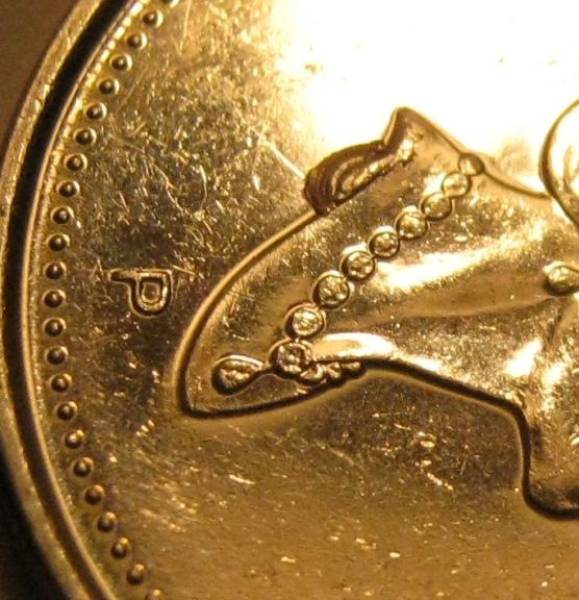 |
|
Valued Member
Canada
491 Posts |
@Staircase Pretty cool! LOL, loving the look of the little fella with the dunce cap on. Seriously that is the best error coin I've seen, none so fun as that one! Interesting how there is an E broken up just north of the P.
Thanks for showing it off, it gives me some more motivation to inspect my coins.
|
|
Bedrock of the Community
United States
12437 Posts |
Some die designs will have inherent points of weakness where you will see similar cracks repeated across the mintage. Some examples for US coins would be very common cracks on the leading edges of the wings on the reverse of the Washington quarter and the cornices of the Lincoln Memorial on an LMC. |
|
Valued Member
Canada
491 Posts |
@biokemist6 Appreciate the information, if any american coins come my way I'll look in those areas first. After Staircase posted his error the urge to search struck, this is the result. Total number of breaks for this coin is 22, 21 on the obverse with one on the reverse. I was wondering though, would the same type of error that is on his coin result on this one if the QC department didn't do their job? 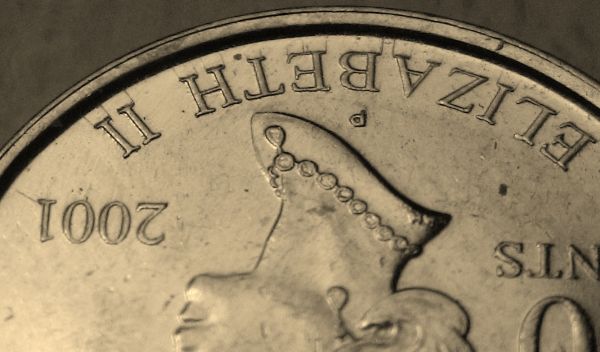 |
| |
Replies: 11 / Views: 1,749 |
|





 Posted 01/23/2012 11:25 am





