| Author |
 Replies: 24 / Views: 12,945 Replies: 24 / Views: 12,945 |
|
Valued Member
Australia
146 Posts |
Have been doing a bit of reading/research on Japanese Puppet Banks in China before/during WWII
One in particular has caught my attention "Amoy Industrial Bank"
Have been trying to locate information on it but have had no luck so far
Is anyone able to provide details as to the notes that the Amoy Industrial Bank issued during its existence
From what I can determine they are (I believe) listed in Pick's Specialised Banknote Catalogue
Thanks in advance for any information provided
|
|
|
|
Pillar of the Community
United States
747 Posts |
The Amoy Industrial Bank was not recognized by collectors and cataloguers as a Japanese Puppet Bank until fairly recently (last 5 years or so). That is why the notes are catalogued in Volume I (Specialized) edition of Pick and not with the other Puppet Banks in Volume II. Notes from the bank have been coming out in large numbers over the last few years. I will post the Pick information later when I can access the catalog (if no one beats me to it). There are plenty available on ebay but I would be suspicious of the pricing there as they appear more common than the pricing would indicate. |
|
Valued Member
 Australia
146 Posts |
thanks lettow - not particularly concerned about values - much more interested in how many were issued and have been catalogued
|
|
Pillar of the Community
United States
747 Posts |
Only five notes are listed in Pick for the Amoy Industrial Bank
S1655 1 cent 35.00
S1656 5 cents 35.00
S1657 10 cents 75.00
S1658 20 cents 80.00
S1659 50 cents 75.00
My catalog is older and only lists them in UNC (which is how they are usually found) except the 20 cent which has values in the lower grades. As I indicated in my earlier post, I would pay no attention to the catalog prices. They are not that scarce.
|
|
Valued Member
United States
347 Posts |
I do not know the reason why this bank was not recognized earlier as a Japanese puppet bank in the Western catalogs. The Amoy Industrial Bank began operations and started issuing paper money on February 16, 1940. It ceased operations in 1942. The bank only issued notes in the five denominations already mentioned. It also issued bonds and other financial instruments. According to Chinese resources, a very large quantity of Amoy Industrial Bank notes were discovered in 2007 on Gulangyu Island which is a small island off the coast of Xiamen ("Amoy"). This could explain why the notes are now more plentiful. I have not seen any numbers regarding how many of each note were actually issued. However, the Chinese sources state that the "50 cent" note exists in the largest quantities. The "20 cent" note exists in the smallest quantities. Gary |
|
Pillar of the Community
United States
747 Posts |
Most of the information in the Pick catalog for Chinese notes is taken directly from the Smith-Matravers catalog of Chinese paper money from 1971. It is probable that Smith and Matravers did not have any information about the bank itself and only had seen or been told about the notes issued by the bank.
|
|
Valued Member
Australia
146 Posts |
|
|
Valued Member
United Kingdom
129 Posts |
I have some info to add/expand on this topic: On February 16, 1940, the Japanese Puppet government invested 800,000 Yuan to incite Yin Xuefu and Chen Changfu, to establish the Amoy Industrial (Development) Bank, and begin issuing paper money. The first elected Chairman and Manager was Yin Xuefu (Yin Hsueh-fu). Later in 1940 an incident was reported, that the manager, Yin Hsueh-fu, was wounded by two unidentified gunmen, ‘believed to be political terrorists'; in other words, agents working for the Nationalists at Chungking (Chongqing). Soon after this incident, he understandably resigned. On banknote issue there is the 1, 5, 10, 20 & 50 cents as mentioned. However what is less well known is that there are (assumedly the first) versions of the 10, 20 & 50 cent notes printed in a slightly different manner, with variations in the colour and with serial numbers on both sides. These are far scarcer. I have a check from the bank which does seem to be dated 1945? 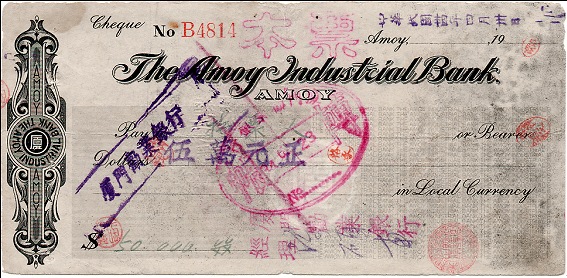 |
|
Valued Member
Australia
146 Posts |
thanks for the additional information xavierz27 - very much appreciated
|
|
Valued Member
United Kingdom
129 Posts |
Your welcome Huckles. It did occur to me that I should have added a few pics of the scarcer Amoy notes! Plus I made a mistake - these other versions have the serial number on the front, not on both sides as I said. Images of both sides of the unlisted 10 cents, and the front of the 20 cents: 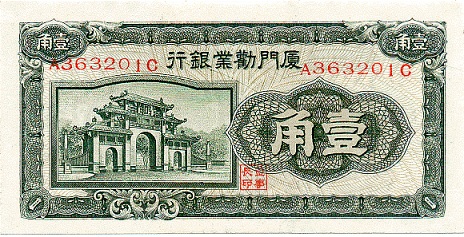 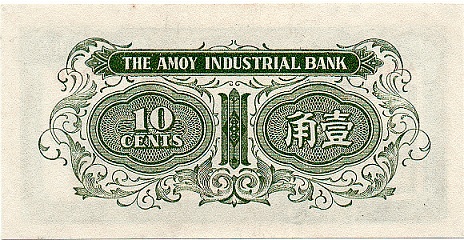 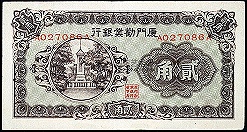 |
|
Valued Member
United Kingdom
129 Posts |
An update on this topic:
I was trying to find more information on these notes earlier today and on the bank itself and suddenly realised something which I've managed to confirm (more or less) via an on-line Chinese source.
I dont know why but bizarrely as it seems now, having owned these notes for years, and studying them on and off; I've only just realised what's missing. Oddly I was examining the 1935 De La Rue, and ABNCo, printed notes of the Farmers Bank of China recently and suddenly realised what was 'wrong' with them first: they lack the usual square red seals on the front of the note (and the notes were clearly designed to accomodate them).
Likewise, on the more common Amoy notes which carry the serial numbers on the reverse, a single red governors seal is missing from the front. This seal is visible on the earlier version of the notes which have the front serial number (as shown in an earlier post above), and on all of the 1 and 5 cent notes. The point anyway is that these notes which lack the seal are assumedly incomplete remainders, which is confirmed by the survival of some circulated examples of this version which do carry the seal.
|
|
Pillar of the Community
Canada
3692 Posts |
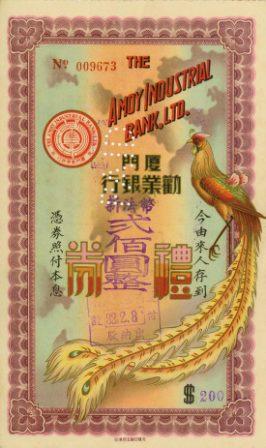
That first note posted with the bird on it is amazing! So colorful! How much does it go for - retail?
|
|
New Member
Germany
12 Posts |
The "note" with the bird is not a banknote, but a gift coupon.
Already in 2001 I wrote an article in "Occasional Papers on Chinese Banknotes": THE INDUSTRIAL BANK OF AMPOY, ANOTHER JAPANESE PUPPET BANK. In this article I wrote about the history and identified the buildings of the notes. These are:
1 Fen: a pavilion in the Zhongshan Public Garden. The pavilion was built in 1932 and no longer exists.
5 Fen: same picture
1 Jiao: South Entrance (gate) of the Zhongshan Public garden. This gate still exists.
2 Jiao: "Sun Yatsen Memorial Monument in the Zhongshan Public Garden. This monument no longer exists.
5 Jiao: Nantaotianwan Hall. This hall still exists.
The bank opened on Feb.26, 1942. Chairman of the board was Yin Xuepu. He soon resigned and Lee Sixian succeeded him. General manager of the bank was Wu Ruikun, while Zhou Zhaochun became vice-manager.
Erwin
|
|
Pillar of the Community
Hong Kong
1270 Posts |
Hello Chinnotes, may I have a chance to read your articles? Henry
|
|
New Member
Germany
12 Posts |
@wonghinghi: if you send me your postal address to
*** Private information removed by Staff. Please do not post your address/email/phone number etc. ***
I can send you a copy of the paper version.
Erwin
|
|
Pillar of the Community
Hong Kong
1270 Posts |
@chinnotes, can you send a link here, I can search this site by Google.
|
| |
Replies: 24 / Views: 12,945 |




 Posted 02/22/2012 7:29 pm