| Author |
 Replies: 12 / Views: 4,089 Replies: 12 / Views: 4,089 |
|
|
Valued Member
Israel
84 Posts |
I have a coin with arabic one side, english the other side. The date in arabic is the christain date. 1863, Sug el Manscie, Ramle, 10 Para. Made in Jerusalem? Used in Ramle Palestine or in Ramle near Alexandria. Someone said was made during French Colonization of Syria (early days) Anyone can help me? 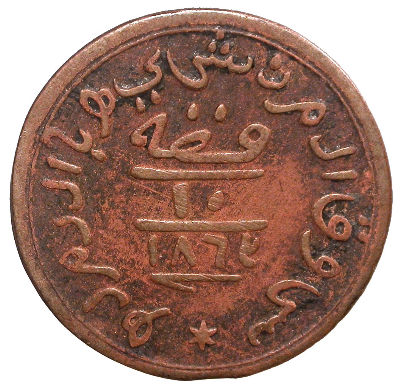 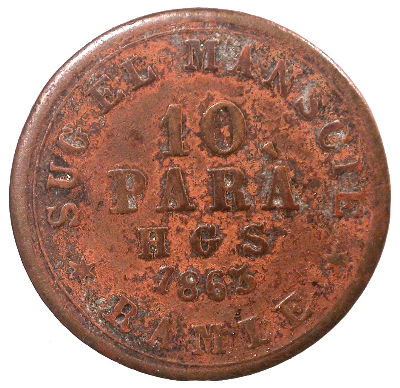 |
|
|
|
Pillar of the Community
United States
2254 Posts |
AJL, I combined your posts into one. No need to start a new topic to add pictures.  |
|
Pillar of the Community
United States
2605 Posts |
Your item (I believe the exact photo) appears in this sale. All I did is google "Sug el Manscie Ramle" |
|
Valued Member
 Israel
84 Posts |
Thanks, but is isn't that easy. There are about 4-5 different listings with different references, some to Egypt some to Palestine (the majority). The coins sold for 250-500 dollars each time. When I inquire to the source and original use, I reach a dead end. I am looking for real source information. Would love some help.  |
|
Pillar of the Community
United States
2254 Posts |
Quote:
Thanks, but is isn't that easy. There are about 4-5 different listings with different references, some to Egypt some to Palestine (the majority) What is in this listing that makes it not easy to understand? According to the website, they are specialists in Islamic coins. 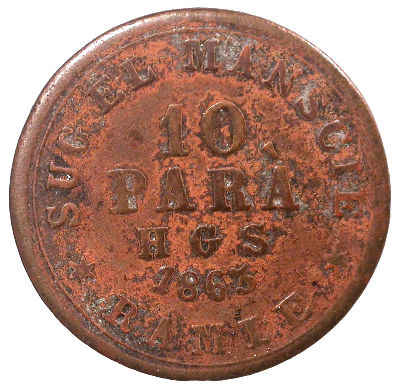 PALESTINE: AE 10 para, al-Ramla, 1863. Lecompte-46a. Ramle, Sug-El-Manscie, 10 para HGS 1863 / the same in Ottoman Turkish around, Fine, ex. W.J. Noble Collection, Sale 61B (lot 1747) and D & W Sale 29 May 1996 (lot 361), . PALESTINE: AE 10 para, al-Ramla, 1863. Lecompte-46a. Ramle, Sug-El-Manscie, 10 para HGS 1863 / the same in Ottoman Turkish around, Fine, ex. W.J. Noble Collection, Sale 61B (lot 1747) and D & W Sale 29 May 1996 (lot 361), .
Struck during the Ottoman period in the Mutasarriflik of Jerusalem. |
|
Pillar of the Community
Australia
852 Posts |
Tights24
It may not be as straightforward as taking the position that Album is a specialist and therefore what he states is the final word on the subject
(not in any way knocking Album as I hold him in great respect, but even he is mortal and may be passing on erroneous information that was recorded generations ago).
In my own articular area of expertise (the Australian 1920 penny) I have seen published information from coin dealers, numismatic researchers, variety specialists, a mint official and a museum curator all take certain positions on a subject; yet they are all horribly wrong as they all assume info that was published 50 years ago was correct. When I know that experts are wrong in a field where I have higher expertise then it is safe to assume that other experts also make mistakes in areas outside my field.
As Album has over 6000 coins in his 3rd edition list it is very likely that he is in error on the details of a few of them, heck if he knew everything that was possible to know on the subject he wouldn't have needed to add another 1500 or so items from his previous list and there would never be a need for new edition. I'm certain that if he publishes a 4th edition there will be yet more findings and corrections.
BTW I used to live in Egypt and Ramle (in Alexandria) always had a large foreign population that dated back to the 19th century. Unless conclusive evidence from the time the tokens were minted shows that they were minted for an establishment in Jerusalem then it is valid for others to claim that they were minted for an establishment in Alexandria (especially as it was common for more than one firm to exist in different cities of the region with the same name or for people related to each other to set up in different locales).
|
|
Pillar of the Community
Australia
852 Posts |
I should add that Heritage sold a similar token in 2004 that they attributed to an unknown merchant in Ramle EGYPT. So which respected firm is in error? (Heritage or Album)
|
|
Pillar of the Community
United States
2254 Posts |
Thank you Neal for the post. I guess in my opinion, I would go with what the Specialist says over Heritage if solely for the fact that Heritage "specializes" in everything, and I would assume that they would title things per the seller if they were not sure of the exact origins.
Yes, things change and new discoveries are made that contradict the current knowledge base out there for all coins, but for now, I would go with a "Specialist's" listing for identification.
The problem here is that the OP posted a question and received a pretty good answer with someone going out of their way to do a google search to help. Upon posting what they found, they were in essence immediately rejected by the OP. This will not aid in illiciting more help from folks on here.
Maybe it would help if AJL would list the 4-5 different references he/she eludes to in their post. If there is that much data available and already known, why not post it here so we can help figure out which one is correct.
|
|
Valued Member
Israel
84 Posts |
Food for thought.
The Arabic side dates says 1862, the english side 1863.
The word Manscie, means like boardwalk, Sug means Shuk, or Market. "the manscie market". The arabic is not written similar to any way written by the Ottoman Empire and moreso, they would use the Arabic dates, not the Christain dates.
I received more detailed opinion from a professor. He states that most likely the word Manscie is Italian, not English or French, whom all were around during that time.
Neil is correct about Egypt, most likely there were Italians there. The period of the beginning of the 19th century there was a lack of small coins. No one wanted to upset the Ottoman empire, so they created "tokens" with value.
Does anyone know where Ramle Egypt is? Moreso, is there a history of a market there, maybe near the ocean or river?
Moreso, someone told me there is a source from "Jetons of Francais Colonies" from 2007, in French. Does anyone have a copy?
|
|
Valued Member
Israel
84 Posts |
|
|
Pillar of the Community
Australia
852 Posts |
AJL
Ramle is a suburb of Alexandria. Well established and on the tram line. Everywhere in Alex is near the coast and Alex is the main sea port of Egypt (in 1863 it would have been a boom town with the cotton trade). Lots of Greeks and Italians (plus Levantines) migrated there in the 19th century (still plenty of reminders there of them, although most left/were expelled by the early 1960s).
Lots of retail establishments still have Greek or Italian names.
I agree about the Arabic font, especially how the names are spelt out as individual letters. It is possible that a native arabic speaker wrote the date as that shape for the letter 2 (in arabic) is confusingly how many people write a 3 (a simplified/lazy way of writing).
To me Jerusalem (being an inland provincial town in 1863) doesn't sound like a locale where there was a demand for bilingual tokens. Pilgrims would be the only European visitors (and they would have guides). Alexandria had a huge European population and they dominated trade and the sea port.
I agree that Album is THE specialist; but even he (and his staff) probably don't have a lot of time to research something with low market appeal such as tokens and for all we know the only reference he had was an incorrect locale description on the 2X2 put there by a previous owner.
|
|
Valued Member
Israel
84 Posts |
Well said. Thanks for your thoughts.
|
|
Valued Member
Israel
84 Posts |
For anyone interested, the coins sold on ebay lately for 540$. I traded mine for 2 Templar coins from the late 1880's, used in Israel, valued at 1000$. |
| |
Replies: 12 / Views: 4,089 |
|







 Posted 02/25/2012 1:45 pm





