









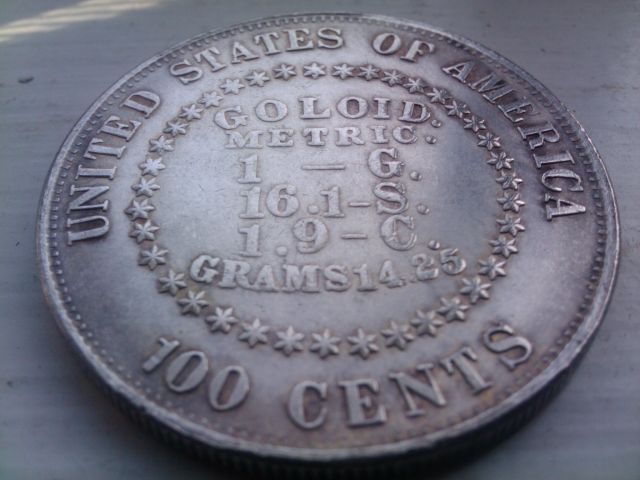
 Tried looking it up but haven't found a matching coin yet to find out more


 Posted 03/15/2012 10:24 am


Here are images and a narrative for authenticated 1879 Goloid Metric Dollars. The first is the 14 gram version.
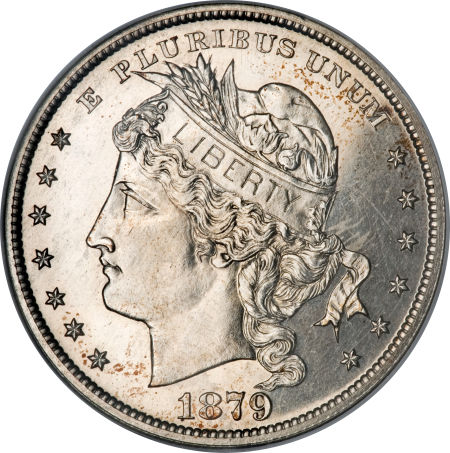
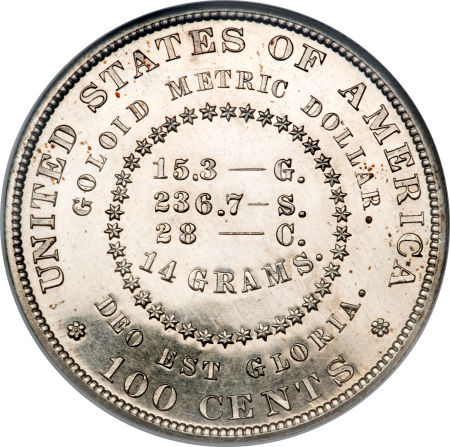
1879 $1 Goloid Metric Dollar, Judd-1626, Pollock-1822, R.4
William Barber's design for the Goloid Metric dollar with a capped head of Liberty on the obverse, paired with a reverse that carries verbose statutory as well as elemental inscriptions. A circle of stars about the central inscriptions breaks the otherwise continuous wording. Struck in goloid (allegedly) with a reeded edge. According to USPatterns.com: "These sets were available to the congressman at $6.10. Unsold sets were later offered to the collecting world for $15.
Another example with a weight of 25 grams:
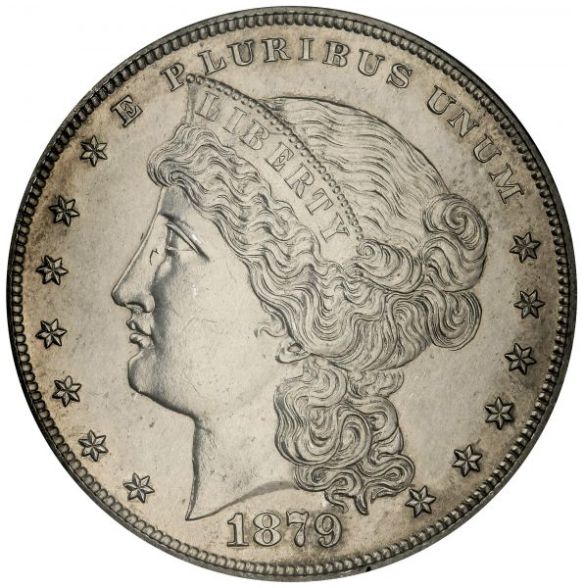
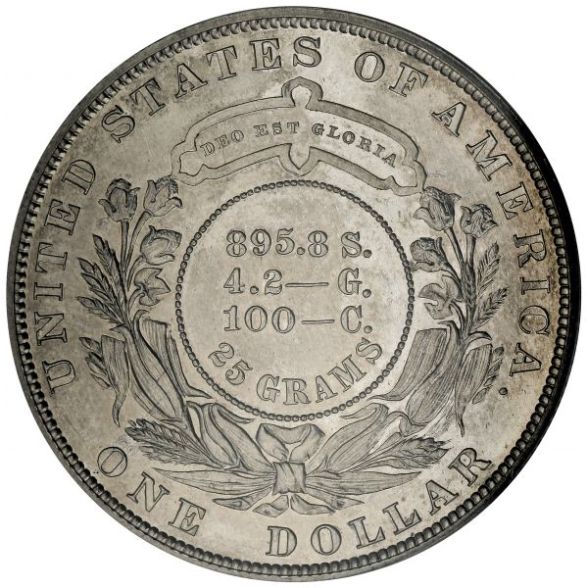
1879 Goloid Metric Dollar. Judd 1618 (Low R-7). Silver, RE. Choice Brilliant Proof. William Barber's distinctive coronet Liberty head that first appeared on his 1878 Pattern Dollar dominates this obverse. The reverse presents a cereal wreath and motto DEO EST GLORIA, to God is the Glory around a dotted circle holding a statement of the proposed alloy and weight. This weight was 25 grams, that of the Latin Monetary Union's 5 Franc Silver piece.
Although actually struck in Silver, this Pattern's intended metal was Dr. Wheeler W. Hubbell's proposed ''Goloid,'' made up of 895.8 parts Silver, 4.2 Gold, 100 Copper. In theory, this new alloy would enshrine the existing Gold-Silver ratio so that two Goloid Dollar coins would contain $1 in Gold and $1 in Silver. Regrettably the new alloy was indistinguishable from normal coin silver in color and weight. Goloid was probably what Mint spokesman Patterson Dubois had in mind in his often quoted January 1883 diatribe against Patterns in the American Journal of Numismatics, ''the impractical schemes of visionaries and hobbyists.''
NOTE that the motto "DEO EST GLORIA" (God is Glorious) was absent from the 1878 first year patterns and added to the 1879 versions.
1879 $1 Goloid Metric Dollar, Judd-1626, Pollock-1822, R.4
William Barber's design for the Goloid Metric dollar with a capped head of Liberty on the obverse, paired with a reverse that carries verbose statutory as well as elemental inscriptions. A circle of stars about the central inscriptions breaks the otherwise continuous wording. Struck in goloid (allegedly) with a reeded edge. According to USPatterns.com: "These sets were available to the congressman at $6.10. Unsold sets were later offered to the collecting world for $15.
Another example with a weight of 25 grams:
1879 Goloid Metric Dollar. Judd 1618 (Low R-7). Silver, RE. Choice Brilliant Proof. William Barber's distinctive coronet Liberty head that first appeared on his 1878 Pattern Dollar dominates this obverse. The reverse presents a cereal wreath and motto DEO EST GLORIA, to God is the Glory around a dotted circle holding a statement of the proposed alloy and weight. This weight was 25 grams, that of the Latin Monetary Union's 5 Franc Silver piece.
Although actually struck in Silver, this Pattern's intended metal was Dr. Wheeler W. Hubbell's proposed ''Goloid,'' made up of 895.8 parts Silver, 4.2 Gold, 100 Copper. In theory, this new alloy would enshrine the existing Gold-Silver ratio so that two Goloid Dollar coins would contain $1 in Gold and $1 in Silver. Regrettably the new alloy was indistinguishable from normal coin silver in color and weight. Goloid was probably what Mint spokesman Patterson Dubois had in mind in his often quoted January 1883 diatribe against Patterns in the American Journal of Numismatics, ''the impractical schemes of visionaries and hobbyists.''
NOTE that the motto "DEO EST GLORIA" (God is Glorious) was absent from the 1878 first year patterns and added to the 1879 versions.


