| Author |
 Replies: 8 / Views: 1,125 Replies: 8 / Views: 1,125 |
|
|
Pillar of the Community
United States
1721 Posts |
First, I want to thank all for looking at my posts and a special thanks to those who took/take the time to respond. You guys are the best. Today, I purchased about 2 dozen wheaties and this one was in the bunch. There is a split on the planchet that runs through the number 9 and extra copper on the base of the 9. Comments please. 1. What is the proper term for this error? 2. Any value? Thanks again to all..........Mike. 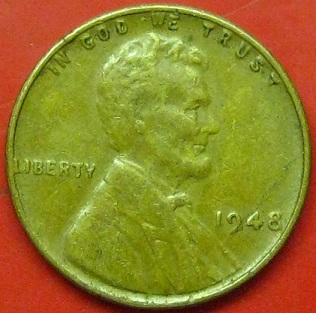 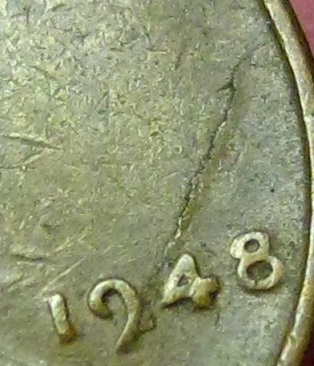 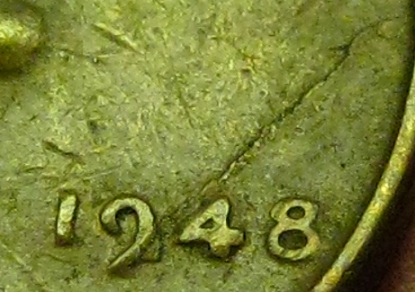
|
|
|
|
Pillar of the Community
United States
2224 Posts |
This is known as a planchet lamination. There is a small possibility that the entire planchet is split but if you cannot see damage on the reverse side of the coin odds are it is just a layer of copper that is split. If a small amount of the copper used to make the coining strip is mixed improperly the metal can come apart. These errors are actually found with some frequency. The more of the coin that is damaged the more valuable it is. Unless you come across a person that might be making a Lincoln lamination date set this coin would not have great value, maybe $1 or so.
|
|
Bedrock of the Community
United States
12437 Posts |
Personally, in most cases I consider laminations to be more mint-made damage rather than an error since it is due to an internal flaw in the alloy. Small laminations tend to distract from the eye appeal of a coin and can actually cause a devaluation when compared to a normal coin of the same grade. However, large delamination peels do have collectible value as errors but they still have relatively low value compared to other errors.
|
|
Pillar of the Community
United States
1054 Posts |
I have several of these, they're neat but like the others have pointed out, you won't see a huge premium on them. It's a keeper in my book.
|
|
Pillar of the Community
2226 Posts |
Question for coppernickeldaddy or biochemist6 (or anyone else) - Can you take the OP answer one step further, why wouldn't this be a crack vs lamination? Is it because it is not raised or other reason...   I'm just looking for further education here, not disputing your original answer. |
|
Pillar of the Community
United States
2224 Posts |
I guess you could call it a cracked planchet. Since nothing on the OP's coin shows any metal peeling, I don't see why not.
|
|
Pillar of the Community
2226 Posts |
Ok, thanks for the follow up.
|
|
Bedrock of the Community
United States
62064 Posts |
Laminations (actually delaminations) are caused when the stock material for the blanks/planchets is not bonding together. The copper was a poor mix or two different batches with imperfections are not adhering together. These are usually in a straight line across a coin. Some are like the OP coin and others delaminate and leave part of the devices missing or weak under where the delamation happened. A die crack is caused by a die crack on the die that leaves the raised area from a coins surface. So the lamination issue is actually incuse on the surface and die cracks are raised on the surface of a coin. Hope this helps.
|
|
Bedrock of the Community
United States
17884 Posts |
He's asking about laminations and planchet cracks not die cracks. What I would consider to be the difference would be that on a planchet crack it passes completely through the coin and is visible on both sides of the coin. Especially so if it includes the edge of the coin so you can see that the crack passes completely through the coin.
|
| |
Replies: 8 / Views: 1,125 |
|










 Posted 03/16/2012 3:52 pm


