| Author |
 Replies: 7 / Views: 1,124 Replies: 7 / Views: 1,124 |
|
|
Pillar of the Community
United States
1315 Posts |
Sicly, Syracuse AE17, 6.3 grams ΣΥΡÎ'[CΩ]? Head of Athena left in Corinthian helmet decorated with  / Hippocamp left. Sear dates these to the time of Timoleon ca 344-336 BC, but it now appears that they were probably struck during the time of Dionysios I (405-367 BC), most likely ca 390 BC. (Coinproject) This example is a bit different than others in that the Helmet is decorated with another object (not sure what... serpent?) rather than the usual laurel wreath and the inscription is longer than the usual ΣYPA 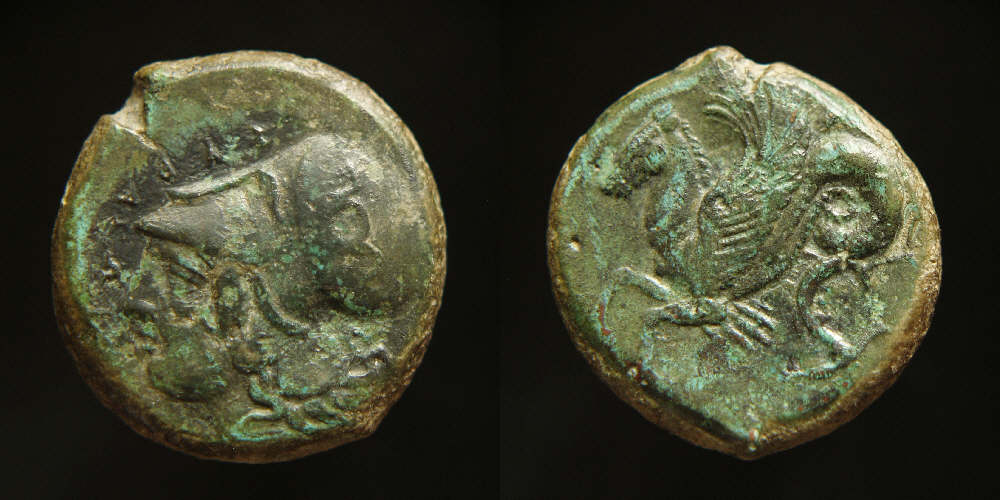 |
|
|
|
Bedrock of the Community
United States
10045 Posts |
Very nice, interesting Litra--I really like the details on the Hippocampus!  I'm unsure of the symbol on Athena's helmet--maybe somebody will recognize it. |
|
Moderator
 United States
23731 Posts |
Very nice, excellent reverse detail.
|
|
Bedrock of the Community
Australia
21794 Posts |
The fabric of these litra coins intrigue me.
They have a slight point at either end of a diameter.
I have not read how the blanks may have been made, but by the looks of them, the metal may have been pressed in a mold, with the bronze in the paste range.
The 'Paste Range' temperature of an alloy is where one of the metals which make up the alloy is liquid, but where other metals in the alloy are still solid.
With bronze in this instance, tin has a melting point of 232 deg. C., and copper has a melting point of 1083 deg. C. The pouring temperature for bronze is around 1110 deg.C. As can be seen the paste temerature range is quite large of around 850 C. degrees, which makes bronze an alloy easy to work with.
I have presented a few facts about bronze as an alloy here, but I have not read anything about how this information may have been applied to the making of blanks for the bronze litra coins of Syracuse. I stand to learn if my assumption made above is near the mark or not.
|
|
Pillar of the Community
 United States
1315 Posts |
That's interesting thinking Sel. I do not know the answer.
I had never thought about the fabric of these flans until now.
I may be able to find something out, or hopefully someone here will know.
Thanks
|
|
Bedrock of the Community
United States
10045 Posts |
Sel_691, That's interesting reading about the "paste range" of bronze. I have seen this flan shape on other AEs from Syracuse, and also wondered if those corners were remnants of casting sprues, mentioned here.  |
|
Bedrock of the Community
Australia
21794 Posts |
My assumption is that the blanks were cast by pressing into a mould, and the coins were struck s from the blanks. My assumption. I stand to be corrected and thus learn.
|
|
Pillar of the Community
United States
3229 Posts |
|
| |
Replies: 7 / Views: 1,124 |
|




 Posted 03/25/2012 6:00 pm





