| Author |
 Replies: 436 / Views: 33,655 Replies: 436 / Views: 33,655 |
|
|
|
Pillar of the Community
 3352 Posts |
|
|
Bedrock of the Community
United States
10045 Posts |
There is a lesser-known variation of this coin, depicting Lincolnus.   |
|
Moderator
 United States
23731 Posts |
It's very rare, only one known.  The legend GLORIA ROMANORVM (Glory of the Romans) first appeared on coins on Constantine I. |
|
Pillar of the Community
3352 Posts |
=> you guys aren't foolin' with me, are ya?!  |
|
Pillar of the Community
3352 Posts |
DAY#2 => COIN #29
Roman Imperial - Constantinopolis Commemorative. Æ19. Heraclea mint, 330-333 AD. Obv: CONSTAN-TINOPLI, helmeted & laureate bust of Constantinopolis left. Rev: Victory standing left on prow of a galley, holding transverse across her body spear & shield, SMHD in ex. Composition: AE, weight: 1.90 gm. diameter: 19 mm 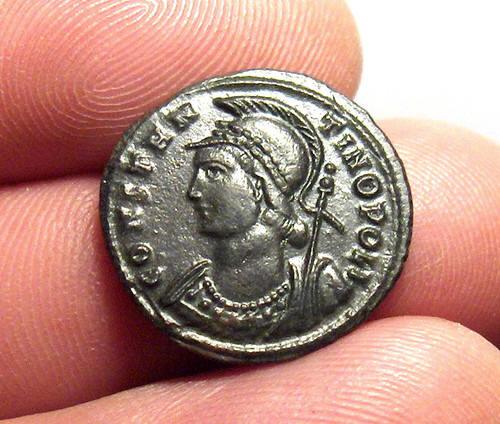 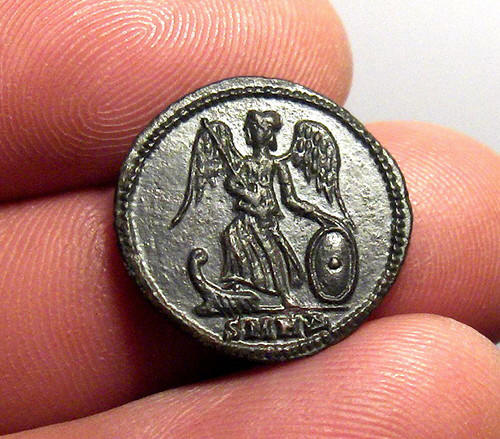 => So, what can you tell me about this coin? => So, what can you tell me about this coin?
... and thanks for your help with yesterday's coinAlso, I suppose you've noticed that I have decided to go "backwards-through-time" ... in other words, this coin is older than yesterday's coin and tomorrow's coin will be older than today's coin, etc, etc (that's probably arse-backwards, but we'll just see how it goes, okay?)
Edited by stevex6
04/02/2012 06:46 am
|
|
Pillar of the Community
United States
4253 Posts |
Constantine and his sons issued a few different types of commemoratives from 330-346. These were issued to mark the foundation of Constantinople and to also re-affirm Rome as the traditional center of the Empire. Thirteen mints produced these types: Trier, Lugdunum (Lyons), Arelate (Arles), Aquileia, Rome, Siscia, Thessalonica, Heraclea, Constantinople, Nicomedia, Cyzicus, Antioch and Alexandria. The two most common are the CONSTANTINOPOLIS (Victory on a prow) and VRBS ROMA (wolf and twins) types.
The victory on a prow type alludes to the naval victory of Crispus and his subsequent capture of Byzantium (soon to be re-named Constantinople). Zosimus said that Constantine's fleet had 200 ships and Licinius had 350 ships. Zosimus might have exaggerated, but all sources agreed that Constantine's fleet was greatly outnumbered. What accounted for the surprise victory of Constantine's forces? Could it have been that Constantine had better trained sailors...maybe divine providence? A papyrus letter from circa A.D. 323, gives an answer. The letter is from a procurator who said that the government of Egypt had an urgent requirement of box and acanthus wood for repair of the men-at-war vessels in the arsenals of Memphis and Babylon. Egypt sent a total of 130 ships to serve in the navy of Licinius, but it seems that they were all old tubs!
|
|
Pillar of the Community
United Kingdom
2838 Posts |
Rome was the capital of the Roman Empire for 1000 years. Constantine made the decision to move it to Byzantium and in the process rename it Constantinople. Both Rome and Constantinople were built on seven hills offering excellent defensive positions.
Constantine believed Rome was too far from the Empires problem borders to be effective and I would think the idea of building his own capital appealed to him, he had after all re-united the Empire and restored much of its strength. These coins celebrate the new capital. Rome had, for the previous century or so been used less and less by Emperors, instead they had chosen to base themselves further East.
Byzantium had already adopted the crescent moon as its symbol. According to some reports, they chose it in honor of the goddess Diana. Others indicate that it dates back to a battle in which the Romans defeated the Goths on the first day of a lunar month. When the Turks conquered Constantinople (Istanbul) in 1453 it is thought they too adopted the symbol and this is how it still resides on the Islamic flag and many Islamic countries flags today.
Your coin is well centred, and stamped and has good clean fields, its a nice example. Your coin could be from Nicomedia (3rd MM character not 100% clear) but style wise I too would place it at Heraclea and showing SMHDelta on the Mintmark. It was made in workshop 4 (only 4 in use) between 330 and 335AD. RIC No is RIC VII Nicomedia 196.
Edited by bobbyhelmet
04/02/2012 09:35 am
|
|
Moderator
United States
23731 Posts |
There isn't anything more that I could add to JW's and Bobby's excellent historical write-ups other than this is one of the nicest examples of this type that I have seen.
|
|
Pillar of the Community
3352 Posts |
wow => fascinating stuff guys! jwharper & bobbyhelmet => thank you very much for your efforts (I really appreciate it!) echizento => thanks ... yes, it is quite a nice, sweet little coin!  |
|
Bedrock of the Community
United States
10045 Posts |
That's really a beautiful coin--the strike and centering are really great! |
|
Pillar of the Community
3352 Posts |
So, I have been reading through a couple of the books that I ordered (NOTE => they haven't all arrived, yet) and I am having a blast learning about my ancient coins, the emperors and the stories of those times ... I am a bit of a geeky engineer at times, so I must admit that I found Constantine to be quite interesting, for as jwharper explained, Constantine refounded the city of Byzantium and basically turned it into the new "Roman hot-spot" ... there is mention of Constantine's incredible engineering and project management feats (one book even went as far as saying "ranking as one of the ancient world's greatest accomplishments") ..... so the engineering-side of my brain kinda thinks that Constantine is pretty cool => I wish he worked in my office! ... "However", as always, nobody is ever perfect (well, except for my wife, but I've been trained to say that) ... apparently Constantine was also known for being a bit of a wildcard => "his resume is stained with the blood of many, including his wife and first born child" ... and deep-down Constantine was probably a very vane and paranoid dude with an itchy trigger-finger ... => fascinating stuff, no? ..... well, it's fascinating to me, for I am reading it for the first time (I'm sure that most of you guys know it to death!?) anyway => thanks again for your comments ... so far, I am very happy that I started this thread!1  Edited by stevex6
04/02/2012 4:31 pm
|
|
Pillar of the Community
United States
1549 Posts |
This is a beautiful coin. I am not so brash as to identify it to RIC but tend to agree with bobbyhelmet regarding the question between SMHD and SMND. Further I do tend to question even if the coin belongs to the Volume VII coins rather than the Volume VIII coins which are mislisted due to the use of ditto marks suggesting that the Heraclea lightweight coins (and 1.9g is in the middle so this may well be a Volume VII coin). I simply am not sharp enough to figure out this mess and I do not know a Commemorative specialist that I would accept a dogmatic ID on these without being shown several coins for comparison. Below is my example of what I have been calling RIC 196 page 634 Volume VII. My coin weighs 2.6g so it is definitely, without question an early example issued along with the 2 soldier 2 standards coins. It could be Heraclea; I just do not know. What the N/H looks like to me is the last thing to consider here and I am not into these enough to call the coins from style. Mine is shop A rather than D... I think... Maybe?  Here is what I am saying: I am not willing and able to say if coin #29 and and my coin are or are not from the same mint or even covered by the same volume of RIC. If anyone feels they are 100% capable on Iding these two coins (bet your life?) they are way ahead of me. I am currently engaging in a question regarding another coin on which I have exchanged emails regarding the N versus H question with experts some of you may know. I hate RIC. I sure hope the next 28 coins are not this hard! Coins are supposed to be fun but sometimes they get a bit frustrating. |
|
Pillar of the Community
3352 Posts |
sorry dougsmit => I have no idea if I'm pitching easy lob-balls, or whether I'm throwing you junky spit-balls? ... but I sure hope that tomorrow's coin makes you feel a bit better about my collection!  |
|
Pillar of the Community
3352 Posts |
DAY#3 => Coin #28Partly Silvered Maximian Antoninianus CONCORDIA MILITVM EF Obv. Radiate portrait right Rev. Victory being handed to Maximianus by Jupiter Mint: Weight: 3.61 gms. Size: 22mm Ex. XXI E in midfield Patina: Lighter green 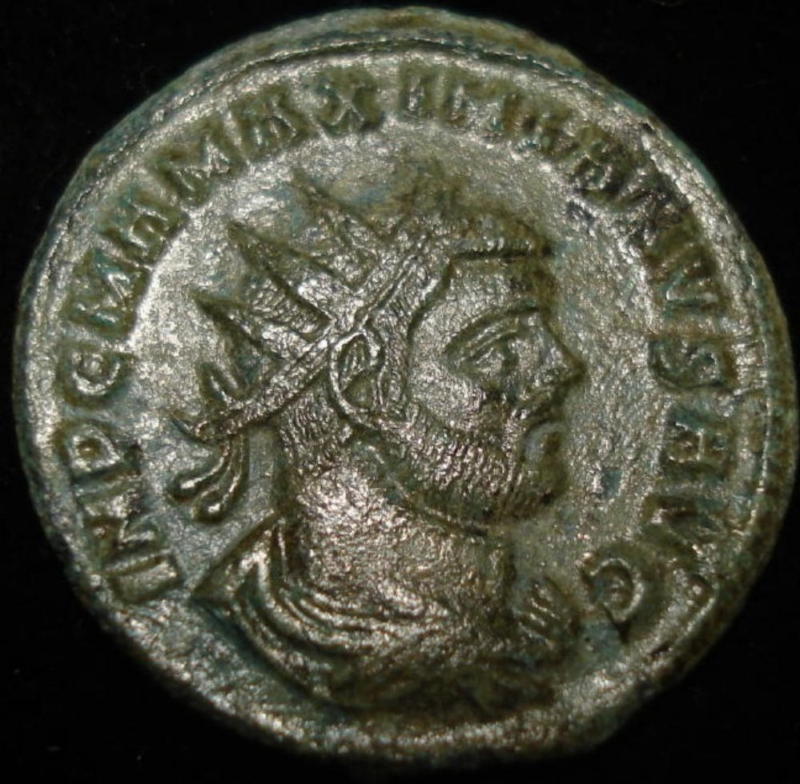 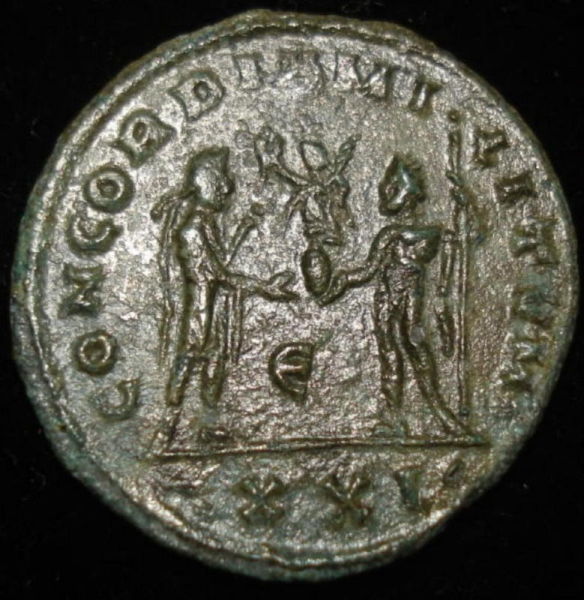 => so what can you guys tell me about today's coin? => so what can you guys tell me about today's coin?(thanks again for helping-out)
|
|
Pillar of the Community
United States
4253 Posts |
Marcus Aurelius Valerius Maximianus Herculius Augustus was Roman Emperor from 286 to 305. He was Caesar from 285 to 286, then Augustus from 286 to 305. He shared the latter title with his co-emperor and superior, Diocletian, whose political brain complemented Maximian's military brawn. In the late summer of 285, he suppressed rebels in Gaul known as the Bagaudae. From 285 to 288, he fought against Germanic tribes along the Rhine frontier. Together with Diocletian, he launched a scorched earth campaign deep into Alamannic territory in 288, temporarily relieving the Rhine provinces from the threat of Germanic invasion.
The man he appointed to police the Channel shores, Carausius, rebelled in 286, causing the secession of Britain and northwestern Gaul. Maximian failed to oust Carausius, and his invasion fleet was destroyed by storms in 289 or 290. Maximian's subordinate, Constantius, campaigned against Carausius' successor, Allectus, while Maximian held the Rhine frontier. The rebel leader was ousted in 296, and Maximian moved south to combat piracy near Hispania and Berber incursions in Mauretania. When these campaigns concluded in 298, he departed for Italy, where he lived in comfort until 305. At Diocletian's behest, Maximian abdicated on May 1, 305, gave the Augustan office to Constantius, and retired to southern Italy.
In late 306, Maximian took the title of Augustus again and aided his son Maxentius' rebellion in Italy. In April 307, he attempted to depose his son, but failed and fled to the court of Constantius' successor, Constantine (who was both Maximian's step-grandson and also his son-in-law), in Trier. At the Council of Carnuntum in November 308, Diocletian and his successor, Galerius, forced Maximian to renounce his imperial claim again. In early 310, Maximian attempted to seize Constantine's title while the emperor was on campaign on the Rhine. Few supported him, and he was captured by Constantine in Marseille. Maximian committed suicide in the summer of 310 on Constantine's orders. During Constantine's war with Maxentius, Maximian's image was purged from all public places. However, after Constantine ousted and killed Maxentius, Maximian's image was rehabilitated, and he was deified.
|
| |
Replies: 436 / Views: 33,655 |







 First Page


 Posted 04/01/2012 7:15 pm





