| Author |
 Replies: 436 / Views: 33,676 Replies: 436 / Views: 33,676 |
|
|
|
Pillar of the Community
 3352 Posts |
=> I'm thinking that "stamp-collecting" is gonna be next month's obsession ...   |
|
Bedrock of the Community
United States
10045 Posts |
Steve, I can read most of that--interesting that it comes from Phaselis in Lycia, and 205-4 BC? That explains why it looks different than Alexander III tets--but an interesting coin and history all the same!  |
|
Pillar of the Community
3352 Posts |
Hey, you're probably correct ..... For the record, DVC => I appreciated you giving me the heads-up to watch out for fakes (otherwise I was headed towards a potential rip-off scenario) ... so thanks (I owe ya one)!! ... phew, thank God they ended-up being authentic!! |
|
Pillar of the Community
3352 Posts |
Quote:
Alexander III of Macedon (20/21 July 356 -- 10/11 June 323 BC), commonly known as Alexander the Great was a Greek king of Macedon, a state in northern ancient Greece. Born in Pella in 356 BC, Alexander was tutored by Aristotle until the age of 16.  Quote:Alexander succeeded his father, Philip II of Macedon, to the throne in 336 BC after Philip was assassinated. Upon Philip's death, Alexander inherited a strong kingdom and an experienced army. Quote:
By the age of thirty, he had created one of the largest empires of the ancient world, stretching from the Ionian Sea to the Himalayas. He was undefeated in battle and is considered one of history's most successful commanders. Quote:
He subsequently overthrew the Persian King Darius III and conquered the entirety of the Persian Empire. Seeking to reach the "ends of the world and the Great Outer Sea", he invaded India in 326 BC, but was eventually forced to turn back at the demand of his troops. Quote:
Details of the death differ slightly -- Plutarch's account is that roughly 14 days before his death, Alexander entertained admiral Nearchus, and spent the night and next day drinking with Medius of Larissa. He developed a fever, which worsened until he was unable to speak. The common soldiers, anxious about his health, were granted the right to file past him as he silently waved at them. Diodorus recounts that Alexander was struck with pain after downing a large bowl of unmixed wine in honour of Hercules, and died after some agony. Given the propensity of the Macedonian aristocracy to assassination, foul play featured in multiple accounts of his death. Edited by stevex6
04/26/2012 5:38 pm
|
|
Rest in Peace
United States
9104 Posts |
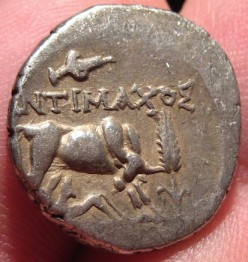 Obverse: Cow suckling calf; corn ear right Who decides what these figures are? The cow looks like a horny b******, with no boobs, try as I might I can't stretch what's under it into a calf (more human), and that looks a lot more like wheat or another grain than corn. |
|
Pillar of the Community
3352 Posts |
Quote:
Who decides what these figures are? The cow looks like a horny b******, with no boobs, try as I might I can't stretch what's under it into a calf (more human), and that looks a lot more like wheat or another grain than corn. biggfredd => ahahahaha, yah it's a little bit difficult to decipher some of the descriptions (in this case, the calf is underneath the cow, facing left, and it is almost bent-over backwards trying to find the ol' teet) ... ... and I admit that the corn is a wee bit wheatish looking, but corn and/or wheat, who really cares => it was "food" (nowadays, they would merely have the golden arches on their coins) ... => Oh, apparently Jimmy the Greek's kid (Timmy) is the current person in charge of writing all of the ancient coin descriptions (for the record, 9 out of the last 10 coins that Timmy has deciphered had "something suckling something else" ... Timmy is currently on probation) |
|
Pillar of the Community
United States
1549 Posts |
When selecting countermarked coins we have to decide what we are willing to flatten as well as all the regular questions about grade. My Seleucid anchor coin lost some of Zeus but kept the nose. 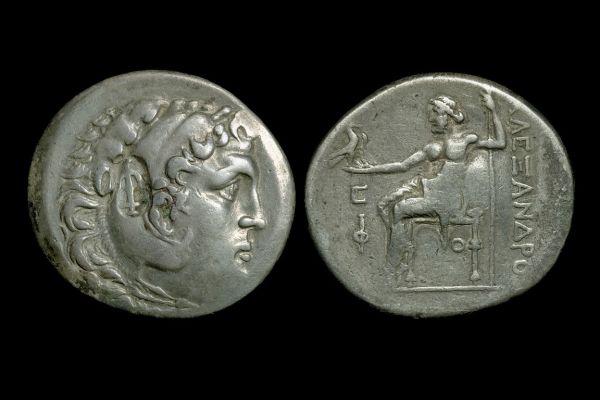 |
|
Valued Member
United States
168 Posts |
Quote:
Cow suckling calf; corn ear right
I am a doctoral candidate in plant biology and I can assure you that this description is incorrect. Maize is only native to the Americas and thus the ancient western world would have no idea it existed. |
|
Pillar of the Community
3352 Posts |
Hi, w00zi ... Odd? => yah, I'm not sure why Timmy the Greek would try to call it corn if it's not, but here is a link to a whole bunch of other/similar coins (some of them mention ear of corn and some mention ear of grain) ... Quote:
doctoral candidate in plant biology => wow, you get to flex your grain-brain!! (well done) http://www.wildwinds.com/coins/gree...chium/i.html |
|
Pillar of the Community
3352 Posts |
dougsmit => your coin is very nice, too ...
In my coin's scenario => I like to think that it was a bit personal when the good ol' ancient decided to stamp my coin "right in the nose" => kapowwwwww!
|
|
Pillar of the Community
United States
1549 Posts |
Quote:
doctoral candidate in plant biology
It is common for UK authors to use the word corn for 'grain' and many coin descriptions have UK origins (Seaby, British Museum). You will not see this coin called Maize and corn is as accurate as need be.
|
|
Pillar of the Community
3352 Posts |
kapowwwwww!
|
|
Pillar of the Community
3352 Posts |
DAY #27 => COIN #4
Neapolis AR NomosDate: 320-300 BC Diameter: 20.6 mm Weight: 7.4 gr Obverse: Diademed female head right (Parthenope, nymph) Reverse: Man-headed bull walking right; Nike flying above, crowning bull, DI below. References: SNG ANS 327 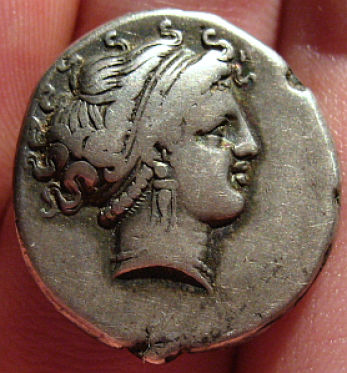 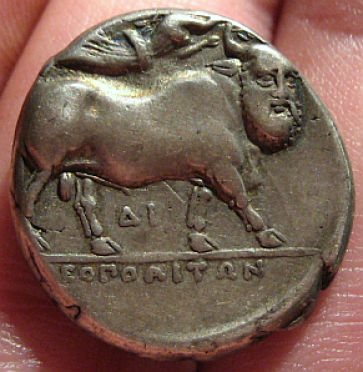 => wow, we've made it down to "my last four coins"!! => wow, we've made it down to "my last four coins"!!
=> please dig-deep and continue to post your comments on the coins, or on any of the figures and/or legends that go along with the coins (thank you very much for your participation!!)
Edited by stevex6
04/27/2012 07:28 am
|
|
Valued Member
Australia
215 Posts |
I like that they made the bull anatomically correct
|
|
Pillar of the Community
3352 Posts |
"Man-Headed Bull" Quote:
The Man-Headed bull figure represents Achelous, a Greek River god (River gods made the fields fertile) Quote:
In Greek mythology, Achelous was the patron deity of the "silver-swirling" Achelous River, which is the largest river of Greece, and thus the chief of all river deities, every river having its own river spirit. Quote:
Achelous was a suitor for Deianeira, daughter of Oeneus king of Calydon, but was defeated by Heracles, who wed her himself. Sophocles pictures a mortal woman's terror at being courted by a chthonic river god:
'My suitor was the river Achelóüs,
who took three forms to ask me of my father:
a rambling bull once, then a writhing snake
of gleaming colors, then again a man
with ox-like face: and from his beard's dark shadows
stream upon stream of water tumbled down.
Such was my suitor.' (Sophocles, Trachiniae)
The contest of Achelous with Heracles can be seen on several coins of Acarnania the god is represented as a bull with the head of an old man
|
| |
Replies: 436 / Views: 33,676 |





 First Page
 Previous Page


 Posted 04/26/2012 11:14 am





