| Author |
 Replies: 436 / Views: 33,679 Replies: 436 / Views: 33,679 |
|
|
|
Moderator
 United States
23731 Posts |
Decius was a general during the reign of Philip II, Revolts by Pacatian and Jotapian was in the works and Decius was sent to take care of the problem. Decius was successful and was proclaimed emperor by his troops. At first he did not want to except it, but felt that it would be a sign of treason if he didn't. Decius than headed for Rome, Philip hearing of this advanced to meet the approaching rebels and met Decius for battle near Verona in northern Italy. Philip lost. Decius advanced into Rome and was confirmed emperor by the senate and given the add name of Traianus in the hopes that he would return the glory of Rome back to the time of Trajan. He returned to a period of the persecution of Christians to deflect attention from others problems that Rome was facing. The Goths were becoming active again and causing problems. Decius lost his life in battle with the Goths.
|
|
Rest in Peace
United States
2668 Posts |
|
|
Pillar of the Community
United States
4253 Posts |
Quote:
jwharper and/or echizento? ... no comments from you guys today? Just giving others a chance to post. |
|
Pillar of the Community
 3352 Posts |
thanks for your comments, echizento ...
=> wow, Decius died in battle => although he didn't die of natural causes, death on the battlefield sounds like a far more noble and desirable death than some of the other options, right?
jwharper => sorry, I wasn't trying to nag you ... I have merely become trained to receive your slick-responses (sadly, I've become a bit like Pavlov's dog ... drooling for people's responses immediately after posting my daily coin!!) ...
anyway ... hopefully this thread isn't dragging-on too much? (on the bright-side, it is stopping me from purchasing more coins ... so job well done!!)
Have a great day, ancient coin dudes!!
Edited by stevex6
04/09/2012 1:36 pm
|
|
Pillar of the Community
United States
4778 Posts |
Well, echizento basically handled today's history lesson, so I thought you might be interested in seeing my one and only Trajan Decius.  |
|
Pillar of the Community
3352 Posts |
Nice => very sweet looking coin, ValiantKnight ... ... does anybody else have any fine examples?   |
|
Rest in Peace
United States
9104 Posts |
Quote:
Sadly, my computer has a virus (several actually) and it looks like it might be in the shop for a few days That sux through a straw. Unless your nerd recommends a different freebie. AVG and Avast are both great freebies. I prefer AVAST, which automagically updates every day or so. http://housecall.antivirus.com is also free, and updates itself whenever you run it. Low on my list are McAfee and Norton. Both want to infiltrate your system. |
|
Rest in Peace
United States
9104 Posts |
Quote:
Holiday check! Holiday check! Turkey is for Thanksgiving, on Easter, you're supposed to eat 50 hard boiled eggs and wash then down with rabbit's, too. |
|
Pillar of the Community
3352 Posts |
biggfredd => thanks for the computer advice (I am going to ask one of my happy minions at work to take a look at my computer ... he is my IT guy and always seems to know what's up, but I'll mention your recommendations to him)  |
|
Pillar of the Community
3352 Posts |
Oh, and next year I'll try your Cool Hand Luke Easter recipe => 50 hard boiled eggs, with rabbit's too!!  |
|
Pillar of the Community
3352 Posts |
DAY #10 => COIN #21
Philip I AR AntoninianusDate: 247 AD Diameter: 20-23 mm. Weight: 3.3 gr. Obverse: IMP PHILIPPVS AVG - Radiate, draped and cuirassed bust of Philip I. Reverse: SAECVLARES AVGG - She-wolf suckling twins, II in ex.. References: RIC 15 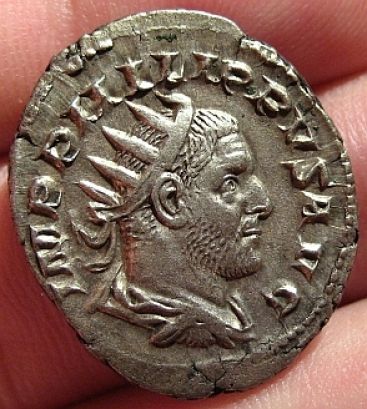 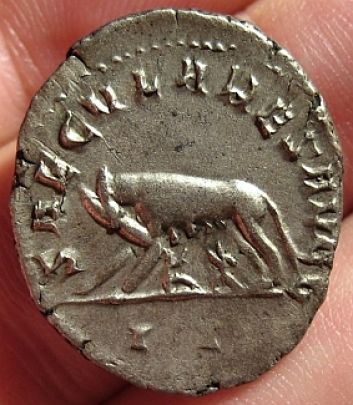 => please continue to make comments and critiques (we're 1/3 of the way there!!) NOTE => or feel free to post examples of your Philip I coins!! ... thanks
|
|
Moderator
United States
23731 Posts |
Very nice details of the emperors image. Will give others a chance to comment.
|
|
Pillar of the Community
United States
2596 Posts |
|
|
Pillar of the Community
United States
4253 Posts |
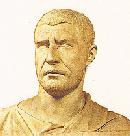 Marcus Julius Philippus rose from obscure origins to rule for five and one-half years as Rome's emperor. Only sketchy details of his life and reign have survived in the historical record. One of those details -- his ethnicity -- was latched onto by later historians, who called the emperor by the name Philip the Arab. Philip the Arab was born in the Roman province of Arabia, in what today is the village of Shahba, roughly 55 miles south-southeast of Damascus. The village was obscure at the time of Philip's birth, though once he became emperor, Philip renamed the community Philippopolis and embarked on a major building campaign. Little is known of Philip's father, save the name Julius Marinus and must have been locally prominent. At some point, probably in the 230s, Philip married Marcia Otacilia Severa. A son was born by 238 and named Marcus Julius Severus Philippus. Philip's early career is also obscure, though it was undoubtedly helped by that of his brother, Julius Priscus. Priscus was appointed praetorian prefect by Gordian III and had previously served as prefect of the Roman province of Mesopotamia. If a fragmentary inscription from Rome can be connected to Priscus, Philip's brother rose quickly during Gordian III's reign through a variety of equestrian offices, including procurator of Macedonia, vice prefect of Egypt, and judge at Alexandria. Priscus' appointment as praetorian prefect probably came at the beginning of the Roman campaign to reconquer upper Mesopotamia in the spring of 242. The success of the campaign must have reflected well on Priscus, and when his colleague Timesitheus (who was also Gordian III's father-in-law) died the following year, Priscus' brother Philip joined him as praetorian prefect. The brothers remained the young emperor's most powerful deputies during the disastrous campaign against the Persians in the winter of 243-44. On the retreat back up the Euphrates after the Roman defeat at Misikhe, Gordian was killed sometime during the winter months of 244. Most sources state that Philip was involved in Gordian's death; some claim that Philip engineered a mutiny by diverting the grain that was supposed to feed Gordian's troops. Philip was acclaimed the new emperor and was firmly in control by late winter 244. Like his predecessor Macrinus, Philip faced, as his first important task, the problem of ending a war in the East. Philip was more fortunate in his negotiations than Macrinus had been. Philip made a peace treaty with the Persian king Shapur in which Philip agreed to pay the equivalent of 50 million sesterces, and possibly an annual tribute. The treaty enabled the new emperor to travel westward to Rome. It remains unknown why Philip was displayed before the soldiers as their new emperor instead of his more accomplished brother Priscus, but Priscus went on to have extraordinary power in the East during the new regime. Priscus is described in one inscription as rector Orientis, and he exercised supreme authority over armies and provinces from his headquarters in Antioch. Philip faced revolts and upheavals in several corners of the empire. He was able to overcome these challenges for half a decade. The empire remained fundamentally sound and stable during his reign. The great disruptions of the third century were yet to come. To restore discipline among the Danubian troops, Philip sent as the new commander Decius, a native of the region. The appointment proved a dangerous blunder. The disgruntled soldiers, still eager for decisive leadership and decisive victories, revolted yet again in the late spring of 249 and proclaimed Decius emperor. Philip marched out from Rome to face the approaching troops of Decius. In late summer, the two armies met outside Verona. Philip's troops were bested, and the emperor either died in the battle or was assassinated by his troops. When news of Philip's defeat and death reached Rome, the praetorian guard murdered Philip's son. |
|
Pillar of the Community
United States
4253 Posts |
I forgot to say your coin is very nice. I love the reverse and I think it may be kind of rare. Here is my best Philip I. It is an Antoninianus, RIC38b: 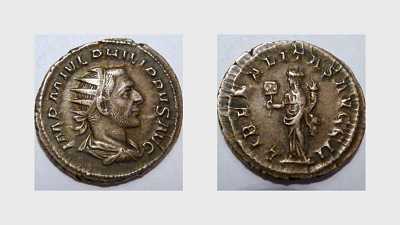 |
| |
Replies: 436 / Views: 33,679 |







 First Page
 Previous Page


 Posted 04/09/2012 12:41 pm





