| Author |
 Replies: 13 / Views: 2,390 Replies: 13 / Views: 2,390 |
|
|
Pillar of the Community
 United States
1551 Posts |
Resurrecting an old topic on denticle clashing again. I bought this coin from Brain R today. Leroy told him it's the earliest die state he had ever seen. In the Vam-listing it is noted for a gouge through Dollar. In this one it also has the denticles above the "gouge" Rim and Denticle Clash!  http://www.vamworld.com/message/view/home/52699366 http://www.vamworld.com/message/view/home/52699366Edited by twohawks
04/09/2012 8:00 pm
|
|
|
|
Valued Member
United States
114 Posts |
 Nice find !! |
|
Pillar of the Community
 United States
1551 Posts |
It has been said that denticles cant make an Impression here is a smoking gun
|
|
Rest in Peace
United States
10625 Posts |
Nice pick! Yeah, I heard it's the standing die feature between the denticles that make this impression.
|
|
Pillar of the Community
United States
5700 Posts |
Russ, I have come to see YOU are a unique collector, being you always seem to come up with one beauty after another, this sweet looking coin is an example of what I am talking about.. I would like to address one subject, the " denticle clash marks".. I do not see how the name could be given to the " marks on the reverse " below the tail feathers. I do not see how the marks could in ANY way be related to the denticles, The distance, the size of the marks, compared to the distance and size of denticles imprints,are IMO, not even a close possibility. Could you possibly, with your apparent expertise assist me in clearing up my disbelief on this topic, Thanks again for sharing, Be Well, Mike.....
|
|
Pillar of the Community
United States
1551 Posts |
Later today I will upload a few photos of 3 other coins with "denticle clashing" and we can Pro & Con them. It is an interesting subject and should be talked about.
|
|
Pillar of the Community
United States
5700 Posts |
Thank you my friend.......
|
|
Pillar of the Community
United States
3076 Posts |
Hey Russ, ol buddy, such an inconclusive subject...not on line much any more but great to see such finds as you have shown!!moved so w2ill clue you in on that later....Gene
|
|
Pillar of the Community
United States
5700 Posts |
Russ, Gene, It is nice to see you around,I am doing some clashing Research and saw this topic, I hope you are well, Mike.....
|
|
Pillar of the Community
United States
5700 Posts |
 Russ, I saw the VW comments and see how one would think the denticles made those marks, I also see the reff to page 225 in the 4th edition. I do not want to seem a problem, I just wanted to hear YOUR comments about the "Gouge being a rim clash"......... I have my opinion, then there's the people who know, LOL..... I also wanted to comment about how on this site there are far fewer people looking down their noses at people like my self seeking answers,It is not what people say, just how they say it!!!  I appreciate the guidance and look forward to hearing your comments on this topic, I see MR VA never stated the gouge is from the rim.......?That is my problem, I do NOT feel it is. |
|
Pillar of the Community
United States
1551 Posts |
What I was thinking for some of the denticle clashes is this.
While making a working die the mint would take a "Working Hub--Hardened metal" This die is a reverse of what would seen on the working die and is struck or hammered into the "in progress Working die" The working die is a Non Hardened piece high grade steel at this point and is much softer on a Rockwell testing scale.
If the working hub was dropped on a part of the "in progress working die" it would dent easily. In the case of this coin I think that is the "How" What is seen on a later die state of this coin is what looks like a gouge but has a slight curve to it only, early die states have a match of the center spacing that should match the reverse design of a working hub. If it was dropped at an angle where the rim hit first or made more contact it in theory makes sense. Keep in mind that 2 flat blunt surfaces hitting together take a bunch of force to make an impression. But like a center punch a harder object with less area of contact needs far less force to leave a impression.
After a working die was made and then hardened they where polished. In many cases the dies where sand blasted that led to the frosted faces you see, the polishing of the new die also removed that sand-blasted effect from the fields giving a coin that DMPL look.
It is "My Theory" that this clash happened during the manufacturing of the die, not during the minting process of a coin.
Edited by twohawks
04/16/2012 11:29 pm
|
|
Rest in Peace
United States
10625 Posts |
Interesting theory. This scenario would hold more water than a clash during the minting process. The hammer die would had to have fell loose from the press and been at an angle during the strike. This probably would have resulted in a total loss of the dies, both hammer and anvil as well as the collet that holds the hammer die. Makes sense that it likely happened during the strike of the master die to the working die. Could have even been a bounce during the strike.
|
|
Pillar of the Community
United States
5700 Posts |
Russ, I thank you for taking the time to reply, MY problem is this, I do not see the "Mint" making a die and this being put into the coining process with a " mark " in the new working die.
IF the die being made, was to of had anything dropped on it why the mark or gouge would not be through the letters, has me in doubt.....I am just not clear on the gouge ,it appears there is a gouge on the die, which to me, looks like the planchet took the " damage " before the die was produced, and the die was produced around the damage, I know how this sounds, but HOW else were the letters NOT involved in the gouge or W/E........
I am not sure I am communicating clearly!!!!! Just my opinion
|
|
Moderator
 United States
23522 Posts |
The working hub is a positive, just like the coin itself. As such, a "drop" contact with an unhardened die would transfer "positive" features, like denticles. But look at your coin. What is transferred is not the denticles, it's the spaces between the denticles. Your image shows this clearly. The denticles themselves are far larger than the dots on your coin. In fact, they're the exact size of the spaces between the dots. My MS65 '21 V3F2 shows the same. 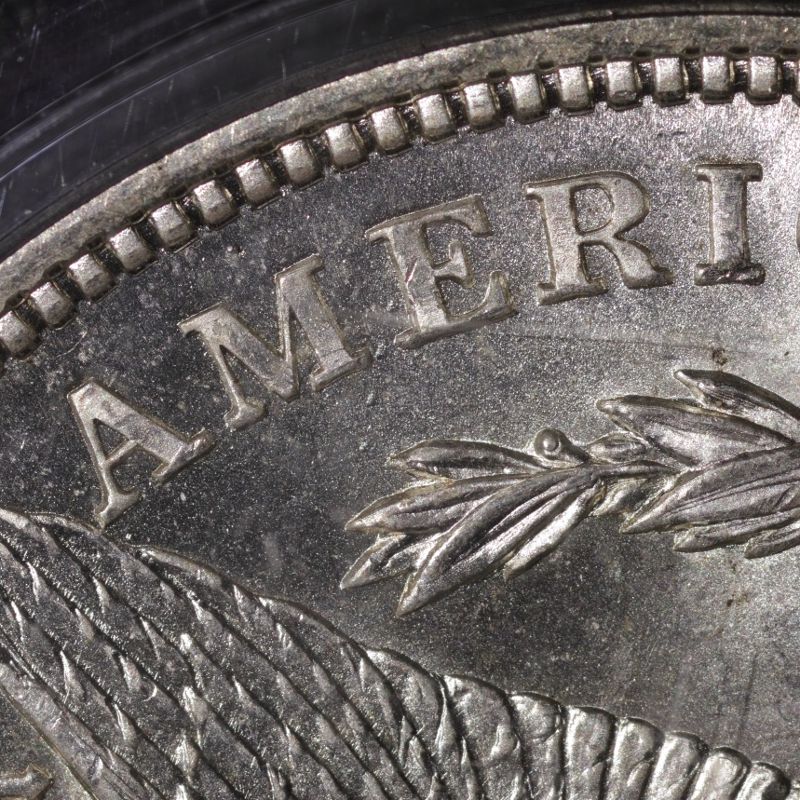 Only a "negative," like a die, can do that. |
| |
Replies: 13 / Views: 2,390 |
|







 Posted 04/09/2012 8:01 pm





