The Cleveland commemorative half-dollar marks the centennial of Cleveland's incorporation as a city along with its hosting of the Great Lakes Exposition that was held to celebrate the centennial; the Exposition ran during the summers of 1936 and 1937. The half-dollar is shown here via an example in PCGS MS-66.
The City of Cleveland can trace its roots back to July 1796 when General Moses Cleaveland and a survey team arrived at the mouth of the Cuyahoga River and Cleaveland decided the plain above the river was a good site for a settlement. The site was named Cleaveland in the General's honor. It was incorporated as a Village in 1814, and then as a City (without the extra a) in 1836.
Read More: Commems CollectionThe coin was designed by Brenda Putnam and features a left-facing portrait of General Moses Cleaveland on its obverse and a map of the Great Lakes area with its major cities noted via stars on the reverse. The largest star -- with the large compass pointing to it -- represents Cleveland.
Half of the coin's maximum authorized mintage of 50,000 was struck in July 1936 and was sold at the Exposition as well as via mail order. As sales of the coin -- under the guidance of Thomas Melish (more about him when I post my Cincinnati) -- were good, an additional 25,000 coins were ordered; they were struck in February of 1937. All coins, however, are dated 1936 and identical so the Cleveland is a single-year, single variety commemorative.
The coin shown is brilliant, has nice surfaces and good cartwheel luster on both sides.
I've included one of the original holders for the Cleveland commemorative half-dollar; there are multiple holder varieties. There are one- and two-coin black holders, with and without notarization on their back, as well as a couple of different imprinted envelopes. The holder shown is a two-coin, non-notarized example.
Enjoy!
1936 Cleveland Centennial -- Obverse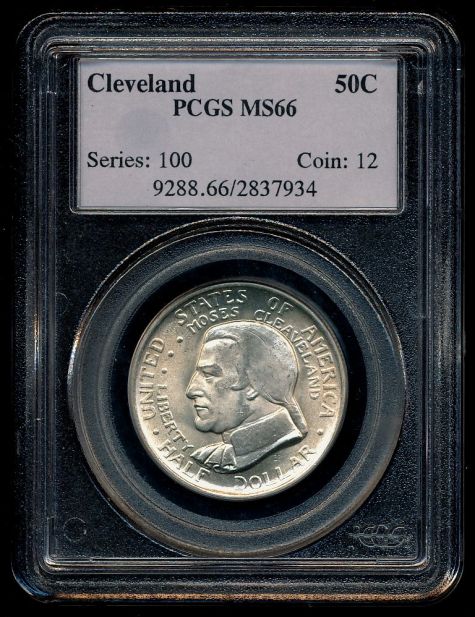 1936 Cleveland Centennial -- Reverse
 1936 Cleveland Centennial -- Holder, Front







 Posted 04/12/2012 10:24 pm





