| Author |
 Replies: 11 / Views: 3,399 Replies: 11 / Views: 3,399 |
|
|
New Member
United Kingdom
35 Posts |
I am hoping that someone can help as this 1917 Eygpt 10 Milliemes coin has me stumped. I picked this up last year in a large collection and just thought it was dirty at the time but looked at it again today and realised that it was made of zinc. I have not seen this type before and can find no reference to this. Is this a copy or fake? Or something else. Thanks for your help. 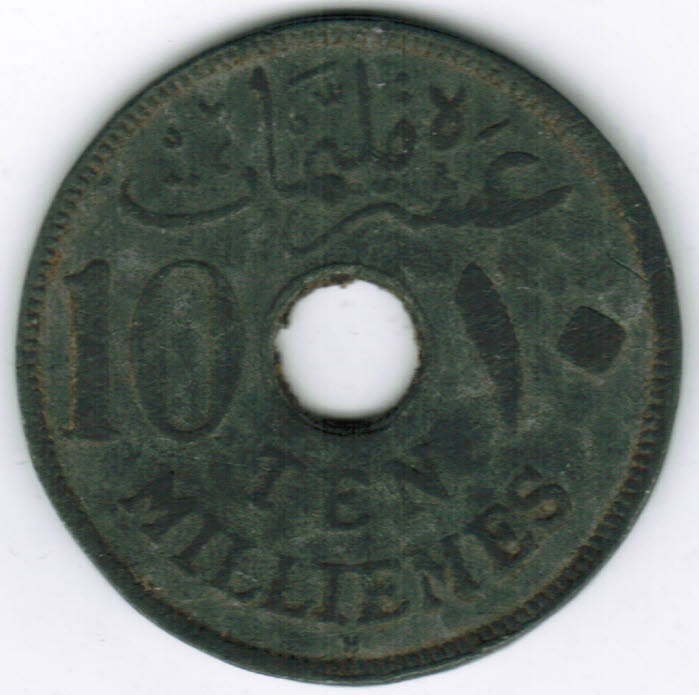 |
|
|
|
Valued Member
South Africa
105 Posts |
as far as I know they were cupro-nickel.. I'm sure some more knowlegable members will shed some light on this.. I have the 1917 2 Piastres : 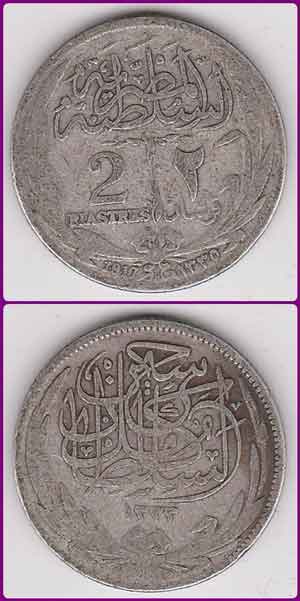 on a different note, was there a specific reason some coins were holed? |
|
Pillar of the Community
United States
513 Posts |
Interesting.
My first question would be how are you certain that it is zinc?
From the one picture, it certainly looks authentic and not fake. However I couldn't tell you if it was copper-nickel or zinc just from the picture. I've certainly seen a lot of filthy US nickels in change.
I have looked in my standard catalog and on numista.com and numismaster.com, and all list the 1916-1917 coins of this type as copper-nickel only. Also the 1917 with the H mintmark is the most common, so least valuable and most likely to be encountered.
Numista says it should weigh 6.0 grams. So the next thing I would do is weigh it to see if it is significantly different.
-wheatiefan
|
|
New Member
 United Kingdom
35 Posts |
I agree as far as I know they are cupro nickel as well. The holed coins were only issued during the British occupation of WW1 and some other British Empire coins of the period went for holes - Palestine, West Africa, East Africa etc. Seems it was the fashion as France, Belgium and Scandinavian countries went for holed coins as well and I guess it is the same as today where are all now getting bi-metallic coins.
Pretty sure it is zinc and not grime. I have compared it to other zinc coins from Belgium and Netherlands and the material looks the same. I don't have scales accurate enough to weigh this but using a simple balance it is clearly lighter than a normal 1917 10 Millieme.
Other than this I am not sure how to identify zinc and I would appreciate any ideas so I can be certain on the material.
|
|
Valued Member
South Africa
105 Posts |
use a magnet? I'm not sure whether copper-nickel or zinc are magnetic but if one is it might help..
|
|
Pillar of the Community
United States
513 Posts |
I am still perplexed by your coin. Neither zinc nor copper nickel should be magnetic. Iron would be. Zinc coins should not 'ring' when dropped on a surface but have a dull clunk or thud. I don't know a definite test for zinc aside from high tech XRF guns used to check metal composition. If you search the forum you will find instructions to check the specific gravity, but this requires an accurate scale as well. When I see cheap coins I assume the magnetic ones are iron, the dull silvery ones are tin, and the others are zinc.  Zinc coins were common in WWI but if it were common for this coin I'd expect it to be well known. Since the Heaton mint might have made coins for other countries, it is possible that it was struck on a zinc planchet intended for another country, but then you'd have to find what other countries used similar sized holed coins made of zinc that were also made at the H mint during that time frame.  I have zinc coins from both world wars, and they often have corrosion or some white film on them, which I don't see on yours. If you have a comparable 10m in CuNi it would be nice to see them side by side, including both sides of the coin. There is also a Great Britain subforum on the CCF you might ask for help from as the more knowledgeable members there might not frequent this subforum. Other possibilities would be to contact a coin club or coin dealer nearby. Ultimately an accurate weight will be required. If you were in the US you could send it to a place like ANACS who would slab it and attribute it as to what type of error it is (assuming it is one). But the cost of slabbing and shipping is so high that it's usually not worth it unless it's potentially worth >$100 or more. Side note: Holes were often put in wartime coins to decrease the weight without decreasing the diameter. -wheatiefan  to CCF |
|
Moderator
 Australia
17006 Posts |
Quote:
on a different note, was there a specific reason some coins were holed?
The holed coins were only issued during the British occupation of WW1 and some other British Empire coins of the period went for holes - Palestine, West Africa, East Africa etc. Seems it was the fashion as France, Belgium and Scandinavian countries went for holed coins as well and I guess it is the same as today where are all now getting bi-metallic coins.The two main "reasons" why coins were holed were (1) to allow natives who didn't have pockets in their traditional dress to carry large numbers of coins on strings (especially in Africa and the Pacific) and (2) to allow quick at-a-glance differentiation between cupronickel coins and silver coins of similar size. As for your coin, another possible explanation for the blackening, porous surface and weight loss is that it's been in a fire. Don't say "infinitely" when you mean "very"; otherwise, you'll have no word left when you want to talk about something really infinite. - C. S. Lewis
|
|
New Member
United Kingdom
35 Posts |
Thanks for your very helpful ideas and advice. I have scanned the coin next to the usual CuNi version and as you can see the condition is not great which doesn't help. It is starting sound like I need to get this checked out next time I visit my nearest coin dealer. Perhaps an excuse to buy something while I am there as well. 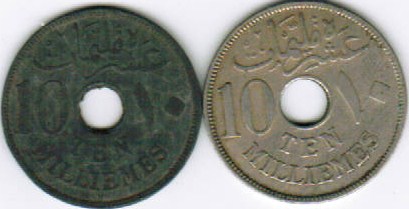 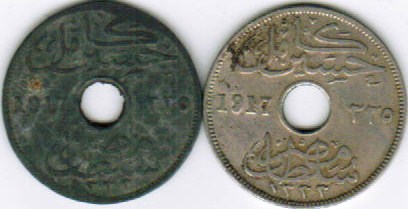 |
|
New Member
United Kingdom
35 Posts |
I have now weighed this mucky little coin and it is only 4.5g so underweight and about right for zinc.
|
|
Pillar of the Community
Egypt
3470 Posts |
Hi Turnstone First to CCF Second if the coin you are asking about is made of a different metal other than Cu-Ni and has a less weight ..... it is most probably made of a cheaper metal or alloy (whether zinc or other) and with this kind of details I would say that; Before coins are struck, an example of the coin is made by the mint as a trial that is shown for the governor in order to take his approval on starting its production and as I heard these trials or examples are usually made out of another metal/alloy than that will be used for the real coin and usually it will be of Aluminum or zinc. So my guess is that may be this is one of these trials or as Sap said it might have been in fire. |
|
Bedrock of the Community
Australia
21792 Posts |
Another simple test is the comparison ring tone test. Try it.
|
|
New Member
United Kingdom
35 Posts |
Thanks everyone for all of your very helpful advice. The ring test was a good one and while the CuNi normal coin will ring the unknown one will not (bit of dull thunk). Together with the light weight I am now sure it is a different material and I believe zinc but I will leave that up to an assessor to confirm.
Thanks again.
|
| |
Replies: 11 / Views: 3,399 |
|










 Posted 04/29/2012 01:20 am


