



Coin Community Family of Web Sites Join Thousands of Coin, Bullion, & Money Collectors
Vancouvers #1 Coin and Paper Money Dealer Join Thousands of Coin, Bullion, & Money Collectors Royal Estate Auctions - $1 Coin Auctions300,000 items to help build your collection! Coin, Banknote and Medal Collectors's Online Mall Specializing in Modern Numismatics Royal Canadian Mint products, Canadian, Polish, American, and world coins and banknotes.


Username:
Password:
Save Password
Forgot your Password?


This page may contain links that result in small commissions to keep this free site up and running.

Welcome Guest! Registering and/or logging in will remove the anchor (bottom) ads. It's Free!

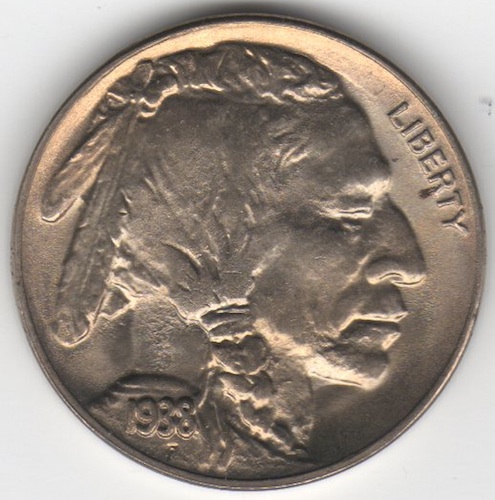
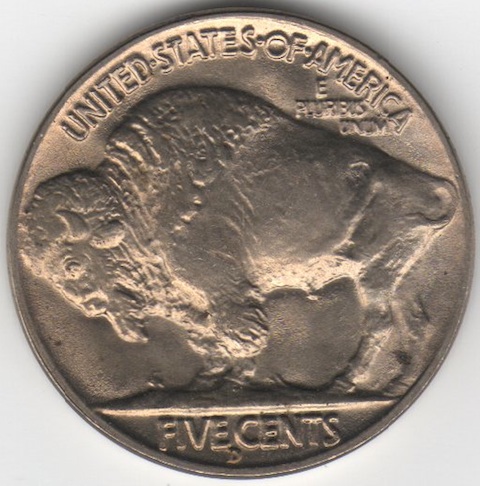
1938-D BUffalo BU

To participate in the forum you must log in or register.
Author Previous TopicReplies: 5 / Views: 1,124Next Topic  
Pillar of the Community
jerseyben's Avatar
United States
1211 Posts
 Posted 06/06/2012  7:58 pm Show Profile   Bookmark this topic Add jerseyben to your friends list Get a Link to this Message Number of Subscribers
Straight from a roll to a 2X2.

Lots of luster. Not a single scratch or mark (besides a few obvious carbon spots).

Grade?

1938-D-BUffalo-BU

1938-D-BUffalo-BU
Valued Member
donkrx's Avatar
United States
227 Posts
 Posted 06/07/2012  02:46 am  Show Profile   Bookmark this reply Add donkrx to your friends list Get a Link to this Reply
Since no one has responded and I'm in a posting frenzy I'll take a shot at it. I say MS66 because of the flat strike, but admittedly I don't know how much to weigh the quality of strike. I do know Buffalo's have weak strikes in general but this one seems pretty weak and it is not on the list of Buffalo's to have the most prevalence for weak strikes.

I honestly have no idea how much strike affects the grade at MS65 and up so I'm curious if anyone can give some expert input on that. I did some searching and only found conflicting information ... I've even seen a lot of people say "it doesn't matter at all", which clearly cant be true according to PCGS grading standards (which explicitly includes strike as a main component of the technical grade). My understanding is that some coins are more commonly seen weakly struck than others, so those are probably graded more forgivingly... but that's not to say it doesn't matter at all. I would have to think it depends on the particular coin in question.
Pillar of the Community
United States
1590 Posts
 Posted 06/07/2012  11:39 am  Show Profile   Bookmark this reply Add jmkendall to your friends list Get a Link to this Reply
Remember that PCGS grades on marketability. Which means that they take strike into account. Technically that means you could have a perfect coin (MS70) with a weak strike; and they might therefore market grade it as an MS65.

Remember MS70 only means it is EXACTLY as it was from the moment it was ejected from the dies, without any contact marks or spots from a mint worker sneezing on them.......MS70 only refers to the condition of the coin, not its strike....on a purist basis.

I can't see any wear but I don't have it in hand and can't check it with a loop. So I would technically grade it as an MS66, baring any wear present I might have missed. Remember that at the higher grades there are marks that can be seen under magnification but not without. So it could grade higher.

Valued Member
donkrx's Avatar
United States
227 Posts
 Posted 06/07/2012  6:25 pm  Show Profile   Bookmark this reply Add donkrx to your friends list Get a Link to this Reply

Quote:
Remember MS70 only means it is EXACTLY as it was from the moment it was ejected from the dies, without any contact marks or spots from a mint worker sneezing on them.......MS70 only refers to the condition of the coin, not its strike....on a purist basis.


Well... according to PCGS's grading standards it makes it clear that strike is a main component.


Quote:
PCGS.com:
For Mint State and Proof coins, the three factors comprising a coin's "technical grade" are:

1. Number and severity of marks and abrasions
2. Luster, or Reflectivity for Proofs
3. Strike, which is rarely a problem for proofs and strike is expected to be sharp, a weak strike being a deduction in the case of proofs.


A few examples of the upper tier grades:


Quote:
PCGS.com:
MS/PR-67: Virtually as struck with minor imperfections, very well struck
MS/PR-68: Virtually as struck with slight imperfections, slightest weakness of strike allowed
MS/PR-69: Virtually as struck with minuscule imperfections, near full strike necessary
MS/PR-70: As struck, with full strike


However, for NGC:


Quote:
NGCcoin.com:
What is a 70? NGC defines a Mint State or Proof 70 coin as having no post-production imperfections at 5x magnification.


Why is this not standardized? And sorry for hijacking the thread.
Pillar of the Community
jerseyben's Avatar
United States
1211 Posts
 Posted 06/07/2012  7:03 pm  Show Profile   Bookmark this reply Add jerseyben to your friends list Get a Link to this Reply
Not sure how much the carbon spots will detract from the grade but I guess I will send it to NGC and hope for MS67 or better?
Pillar of the Community
jerseyben's Avatar
United States
1211 Posts
 Posted 06/07/2012  7:04 pm  Show Profile   Bookmark this reply Add jerseyben to your friends list Get a Link to this Reply
Not sure how much the carbon spots will detract from the grade but I guess I will send it to NGC and hope for MS67 or better?
  Previous TopicReplies: 5 / Views: 1,124Next Topic  

To participate in the forum you must log in or register.


Disclaimer: While a tremendous amount of effort goes into ensuring the accuracy of the information contained in this site, Coin Community assumes no liability for errors. Copyright 2005 - 2026 Coin Community Family- all rights reserved worldwide. Use of any images or content on this website without prior written permission of Coin Community or the original lender is strictly prohibited.
Contact Us  |  Advertise Here  |  Privacy Policy / Terms of Use

Coin Community Forum © 2005 - 2026 Coin Community Forums
It took 0.23 seconds to rattle this change. Forums