| Author |
 Replies: 10 / Views: 3,517 Replies: 10 / Views: 3,517 |
|
|
New Member
United States
16 Posts |
I came across a 1842 3 roubles that is made out of a lightweight alloy as opposed to the original platinum coins. I assume these re-strikes using original dies are pretty common, right? Coin in question (sorry for the low res scan): weight 1.7 grams, reeded edge, not cast copy. 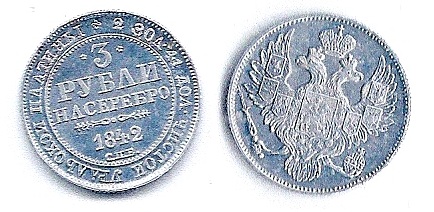 Original Platinum coin: weight 10.35 grams 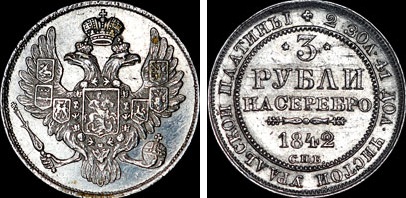 |
|
|
|
Pillar of the Community
Australia
3841 Posts |
There are no known restrikes known using aluminum.
|
|
Pillar of the Community
Russian Federation
5186 Posts |
It's also too heavy for aluminium (if made in proper size specifications an actual aluminium piece would've weighed closer to 1.3 grams, not 1.7).
I did the math, and if it's indeed in proper size specifications (I'm mostly talking about thickness here, more so than diameter which is likely correct) this coin's metal has a density of around 3.5 g/ml; aluminium is 2.7 and most other coin metals are above 5, so I don't know what it could be.
|
|
Bedrock of the Community
Australia
21792 Posts |
If my memory serves me correctly, there were re strikes in silver.
|
|
Pillar of the Community
Australia
3841 Posts |
There were NEVER any restrikes in silver. There were unofficial restrikes struck during the early Soviet era (rumored) but they were restruck in higher quality platinum, not any other metals.
My partial coin collection http://www.omnicoin.com/collection/gxseriesMy numismatics articles and collection: http://www.gxseries.com/numis/numis_index.htmRegularly updated at least once a month. |
|
New Member
 United States
16 Posts |
This coin is much too light for silver. I would have guessed aluminium or similiar alloy by feel alone. Found this: http://www.worthpoint.com/worthoped...ke-243139106 Could be the very same coin. Could someone with an account tell me what it sold for? Edited by BlackAdder
06/18/2012 12:52 pm
|
|
Moderator
 Australia
17006 Posts |
It doesn't look like a restrike from original dies to me. Comparing the two coins in your pics, the edge reeding on the original is much finer, and the obverse less detailed and flatter.
I assume it's either a counterfeiter's trial strike or some kind of "tourist replica".
Don't say "infinitely" when you mean "very"; otherwise, you'll have no word left when you want to talk about something really infinite. - C. S. Lewis
|
|
New Member
United States
16 Posts |
Yes I suppose it could be a replica. Here are some better images of the same coin from worthpoint: 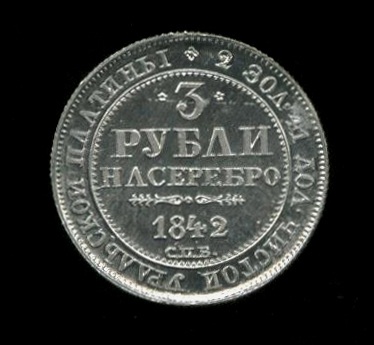 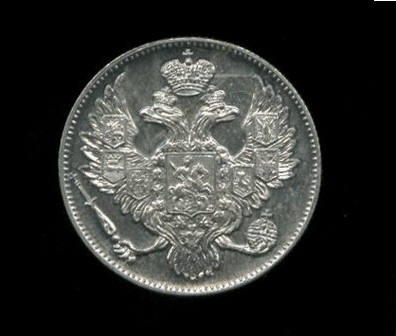 |
|
Valued Member
Austria
194 Posts |
This lightweigt coin is of course a replica, maybe made of whitemedal.
there are lots of unoffical restrikes, forgeries and replikas with or without any marks on the market.
|
|
Pillar of the Community
United States
1767 Posts |
Feel free to send it to me for XRF analysis. I can do it for $25 plus P&H. My guess its a good contemporary counterfeit of tin/lead (white metal) - but if aluminum its then a modern replica. The edge is usually the key when compared to the regal issue and the sharpness of the edge (show us the edge to a real piece). If identical then it may be worth sending it to me. Many Chinese fakes can't come close to reproducing the edge if milled or ornamental and are simply PLAIN and look NEW. If you get Coin World see my latest effort with Mike Diamond on the brassy slightly overweight 1941 Lincoln Cent confirming it was not from Peruvian planchet stock based on its composition. CW (10/15/2012) - page 82-83. John Lorenzo United States |
|
Valued Member
Austria
194 Posts |
its weight is only 1,7 grams? the original coins have also different weights, between around 10 and 10,7 grams everything is possible. this differences are because of the small possibilities of refining, at those days. the platinum was sintered http://en.wikipedia.org/wiki/Sintering, because there was no oven with temperatures to melt platinum developed, yet. it was first in the 1870´s possible to melt platinum. as I know, some of the original coins also contain a considerable proportion iron (up to 15 %) and traces of other metals. today, its possible by analysis to identify the original coins (1828-1845) from the later made, so called "novodels" (also platinum) pattern are not known. your coin is obviously a modern replica. |
| |
Replies: 10 / Views: 3,517 |
|










 Posted 06/18/2012 07:16 am


