| Author |
 Replies: 9 / Views: 1,647 Replies: 9 / Views: 1,647 |
|
|
New Member
United States
1 Posts |
I have had this coin for 20 years and I am assuming that it's a minting pressing/stamping error, and that there was extra metal involved. There is a 1/8" copper ring past the normal diameter edge. It almost looks like a cut out from a blank some how wasn't all the way cut through and removed, and the penny still got pressed. It seems to be all one piece. Took pictures with cell phone, not the best. It's next to a regular penny for comparison. Please let me know what you think of this, and how I should classify it? I will try to get clearer pics 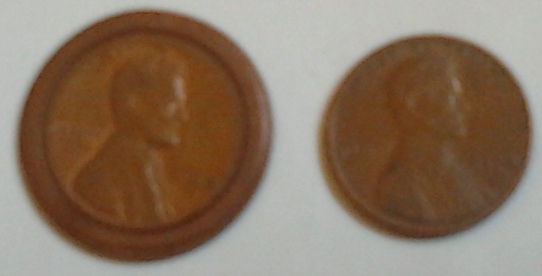 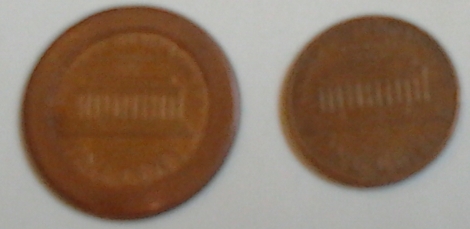 |
|
|
|
Valued Member
United States
116 Posts |
|
|
Pillar of the Community
United States
808 Posts |
 Interesting! Wanna see them better pics. looks like an Encased Coin.  Edited by papatony
07/10/2012 8:58 pm
|
|
Pillar of the Community
United States
2624 Posts |
The outer ring is too uniform, I'm doubting it's an error.
|
|
Pillar of the Community
United States
1699 Posts |
The "outer ring" is just too perfect to be a genuine mint error. Centered broadstrucks just don't have that look, even from the not-so-good pictures. I'm interested to see exactly what it is though...
And Welcome Chase!
Edited by ErrorCoins222
07/10/2012 9:18 pm
|
|
Bedrock of the Community
United States
12437 Posts |
Unfortunately, it is definitely not an error as there is nothing in the minting process that could create a coin that looks like that. At some point in its life, it had a copper bezel added to it. A broadstruck error has a larger-than-normal diameter but the weight will always be the same as a normal coin. Edited by biokemist6
07/10/2012 10:38 pm
|
|
Valued Member
United States
275 Posts |
|
|
Bedrock of the Community
Australia
21792 Posts |
Chase27: to the CCF! Much sharper pictures including the edge, would much better describe this coin. Edited by sel_69l
07/11/2012 12:55 am
|
|
Pillar of the Community
United States
2752 Posts |
Biokemist6 is right on the money. The coin is sitting inside a copper donut that was added outside the Mint.
Error coin writer and researcher.
|
|
Pillar of the Community
United States
7629 Posts |
A good understanding of the minting process at the US Mint is in order here. This simply could not happen at the mint the way they make coins. Anyone who has even a decent elementary education in the overall process (like me) can spot this as a non-error altered coin inside of two seconds. I say 'like me' because I only have a decent general understanding of the entire process. I have more detailed knowledge in the die making part of the process, because it is the only part that has much of anything to do with what I collect. The remainder of the process is a bit of a fog to me, but I at least understand enough of it to recognize an error coin when I see one. The best resource for learning the minting process like I did would be the ANA library. You can check books out for free (plus postage cost) from the ANA library if you are a member. I would suggest everyone here first be a member, then check out "The Modern Minting Process and U.S. Minting Errors and Varieties," by James Wiles. It's a good book - all I needed to be able to understand the process well enough that I never needed to ask elementary questions about coins that are obviously not errors. No dig here against anyone, but instead of constantly attributing coins as altered or damaged for people who really don't understand the process, I think it's best that people learn the process. It really helps to know the science behind why coins are what they are to be able to collect them with the requisite knowledge. |
| |
Replies: 9 / Views: 1,647 |
|







 Posted 07/10/2012 8:56 pm





