| Author |
 Replies: 11 / Views: 3,406 Replies: 11 / Views: 3,406 |
|
|
New Member
United States
17 Posts |
I have no idea what these coins are exactly and have no idea of how to find out.  Thanks for all the help.  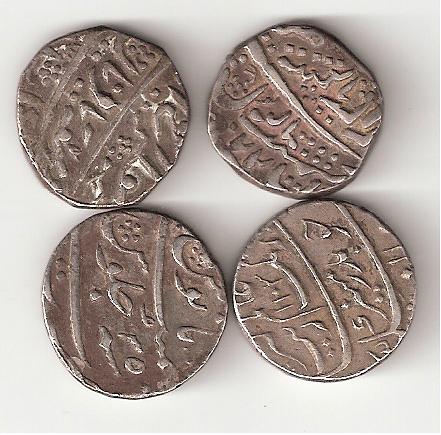 |
|
|
|
Valued Member
United States
206 Posts |
|
|
Valued Member
Pakistan
207 Posts |
I'm not sure, but THINK they're indian. You've got none of the coins the right way up, but I guess since you couldn't read them, it can't be helped  . The 2 lines going across all the coins should be horizontal, but the top right one, which does have them horizontal, is upside-down. The lower two coins are dated 1103AH, which would be 1691-1692. Even though I can kinda read the language (if not understand it), these type of coins always confuse me for being so weirdly and compactly organised and designed. I can read "Jahan" on one of the coins, which is what made me think Indian (it is a persian loanword, but there were loads of kings/queens with "Jahan" in their name). |
|
Pillar of the Community
India
1996 Posts |
The topmost coin is an Indian Princely state coin of Jaisalmir
Second one is a rupee coin of Aurangazeb, the Mughal ruler
Third one again is a rupee from Jaisalmir
The last one is once again of Aurangazeb.
Both coins of Aurangazeb are Surat mint issues of 1103.AH
Second coin was issued in the 36th regnal year and the fourth in the 35th.
|
|
Valued Member
Pakistan
207 Posts |
Thanks drnsreedhar!
I'm curious how you are able to identify them so well, though! Care to share some tips? Despite being able to read the persian script (if not always understand it), I have no idea.
In the threads you authored on indian coins, I was amazed that even with just the corner of one word visible, you were able to identify which king or which state it was from!
It would be my humble request that you start a thread focused on the structure and layout of these coins (as opposed to mostly the history, like you have), explaining stuff like how they were struck, what the 3 rows of text usually mean, why they're divided by those two lines, what usually comes where, what those 5 dots mean (I keep seeing them on coins, but I do not think there is any persian character like that...is it a mint mark?), etc.
Unless of course, you've already done that, and I've missed it...
Thanks!
Edited by Babar
07/18/2012 02:29 am
|
|
Pillar of the Community
India
1996 Posts |
Hai! Babar:) Thanks for the post.
Let me confess first that I am not an expert in numismatics.
I can read the script to some extent but cannot understand the meaning of any of those words! . I go mainly by the calligraphic pattern of coins to attribute them. Once you are familiar with the pattern of calligraphy, you will be able to guess the remainder of the legend. Letters may sometimes be there in odd positions making it difficult to link with the legend. That is where experience comes to your help.
The coins of Aurangazeb are differentiated by the legend's peculiar pattern. The Jaisalmir coin can be identified by the crude style, the peculiar pattern of distribution of letters and the circle of dots within the double circle at the periphery. The date "22" on the reverse also points to Jaisalmir state. Experience helps to place that with Jaisalmir.
I am posting image of an annotated coin of Aurangazeb for your reference. That "gaf" with a long leg and parts of "Alam" above can never be mistaken. Many a time, date in A.H is written in between the Gaf and Alam. Mint name follows "zarb". The independent letter "te" without any stroke before it comes most commonly for Surat. Others can be Arkat where "ka" will be seen and for those mints like Kanbayat that letter is never independent. Since you can read the script, I am sure that you will make an excellent identifier of similar Indian coins.
Knowledge about why those letters were written in three lines, what those lines signify etc. are still Greek and Latin to me too!! Regarding the dots, that seems to signify the mint and date of strike, but not easy to understand.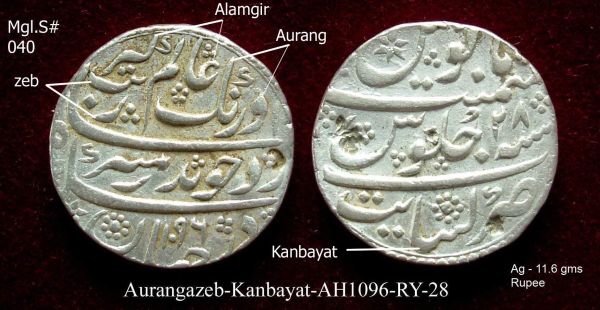 Regards and best wishes. Thank you.
|
|
Valued Member
Pakistan
207 Posts |
Thanks, drnsreedhar, that was very helpful!
|
|
New Member
 United States
17 Posts |
Thank you very much, that is more information than I could have expected
|
|
Pillar of the Community
India
1996 Posts |
There is something to add. The annotated coin shows some pits dug into it. That signifies the tests of purity that the mint masters used to do those days. They are called Shroff marks.
It is documented that those coins depreciated by 3% every year and people could get them reminted at a cost.
Interesting!Eh!
|
|
Pillar of the Community
United States
4897 Posts |
WOW! very interesting thread. I've seen a lot of princely states coins but have kinda been intimidated by them...they are very confusing to my western eyes. Are there any good books, in English, that would help?
|
|
Pillar of the Community
India
1996 Posts |
|
|
Pillar of the Community
India
1996 Posts |
And if you are interested in seeing images of Sultanate and Mughal coins of India, I have posted some threads in the series "Coins of India" under "World coins and comemmoratives".
|
| |
Replies: 11 / Views: 3,406 |
|










 Posted 07/16/2012 03:24 am


