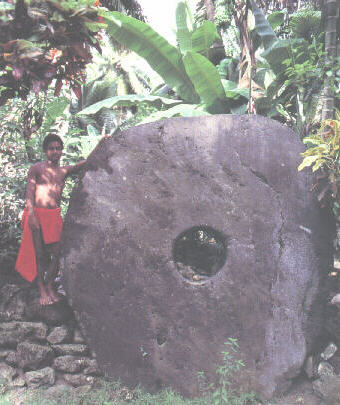
Many of the mottled gray stones are centuries old and are worth thousands of dollars. The larger pieces are seldom moved and instead change hands in something akin to an electronic bank transfer. They are used to buy land, pay for services or provide compensation in cases of wrongdoing or negligence. Even stones that sank offshore long ago still hold their monetary value.
In Yap's warring past, a stone could buy a clan's neutrality, pay for the killing of a rival or secure the pardon of a captured warrior. Today, rai are used for more mundane purposes. Gov. Ruecho said he recently spent one of his older stones on farmland. "For the piece of land I bought, I would easily have paid $20,000," he said.
The Bank of Hawaii used to lend dollars to islanders who put up their stones for collateral, but it has since closed its Yap branch. The island's remaining bank, the Bank of the Federated States of Micronesia, doesn't lend money for rai.
Branch manager Cyril Pong Chugrad notes that calculating an international exchange rate for stone money would be problematic. "Stone money can be used for a lot of things," said Pong, whose family owns several rai. "But to value it in U.S. dollars is very difficult."
(
http://www.latimes.com/news/nationw...e-headlines)Most rai (stone discs) are highly valued: By one account, a stone of "three spans" (about 25 inches across) would have been sufficient in the early twentieth century to purchase 50 baskets of food or a full-sized pig, while a stone the size of a man would have been worth "many villages and plantations." Obviously, these stones do not change hands very frequently, since expenditures of such magnitude are rare. For more ordinary transactions, the Yapese either used pearl shells or resorted to barter.
(
http://everything2.com/index.pl?node_id=1259375)More than a century later, the official currency of Yap is now the United States dollar. Stone discs are still legal tender in the villages, though, where the people maintain a relatively traditional lifestyle. Over 2000 of them exist, on display for all to see: some outside houses, where they remain heirlooms and give the occupants great prestige. Others lie in public areas. Never stolen, they occasionally change hands, remaining in the same location and often being grown over with vegetation. The stones even have a "bank" of sorts, a canal in which most are stored.
(
http://everything2.com/index.pl?node_id=1259375)The US dollar is the common currency in Yap, but the stone money is still used to this day for major transactions like payment of dowry or purchase of land.
The Rai are not carried about, for obvious reasons. Individual pieces are found all over Yap, but most are kept in "Stone Money Banks" in the villages.
When Rai shift hands as the result of a land transaction, a wedding or otherwise, the news spreads fast and it is soon common knowledge that a particular piece has a new owner. The Rai are seldom moved, but remain where they stand.
(
http://www.mantaray.com/yap/yap_stonemoney.html)



 Posted 03/01/2007 11:01 am