| Author |
 Replies: 8 / Views: 5,334 Replies: 8 / Views: 5,334 |
|
|
New Member
United States
5 Posts |
I cannot find any info as to the value of this coin. I find these in bronze and copper but have not seen another in silver. I assume it is a Philadelphia mint, since there is a P on the back. Does anyone know the rarity and value. Mine is toned but UNC 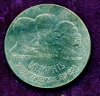 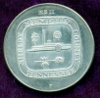 |
|
|
|
Bedrock of the Community
United States
12437 Posts |
 You need to post larger photos, no one will be able to see anything from thumbnails. It would be a medal, not a coin, since it is not monetized. The P is not likely an indicator of the Philadelphia Mint either. Official US medals are typically minted at Philadelphia but sans mintmark. Without more information, I would have to guess that it would fit into the category of "so-called dollars". Unfortunately, the website only lists medals that were available through the first edition of the book(1963). A new edition was published a few years ago but I have not added it to my numismatic library yet. If anyone else reading this post has the new edition, they could check for you to see if it is listed. |
|
CCF Master Historian of USA Commemoratives
 United States
12494 Posts |
Your piece is actually a medal rather than a coin. It is part of a series of commemorative medals struck by the US Mint that dates back to 1876.
Medals in this series are sponsored by private organizations, in this case the Memphis Sesquicentennial Corporation, who get their local US Congressman or Senator to introduce a bill in Congress to authorize the US Mint to strike it. The bill needs to pass the House and Senate and then be signed by the President before it can be struck by the Mint. They follow the same path as our commemorative coins, but do not carry any legal tender status.
Over the years, these national commemorative medals have been struck at Philadelphia, Denver, San Francisco and West Point. They have primarily been struck in bronze, silver and gold; there have also been a few struck in platinum. All of the Memphis medals were struck at Philadelphia.
You likely have noticed that your medal has "MS II" on the reverse. These silver medals were struck in two batches. The first batch did not include this marking; 10,000 were struck. The second batch of 5,000 silver medals included the marking. The medals were also struck in bronze; you mentioned copper and bronze in your post -- only bronze medals were struck.
The smallish images posted make it hard to determine the condition of the medal, but I see that you have graded it as uncirculated.
Pricing is variable. I have seen uncirculated medals go for little more than their intrinsic silver value (i.e., $25 to $35) and I have seen them go for $70 or $80 in top condition (often certified by NGC).
Hope that helps!
Collecting history one coin or medal at a time! (c) commems. All rights reserved.
|
|
New Member
 United States
5 Posts |
Thanks for the great info. Sounds like mine is rarer than the first strike anyway.
|
|
CCF Master Historian of USA Commemoratives
United States
12494 Posts |
Quote:
The P is not likely an indicator of the Philadelphia Mint either. Official US medals are typically minted at Philadelphia but sans mintmark. Not entirely true. While a good number (likely even the majority) of US Mint medals struck at Philadelphia do not carry a 'P' mintmark (the Presidential series is an example), there are quite a number of commemorative medals that do have a mintmark on them. Just a few examples from a long list: - 1968 San Antonio HemisFair
- 1968 Tercentenary of Father Marquette's Explorations
- 1969 Centennial of the Completion of the Transcontinental Railroad
- 1969 Bicentennial of San Diego
- 1972,'73,'74, '75 and '76 ARBA Bicentennial (bronze in PNC)
- 1993 Benjamin Franklin Fire Services
- 2011 September 11th National Medal
There are also US Mint medals that carry the 'D', 'S' and 'W' mintmarks. Collecting history one coin or medal at a time! (c) commems. All rights reserved.
|
|
Bedrock of the Community
United States
12437 Posts |
Commems, I am glad you addressed that because I was going to ask you that exact question  Is the usage of a mint mark more of a modern-era touch? I have noticed that many of the older so-called dollars minted at Philly have nothing resembling a mint mark but I do not have much experience with medals less than ~50 years old such as the ones you listed and the one that started this thread. |
|
CCF Master Historian of USA Commemoratives
United States
12494 Posts |
Quote:
Is the usage of a mint mark more of a modern-era touch? Yes. The frequent use of 'P' mintmarks on Philadelphia-struck medals started in the mid-1960s. It should be noted, however, that the mintmark was primarily used for the privately-sponsored national commemorative medals that I described above. The standard "List" medals produced by the US Mint (e.g., the bronze duplicates of Congressional gold medals, the First Spouse medals, the President medals, etc.) generally do not include a 'P' mintmark. Collecting history one coin or medal at a time! (c) commems. All rights reserved.
|
|
Moderator
United States
15850 Posts |
I remain in awe and deep respect for commems continued contributions to this forum. We have not found anything related to commemorative history that commems has not been able to offer an educated and well-written comment. Very well done again commems ... my personal Thank You for sharing with all of us.  David |
|
CCF Master Historian of USA Commemoratives
United States
12494 Posts |
@nickelsearcher: You're far too kind, but your positive words are very much appreciated!
I'll do my best to continue contributing in a positive way to the CCF Commemorative section whenever/wherever I can.
Collecting history one coin or medal at a time! (c) commems. All rights reserved.
|
| |
Replies: 8 / Views: 5,334 |
|










 Posted 07/23/2012 2:01 pm


